
🚀 TL;DR
- Hiring as a default growth strategy creates complexity, overhead, and loss of speed.
- Modern businesses can scale revenue by building systems and leverage before adding people.
- AI and automation now replace many roles that once justified full-time hires.
- Growing without hiring means managing systems and contractors—not doing everything yourself.
- The founders who win will prioritize leverage, specialization, and optionality over headcount.
I once had a monthly payroll of $296,463.65.
That was part of the $5M a year agency I built with Fortune 500 clients and a team across the globe…the whole thing. And I became someone I didn't recognize: less builder, more babysitter.
Here's what nobody tells you: I grew that same business to seven figures before I had any employees. Zero. Just me and systems, back in the late 2000s, before Zapier or Calendly even existed.
If I could do it then, imagine what artificial intelligence makes possible now.
Most founders still run on an old business plan: more clients means more people. That equation broke somewhere along the way.
Today, the labor market rewards leverage over headcount. They use customer service bots that work and create content systems that sound like you.
This article is about growing without hiring, in a way that doesn't feed The Hungry Dragon called payroll.
Why hiring shouldn't be your default growth plan
For decades, agencies and service businesses ran on a simple assumption: more clients equals more people. You win the account, you staff up. Revenue grows, headcount follows. It felt like physics.
That model made sense when labor was the only lever you had. But not anymore. Here’s why:
Growth used to mean headcount
I remember pitching Fortune 500 companies and watching their eyes light up when I mentioned team size. Thirty people. Employees in multiple cities. It signaled legitimacy and capability. The unspoken message was clear—big teams do big work.
But here's what was actually happening behind the scenes:
- Every new hire meant another person to manage, train, and retain
- Culture became something I had to actively protect instead of something that just existed
- My calendar is filled with check-ins, not client work
- The business existed to feed itself
I went from building technology to managing people who managed other people. The thing that made me good at my job? I barely did it anymore.
What changes when AI enters the picture
The rise of tools like ChatGPT and Claude rewrites this entirely.
I recently spent half a day building a system that pulls all my content and produces newsletters and LinkedIn posts that sound exactly like me. Minor edits, maybe 20 minutes of polish, and it's done. That used to be a part-time hire.
Hiring is not always about people. Some of you are just barely using ChatGPT or Claude, and you don't understand how to push it deeper into the business.
The equation has flipped. Today, you don't have to pay the $300,000 a month that I paid for my team. You can build a fleet of systems that handle research, drafts, scheduling, customer support, and half your operations.
This isn't about replacing humans with robots. It's about recognizing that the default "I'm busy, so I need to hire" is no longer the only answer. Often, it's not even the best one.
What it actually means to grow without hiring
Let me be direct: Growing without hiring doesn't mean doing everything yourself. That's a fast track to burnout, and I've been there, too.
It means not defaulting to employees as your growth lever.
It's not just about staying solo
I still work with contractors. I still collaborate with specialists. The difference is I'm not building a traditional org chart with layers of management and recurring payroll obligations.
The minute you have someone on payroll, the game changes:
- You need HR policies
- You think about culture documentation
- You worry about retention
- You become responsible for someone else's livelihood
None of that is bad. But all of it is overhead. And if you haven't proven your model can scale without it, you're adding weight to a vehicle that hasn't yet found its engine.
You replace roles with systems, not stress
When I talk to founders who feel stuck, the instinct is always the same: "I need help." And they immediately picture a person.
But the better question is: what decision does this hire actually make?
Most of the tasks we think require people are actually processes waiting to be documented. I use a simple framework called Document → Template → Automate. Write down what you do. Turn it into something repeatable. Then let technology run it.
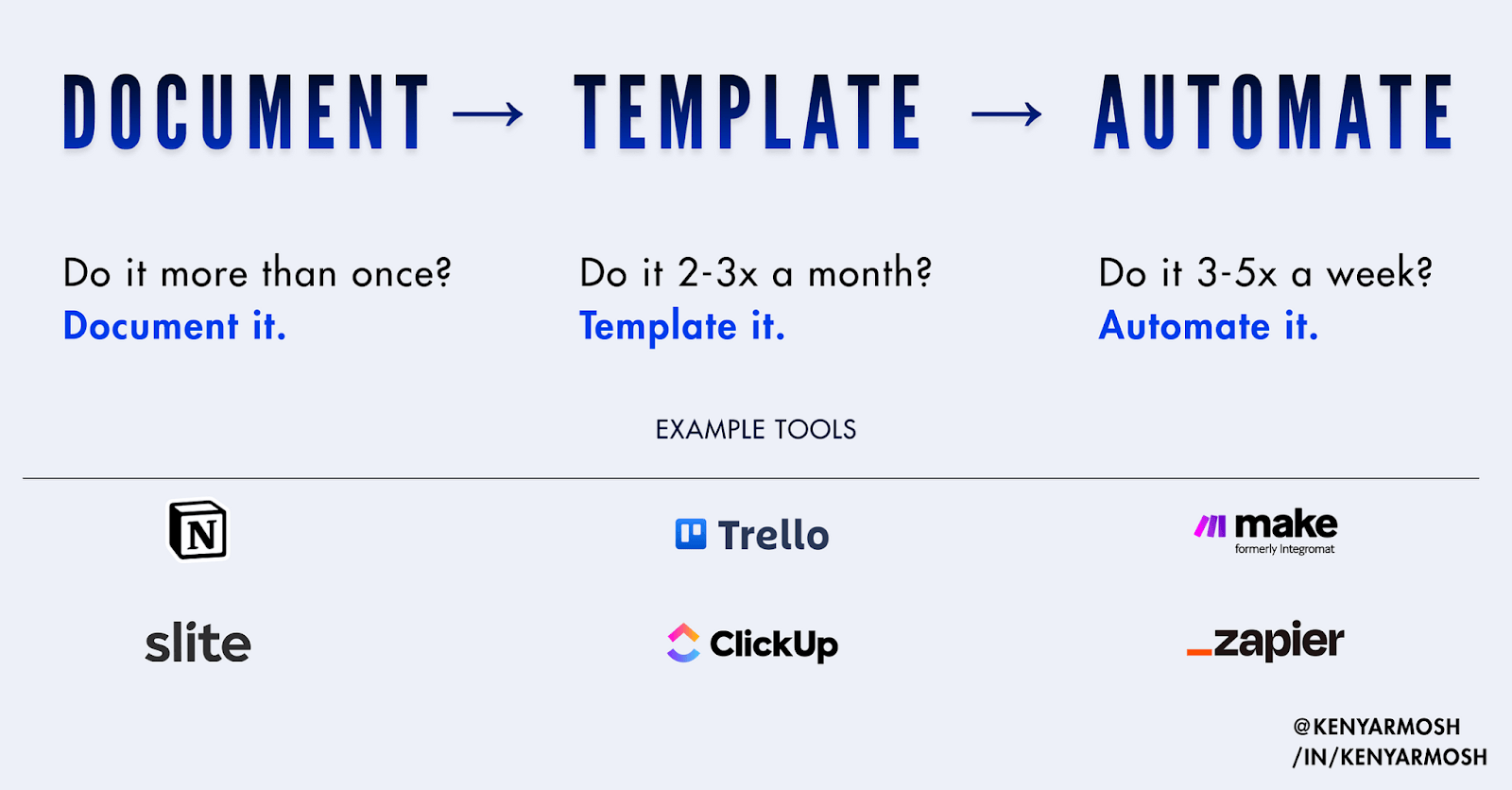
Your knowledge, combined with what's available today, goes really far.
You still need support, but it doesn’t have to be in-house
Growing without hiring doesn't mean growing alone. It means your support structure looks different.
Instead of employees, you build relationships with:
- Contractors who plug into specific projects
- Peers who think at your level and challenge your assumptions
- Tools and automations that handle the repetitive work
- Communities where you can pressure-test ideas
I now have five to six times as many clients as when I ran a full agency. Different revenue model, sure. But the reason it works is that I'm not managing people—I'm managing systems. And systems don't call in sick.
In 2026, systems are the new first hire
Before you add a person, add a process. That's the mindset shift that changes everything.
The first question is what can be automated
Every time you feel overwhelmed, pause. Ask yourself: Is this a capacity problem or a systems problem?
Nine times out of ten, it's systems.
I watch founders hire virtual assistants to manage their inbox when what they actually need is better filtering rules and templates. They bring on project managers when a properly configured Trello board would handle 80% of the coordination.
The work isn't always to do more. Sometimes the work is to design better.
You don't need to be technical to build systems
I didn't write code in my agency. I'm not an engineer. But I understood how to connect tools and create workflows that removed me from the equation.
Today it's even easier. For example:
- Zapier connects apps without code.
- Notion organizes everything in one place.
- Calendar tools like Calendly and SavvyCal eliminate the back-and-forth of scheduling.
You don't need a computer science degree, but you do need the willingness to sit down for an afternoon and figure it out.
Start small. Automate one thing this week.
AI gives you leverage without the headcount
I was working with two different LLMs simultaneously the other day, like I used to work with team members in my agency. Except I was sitting on a bench in a town center, laptop open, using a hotspot.
I stopped and caught myself thinking: this is incredible and a little terrifying.
AI isn't coming for your business. It's coming for the parts of your business you shouldn't be doing anyway. The research. The first drafts. The repetitive admin. Let it handle those so you can focus on judgment, relationships, and strategy.
The goal is faster decisions, not just faster output
Systems reduce coordination overhead. That's where most speed dies when teams grow.
Even when I had a team under 30 people—small by many standards—small changes required keeping multiple people in the loop. A homepage tweak became a multi-week effort. Decisions needed sign-off from people who needed context from other people.
Now? I can overhaul my entire website in a weekend. No meetings. No approvals. Just execution.
Speed is a competitive advantage. Don't give it away to org chart complexity.
Focus on one type of client before building a team
The key to growing without hiring is fundamentally based on having a singular type of client that is your best client of all time.
I call this your Lighthouse Client.
Why most businesses get stuck customizing everything
Without a clear ideal client, every project requires new thinking. New proposals. New scoping. New delivery methods. You end up reinventing the wheel with each engagement.
That kind of variety feels exciting at first. Then it becomes exhausting. And eventually, it forces hiring because you can't hold all the variations in your head anymore.
Specialization isn't limiting. It's liberating.
Repeatable problems are easier to scale
When all your clients want similar transformations, you can build systems around delivery. Onboarding becomes a template. Milestones become predictable. Results become consistent.
I have dramatically more clients today than I ever did running a full agency. The only way that works is because I honed in on a singular Lighthouse Client—experienced service providers who want to scale without adding headcount. They share similar struggles, want similar outcomes, and fit into similar delivery systems.
Your Lighthouse Client unlocks everything downstream.
Don't just target an industry but define an outcome
Most people define their ideal client by demographics: title, company size, and revenue. That's fine as a start, but it's not enough.
The real clarity comes from understanding the transformation they're after. What problem keeps them up at night? What does success look like on the other side?
When you can articulate that better than they can, you become the obvious choice. Not because of your credentials but because of your clarity.
Delivery systems prevent client bottlenecks
With strong offers and clear onboarding, delivery doesn't require five people on standby.
My limitation today isn't capacity. It's how many qualified leads I can put into my closing system. That's the only constraint—and that's exactly where I want it to be.
You should be able to bring on a new client without panic. If every new engagement feels like a fire drill, you don't have a hiring problem. You have a systems problem.
3 tips to know when hiring actually makes sense
I'm not anti-hiring. I'm against default hiring.
There's a difference between building a team because you've earned the right to scale and hiring because you're overwhelmed and can't think of another option:
1. Don't scale before you're ready
When you bring on that first person, don't just bring on one person. Be prepared to build out something that might have 15, 20, 30 people eventually.
That sounds dramatic. It's meant to.
Hiring one employee changes everything. You need policies, culture, HR considerations, retention strategies. If you're not ready to commit to that trajectory, you're not ready to hire. You're just adding cost to a business that hasn't figured out its leverage yet.
2. You should have a system before you add a person
A hire should plug into a working system, not become the system.
If you can't explain exactly what this person will do, how their success will be measured, and what processes they'll follow, you're not hiring strategically. You're hiring reactively.
Document the role before you fill it. Build the workflow before you hand it off. Otherwise, you'll spend more time managing the person than the work would have taken you in the first place.
3. You can grow first, then build the right team
Growth without hiring gives you something invaluable: optionality.
When you're not bleeding payroll every two weeks, you can be patient. You can wait for the right person rather than the available one. You can test contractors before committing. You can scale back if the market shifts.
Even if one employee adds check-ins, documentation, and shared context that you didn't need before. That's not bad—but it's not free either.
Hire from a position of strength, not desperation.
Growing without hiring in an AI world
That $296,463.65 monthly payroll taught me something I couldn't have learned any other way.
Headcount isn't a growth strategy. It's a consequence of not having one.
The founders who thrive in this next era won't be the ones with the biggest teams. They'll be the ones with the best systems, the clearest positioning, and the discipline to add people only after exhausting every other lever.
You need leverage, not layers. You can always hire later, but you can't always undo it.
The goal was never headcount. It was freedom. Control. Doing work that matters without becoming a manager of managers.
Build for that, and the growth follows.
