
🚀 TL;DR
- Asynchronous consulting isn’t about avoiding clients—it’s about delivering thinking that stands on its own.
- Too many meetings trap consultants in “Delivery Hell,” where calendars stay full but income and leverage stall.
- Real scale comes from selling outcomes and decisions, not calls, hours, or constant availability.
- The right clients value clarity and momentum and are easier to support asynchronously.
- Systems—not more meetings, hires, or tools—are the foundation of sustainable scale.
I've closed over $50M in consulting and coaching deals throughout my career. The vast majority of that value was delivered through async videos, Trello templates, and detailed Google Docs feedback. Not Zoom calls.
Most businesses spend 20-30 hours a week in meetings. When you work with those clients, you start inheriting their culture instead of selling them on your way of working. You can't charge a premium fee and then have half your week disappear in Slack channels and standups.
Asynchronous consulting isn't about avoiding clients. It's about delivering thinking that stands on its own: written recommendations, recorded analysis, frameworks that work without you explaining them live.
Clients don't pay for conversations. They pay for decisions, clarity, and momentum.
In this guide, I’ll show you why asynchronous consulting matters and how you can get started, too.
The $100K trap gets worse when you're stuck in meetings
When your calendar is full, but your bank account isn't growing proportionally, something's broken. Usually, it's the model itself.
Most consultants are selling their hands, not their brains. They price by milestone, day rate, or output. Even value pricing becomes confusing without clarity around outcomes. These old models keep you trapped under $100K—or worse, they keep you at $200K while working like you're trying to hit a million.
Faster delivery doesn't fix this. AI might reduce your workload on certain tasks, but it won't fix unclear scopes or needy clients.
Those legacy clients you took on out of desperation? They'll keep your calendar full but your business stagnant.
The biggest cost isn't money. It's time to think strategically.
If delivery consumes every hour, you can't build the marketing and sales systems that get you out of the trap. You can't step back and ask whether this client, this project, this way of working is actually moving you forward.
You're stuck in what I call "Delivery Hell," and the vicious cycle just keeps spinning.
Moving toward $1M means changing what you sell and how you work
Growth isn't just about "more." More leads. More clients. More output. That thinking is exactly what keeps consultants stuck.
Real scale happens when you shift from deliverables to transformation. When you stop selling widgets and start selling outcomes. The difference sounds subtle, but it changes everything—from how you price to how you deliver to how clients perceive you.
- Replace bespoke work with Scalable Service Offers clients actually understand: An SSO clarifies the transformation you deliver. It helps prospects say yes faster because they don't have to decode a custom proposal. You're not reinventing the wheel with every engagement, you're refining a repeatable solution that works.
- Advisory beats execution when expertise is the real value: In an AI-accelerated world, your thinking becomes the differentiator. Position yourself as the composer, not the musician. You orchestrate outcomes using tools, systems, and frameworks, not just manual work that anyone with the right software can replicate.
- Focused offers lead to better clients and better margins: When your positioning gets tighter, everything improves. Your marketing resonates with the right people. Your sales conversations go faster. Your delivery becomes more efficient. You attract clients who want outcomes, not hours. And those clients? They're easier to support asynchronously because they don't need hand-holding.
The myth of productizing your consulting is that you need to turn everything into a course. You don't.
Think instead: async office hours, Loom reviews, Notion templates, expert critiques. These are async functions that scale your expertise without requiring you to be live.
AI gives you leverage, but only if your client strategy is clear
AI can't solve for bad client fit. No tool can. The foundation of scale—async or otherwise—is knowing who you serve and who you don't.
I call the right clients "Lighthouse Clients." They pay for expertise, respect your time, and get better results because they trust the process. They don't need you on a call every Tuesday to feel supported. They need clarity, direction, and frameworks they can run with.
You don't need more clients. You need the right ones.
A Lighthouse Client:
- Values outcomes over hours
- Has budget aligned with the transformation you deliver
- Doesn't require hand-holding or constant reassurance
- Trusts your process and gives you room to work
When you're working with the wrong clients, async delivery feels like a risk. You worry they'll think you're not engaged. You overcompensate with extra calls, extra check-ins, extra everything.
But with the right clients? Async feels like a premium feature. They appreciate the thoughtfulness of a recorded breakdown over a rushed live conversation.
That’s also why disqualifying leads is more important than ever. With AI increasing efficiency across the board, working with the wrong clients becomes even more costly. Every hour you spend managing someone who doesn't trust your expertise is an hour not spent on clients who do.
Saying no isn't fear-based—it's a growth strategy.
Great clients are easier to support asynchronously. They read the memo. They watch the Loom. They implement without needing you to repeat yourself three times on a call. That's the result of being intentional about who gets access to your time in the first place.
Systems—not more hires—are the foundation of sustainable scale
One of the most important shifts I made in my business was realizing that systems can replace headcount. Not people in general, but the need to add bodies just to grow revenue.
Whether built in Trello, Notion, or layered with AI tooling, these systems replicate your brain. They handle the repeatable stuff so you can focus on the work that actually requires your judgment.
I use what I call DTA: Document, Template, Automate.
- Document what you do monthly. Write it down. Get it out of your head.
- Template what you do weekly. Build reusable assets so you don't have to start from scratch.
- Automate what you do daily. Let the machines handle the repetitive tasks.
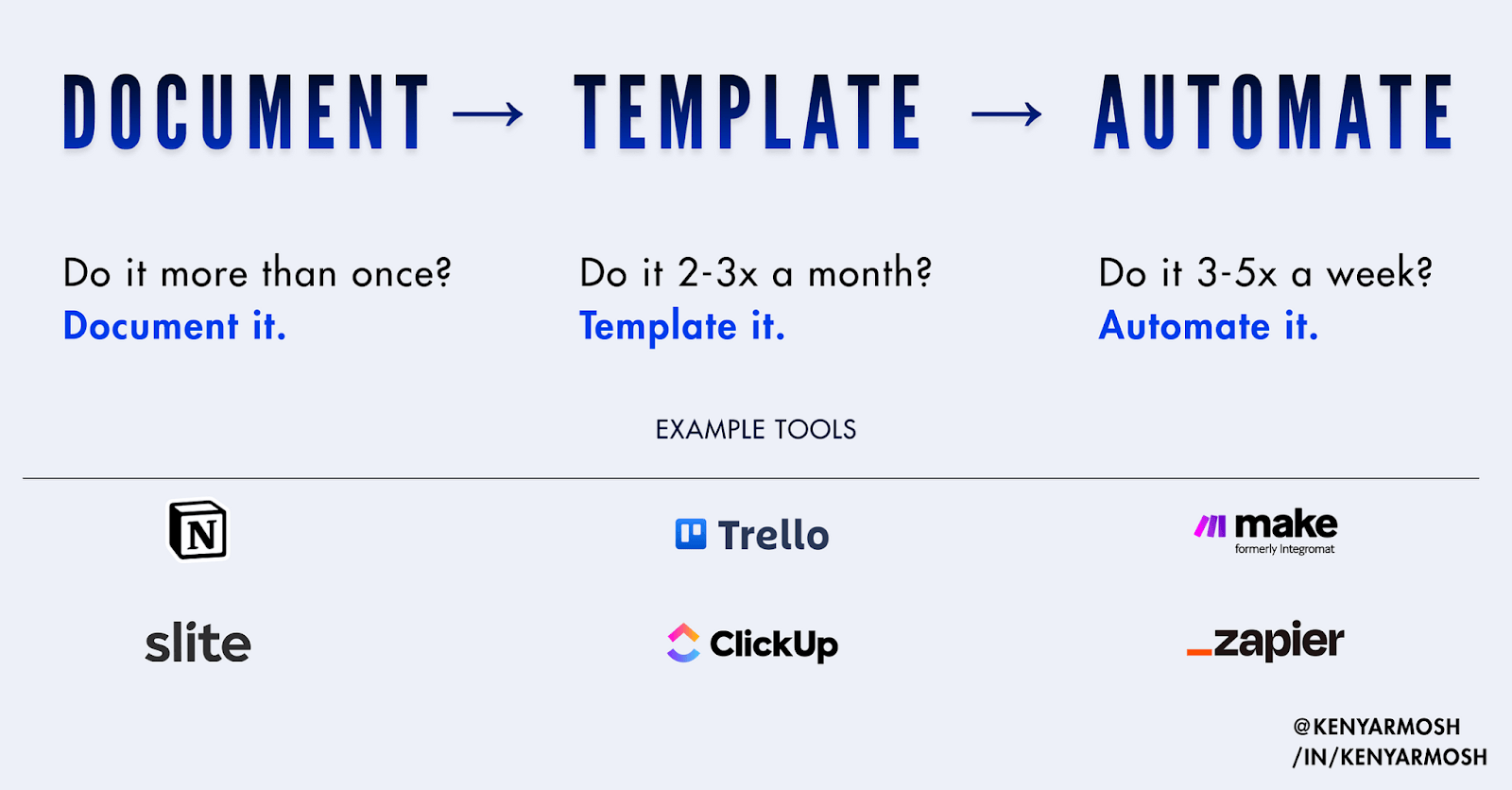
The result? I can write this article, show up on LinkedIn, run workshops, and still deliver outstanding results to clients. My delivery systems work whether I'm doing $500K a year or $5M.
Systems give you time to work on the business. Without them, you're always chasing the next task, the next client ping, the next fire. With them, you create space to think, to market, to grow. That's a requirement if you want to scale without burning out.
I think of this as building a "Fleet of Me." Instead of hiring people to clone my output, I've built systems that extend my thinking across marketing, sales, and delivery. Twelve versions of me handling different parts of the business, none of them requiring a paycheck or a Slack message at 9 PM.
My biggest piece of advice would be not start with AI.
I see consultants jump straight into automation before they've documented anything. They want the shiny tools without the foundational work. It doesn't stick. Systems come first. Only then can AI plug in to multiply what already works.
The async consulting model is your real leverage
AI is a force multiplier. But it only multiplies what you've already built.
Without clarity on your offer, your client, and your systems, async delivery just makes the chaos faster. You'll send more async videos that don't land. You'll build more templates no one uses. You'll automate processes that shouldn't exist in the first place.
Async consulting works when your thinking stands on its own. When clients pay for decisions, clarity, and momentum—not conversations. When your systems deliver value, whether you're on a call or at the pool with your kids.
That's what sustainable scale looks like. Not more meetings. Not more hires. Just better leverage on the expertise you already have.
