
🚀 TL;DR
- Most founders are misusing AI by trying to replace offers instead of strengthening and systemizing them.
- If your offer feels stale, the issue is often positioning, structure, or clarity—not the offer itself.
- AI creates leverage only when paired with codified offers, clear outcomes, and documented systems.
- Specialized AI systems trained on your data and customer context outperform generic AI tools.
- Scalable offers in the AI era come from focus: fewer offers, clearer structure, and outcome-first design.
Fifteen percent of the working world is using artificial intelligence. Almost nobody is using it to actually build a 2030 business.
I see it constantly. Founders are throwing AI at $50,000 problems when they should be building systems that help them grow without hiring. They’re prompting ChatGPT like it's a overpriced version of Google, while competitors are architecting AI agents trained on their own data.
But the AI conversation has become a distraction. Your offer might feel stale. Conversions might be down. And you're blaming generative AI for disrupting your business when the truth is simpler.
Your offer needs attention, not replacement.
Here's how to build scalable offers in the age of AI—by getting back to fundamentals, then amplifying them with the right systems.
Most people are using AI wrong when it comes to offers
Solopreneurs are using generative AI to speed up tasks rather than to improve their business model.
People chase novelty, build clever prompt stacks, and obsess over which AI assistant is better. They optimize $50,000 problems with $500 worth of effort, when the one system that would erase the problem entirely is the one they never built.
Here’s why that’s not the right approach:
AI is not just a better search box
Most founders treat generative artificial intelligence like a glorified Google search. Write a thing. Summarize a thing. Marketing ideas for a thing.
The leverage lives somewhere else entirely.
It lives in specialized systems trained on your business, your clients, and your workflows. When I finish a sales call, I don't download the transcript and push it into a generalized AI assistant. For example, Fathom gives me a specialized GPT for processing sales calls using proven methodologies right in the interface.
That's the difference between using AI and building with AI.
The real power is in systemization
AI doesn't replace your thinking. It forces you to define yourself precisely.
The investors at Y Combinator recently said something that made me pull my car over: prompts aren't the crown jewels of their companies. The data is. The real-world context. The workflow knowledge.
They described sitting next to a tractor sales manager in Nebraska, watching exactly how they work and what they care about. Then, translating all of it into evaluation data that makes sense only for that role.
That's the founder skill of the next decade: deep, obsessive customer understanding codified into systems that software can consume.
Context. Data. Specialization. That's the competitive moat.
If your offer feels stale, the problem might not be the offer
What you're calling "broken" might just be boring.
Your instinct when things go quiet is to burn it all down and build new offers or go in a new direction.
But most founders don't have broken offers. They don't even need a new offer.
They just need a way to light the room differently. Here’s how:
Change the angle when the market stops responding
I tell my clients: test the story before you test the offer.
One of my marketing consultants shifted his positioning to match what he was already delivering, just with clarity on what he actually did well.
Within a few months, he hit $50K months.
That's the power of a narrative reset. When the market yawns, the solution isn't usually a whole new product. It's one of these:
- A fresh hook that reframes the problem
- Updated proof from recent client wins
- Better signals around urgency or timing
- A story that finally matches what you deliver
Not every slow month means you need a new offer
This is where I see founders waste massive amounts of time and money.
They launch something. It works for a while. Conversions dip. And they immediately start from scratch with new positioning, new packaging, and new messaging.
Meanwhile, the original offer was fine. It just needed energy and commitment.
If you've been fishing the same spot for months and nothing's biting, the answer isn't always a new pond. Sometimes it's different bait, but sometimes it's about moving 20 feet to the left.
Before you rebuild everything, ask yourself: Have I actually tested new angles on this offer? Or did I just get bored and assume the market did too?
Reignite, rebuild, or retire—which one do you actually need?
I use three strategies to help clients overcome offer fatigue. Here are the three Rs you should consider, too:
1. Reignite the energy with better framing
This is where you start.
Reignite means the same offer but with new energy. You're reframing the story. Adding a different hook. Dropping fresh proof and finding urgency through better signals.
You're not changing what you sell. You're changing how you talk about it.
I've watched this work faster than any complete overhaul. A single positioning shift that finally matches what the market is asking for. No new deliverables. No new pricing structure. Just words that land differently.
2. Rebuild the structure to match how you work today
Sometimes the angle isn't the problem. The structure is.
Rebuilding doesn't mean starting from scratch. It means designing the offer for how you work now—not how you worked two years ago. This might look like:
- Shifting from open-ended support to tighter guardrails
- Reworking your pitch to emphasize outcomes instead of hours
- Removing scope that drains you and adding what clients actually love
- Restructuring delivery so it doesn't require your presence at every step
Around this time last year, I rebuilt my entire offer portfolio. I removed what drained me and sprinkled in what my clients loved. My target was to make the same revenue with less effort.
The result? Higher run rate and better alignment with what the market wanted.
Each time I've reworked my offers since, I've made more while delivering with more leverage.
3. Retire offers that are holding you back
This is the one you won't want to hear.
Sometimes the bravest move isn't rebuilding. It's retiring.
My Scalable Service Offers framework put me on the map. It made me popular on LinkedIn and brought me the biggest creators on the planet as clients. But over time, the market copied me. The market caught up. Revenue dropped. Conversions slowed.
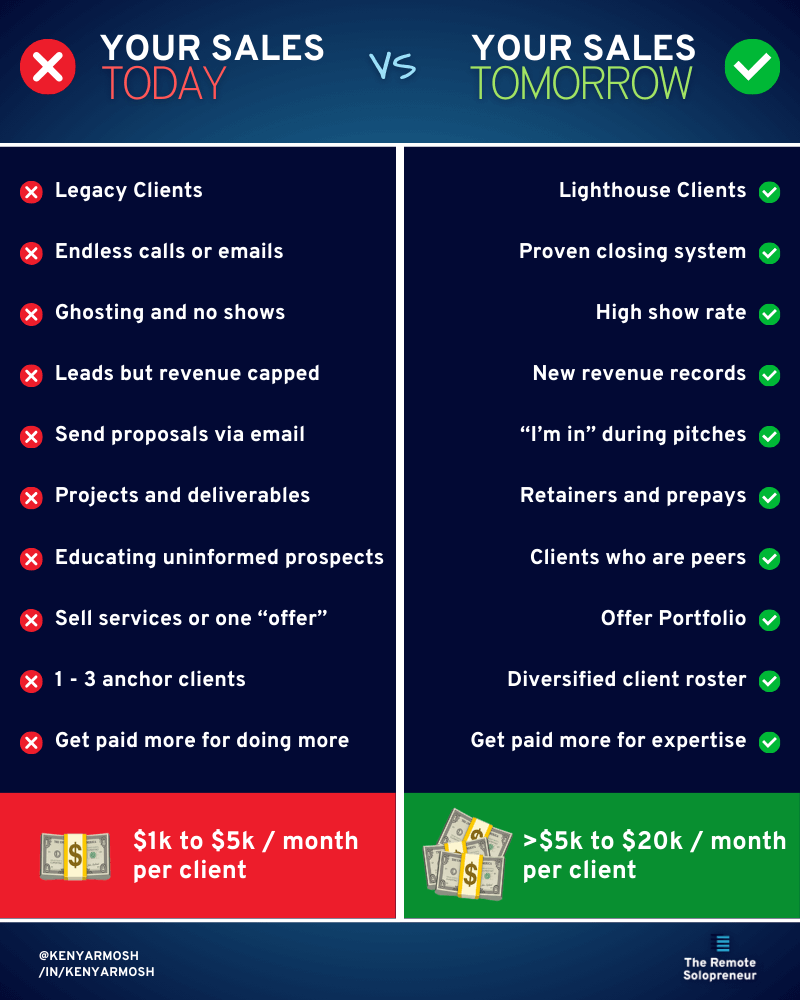
Keeping it alive started costing me more than it made—cognitive load, brand confusion, opportunity cost.
By retiring it, I created space for a next-gen version. And every time I've let go of an offer, I've come out stronger on the other side.
Space is a growth strategy.
What AI actually changes about how you build offers
Now we get to the real shift.
Generative AI doesn't just change how you deliver. It changes what's possible—and what's expected. The founders who understand this are pulling ahead. The ones who don't are about to get exposed.
Offers must be codified, not just described
It's not enough to have a great offer anymore. It has to be clear enough to teach, document, and program.
AI agents run on specificity. If your offer lives entirely in your head—if the transformation depends on your presence and intuition alone—you'll hit a ceiling you can't automate.
The shift is from operator to architect.
General-purpose tools won't differentiate you
This is where most founders get stuck.
They use ChatGPT for everything. Generic prompts. Generic outputs. Then they wonder why their content sounds like everyone else's and their digital platforms feel interchangeable.
The competitive advantage doesn't come from better prompts. It comes from business-specific AI agents built on your data, your frameworks, your understanding of the customer.
I use Fathom's specialized GPT for sales calls. My own Offers GPT for bringing new products to market. Claude Code when I need to write scripts. None of that is prompt magic. Its specialization trained on the context that matters.
Context and data are the new positioning
You're not just selling outcomes anymore. You're selling how well your systems understand the problem space.
This is innovation at its core. AI-first leaders are pulling ahead because they've codified domain expertise into systems that scale without proportionally scaling headcount. They're not competing on price. They're competing on depth of understanding.
The question isn't whether you use generative artificial intelligence. It's whether you've built AI that knows your business.
Focus on being outcome-first, not task-first
Generative AI amplifies leverage only if your offer is built around outcomes rather than time, hours, or deliverables.
If you're still selling by the hour, AI won't help you. It'll expose you.
The solopreneurs winning right now are building offers that promise transformation, then using AI to deliver that transformation more efficiently. More consistently. With less of their personal time.
That's where customer retention comes from—not from more face time, but from better results.
Create fewer offers with more clarity
I've reworked my offers multiple times this year. Each time, I made more while delivering with more leverage.
The pattern was always the same: fewer offers, better aligned, more focused.
AI makes delivery more scalable. But that only works if your offer suite is simple. Complexity kills leverage. Every additional offer you maintain is a cognitive load you carry and a source of brand confusion.
Access and structure matter more now
One of my rebuild strategies is shifting from open-ended support to tighter guardrails around client delivery.
AI makes this easier than ever. You can create structured pathways, automated touchpoints, and scalable systems that maintain quality without requiring your constant presence.
But it only works if your offer is designed for it. If the structure is built in from the start. Bolt-on AI doesn't fix a messy offer. It just automates the mess.
The hardest part might be letting go—but it's key to your growth
Killing once-successful offers is painful. I've done it multiple times.
But outdated offers create brand confusion, mental drag, and opportunity cost. In a market accelerating with generative AI, the cost of holding on is higher than ever.
AI won't fix a misaligned offer. But it will punish you for keeping it around too long.
What worked two years ago or even last year might already be dated. The market doesn't wait for you to feel ready.
The founders who make it to 2030 won't be the ones who prompted best. They'll be the ones who codified deep customer understanding into systems that help you grow without hiring.
Context. Data. Specialization.
That's how you build scalable offers in the age of AI.
