
🚀 TL;DR
- Automation isn’t a shortcut—it’s a multiplier of what already works in your business.
- Scaling by hiring creates the “Hungry Dragon” cycle of more clients, more people, and more overhead.
- System-based scaling decouples revenue from time by building once and deploying repeatedly.
- The highest leverage automations remove you from low-value operational work, not from strategy or relationships.
- Real growth comes from documenting, systemizing, and then automating one workflow at a time.
When I ran my agency with a $296k monthly payroll, growth always meant the same thing: more clients, more people, more clients, more people.
I call that The Hungry Dragon. It starts as a little pet. Then it rains fire on your kingdom.
Today, I have five to six times as many clients as I did back then, without a single person on payroll. And did so by building systems that compound rather than accumulate.
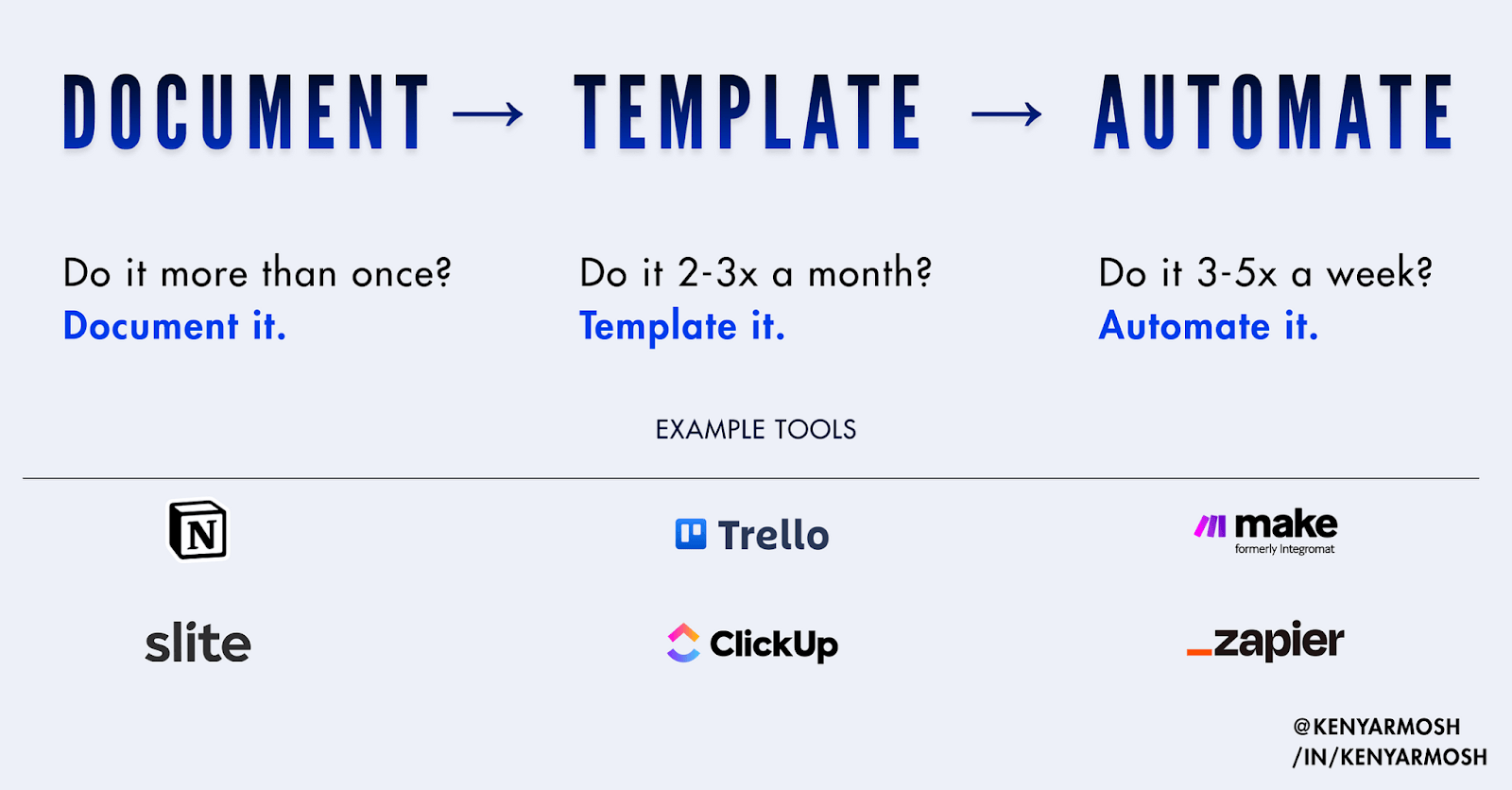
Every one of my big growth wins started as something manual. When it worked, I made it a system. When that worked, I automated it.
That progression matters. People think automation is a hack. It's not.
It’s a multiplier of whatever you’ve already figured out.
If you can do the thing once and get results, systemize it. If you can do it five times and get similar results, automate it.
This piece walks through exactly how to think about automation as a growth strategy, so you can realistically scale what’s working.
What “automation for growth” actually means
Automation isn’t about doing less.
It’s about doing more of the right things. The strategic work. The thinking. The client conversations that actually move the needle. The stuff that got you into this business in the first place.
Most consultants spend 40-60% of their week on administrative and operational tasks. That’s not just inefficient, but it's a growth ceiling disguised as a to-do list. And the minute you start getting more clients, that ceiling drops lower.
So where does automation fit? Consider the areas where you’re doing the same thing repeatedly, week after week.
- Client onboarding is the obvious one. For example, automated proposals, e-signatures, welcome sequences, and intake forms. The best automations feel personal. They remove friction, not humanity.
- Scheduling and communication are next. Booking tools eliminate the back-and-forth. Automated reminders reduce no-shows. CRM triggers ensure follow-ups happen without you having to remember to do them.
Content and visibility often get overlooked. Repurposing a single podcast episode into newsletter snippets, LinkedIn posts, and video clips can be templated. You still do the creative work—automation handles the distribution.
- Billing and reporting deserve attention, too. Auto-invoicing, payment reminders, and client dashboards. These aren’t glamorous, but missed invoices don’t pay the mortgage.
- Lead nurturing and follow-up might be the highest leverage. For example, email workflows, reactivation campaigns, and CRM reminders. Most deals don’t close because someone forgot to follow up. That’s a systems problem, not a sales problem.
The goal isn’t to remove yourself from the business. It’s to remove yourself from the parts of the business that don’t require you.
Why automation is a growth strategy
Increase output without more bodies
There’s a fundamental difference between time-based scaling and system-based scaling.
Time-based scaling means more revenue requires more hours. You hit a ceiling the moment your calendar fills up. And when you’re already working 50 hours a week, “work harder” isn’t a strategy.
System-based scaling decouples revenue from time. You build once, deploy repeatedly. The work compounds instead of accumulating.
When I was running my agency with a $296K monthly payroll, growth always meant hiring. More clients required more people, required more management, and more overhead.
Today, I have five to six times as many clients as I did back then—with dramatically fewer headaches.
Reduce errors and improve client experience
Consistency is underrated.
When every client gets a different onboarding experience based on how busy you were that week, quality suffers. When follow-ups depend on your memory, opportunities slip through the cracks.
Automation creates predictability. The same welcome email goes out every time. The same check-in happens at the same milestone. The same invoice format and payment terms.
This isn’t robotic. It’s reliable. And clients notice reliability more than they notice most things you do.
Competitive advantage and pricing power
Speed matters in consulting. The consultant who can deliver a proposal in 24 hours beats the one who takes a week—even if the proposals are identical.
Automation gives you that speed without the scramble. You’re not working faster. Your systems are working faster for you.
That speed translates to confidence. When you know your backend can handle whatever your frontend generates, you stop underselling out of fear. You quote what you’re worth because you know you can deliver it.
Work-life balance as a business asset
I’ve watched talented consultants burn out because they confused being busy with being successful.
When your business runs solely on manual effort, every vacation becomes a liability. Every sick day creates a backlog. Every evening is at risk of becoming “just one more email.”
Automation doesn’t eliminate work. But it eliminates the operational drag that makes work feel endless. You get back the mental space for strategic thinking—or, you know, dinner with your family.
How to build an automation strategy that scales
Step 1: Map your current workflows
Before you automate anything, document everything.
What do you do repeatedly across sales, delivery, and operations? Write it down. Step by step. The boring stuff, especially.
Most consultants skip this because it feels tedious. That’s precisely why they need it. You can’t improve what you haven’t defined.
Pull out your calendar from the last month. Look at every meeting, every task, every email thread. Ask yourself: how much of this was unique versus routine? The routine stuff is your automation target list.
What to watch out for:
Automating chaos. If the process isn’t clear manually, automation will only amplify the mess. Get the workflow right first. Then make it automatic.
Step 2: Define what “growth without hiring” looks like
Be specific about what you want.
More clients? Faster delivery? Higher margins? Fewer working hours? All of these are valid—but they require different automation priorities.
“Being more efficient” isn’t a strategy. Tie automation to a specific constraint in your business. Maybe it’s lead response time. Maybe it’s a proposal turnaround. Maybe it’s the gap between the invoice and payment.
I call this creating a “Fleet of Me”—systems that extend your capabilities without extending your calendar.
What to watch out for:
Vague goals that sound productive but don’t connect to actual business outcomes. If you can’t measure it, you can't improve it.
Step 3: Pick one process to automate first
Don’t try to automate everything at once.
Start with high-frequency, low-complexity tasks. Client onboarding is often the best starting point. Scheduling. Standard follow-ups. These are repeatable, predictable, and relatively low-risk.
Early wins build momentum. They also build confidence. Once you see a 90-minute onboarding process drop to 5 minutes, you’ll start looking for other opportunities.
What to watch out for:
Starting with the most complex workflow because it feels like the biggest win. Complex automations break in complex ways. Simple first. Scale later. Here’s a framework to help you with that:
Step 4: Choose lightweight, consultant-friendly tools
Not every tool is built for solo operators.
Enterprise software comes with enterprise complexity. You don't need a $500/month platform to send automated welcome emails.
Look for tools that integrate well, require minimal maintenance, and don't demand a computer science degree. Zapier for connections. Calendly for scheduling. Notion or Trello for project management. Simple, proven, boring.
What to watch out for:
Tool sprawl. Every new tool adds cognitive and operational overhead. More isn't better. Better is better.
Step 5: Pilot, measure, then scale
Run a short test period.
Compare before-and-after results. How much time did you save? Did client satisfaction change? Were there errors you didn't expect?
Automation isn't set-and-forget. It's set, measure, adjust, measure again. The first version is rarely the best version.
What to watch out for:
Not measuring impact. If you don't track time saved, errors reduced, or speed gained, you won't know what's working. Gut feel isn't data.
Automation is architecture, not a shortcut
I mentioned the Hungry Dragon earlier—the cycle of more clients, more people, more clients that eventually scorches everything.
Automation breaks that cycle.
It's not about removing humans from your business. It’s about removing unnecessary friction so the human parts—the thinking, the relationships, the expertise—get more room to breathe.
People think automation is magic. It’s not. It's a multiplier of whatever you’ve already figured out.
Start with one workflow. Make it repeatable. Make it automatic. Then do the next one.
That’s how you scale without hiring. That’s how you grow without feeding the dragon.
