
🚀 TL;DR
- Most solopreneurs misuse AI by treating it like a faster Google instead of a system for scale.
- The real advantage comes from building specialized AI systems trained on your expertise, data, and workflows.
- Speed of change makes delaying an AI strategy risky—roles and pricing models are already collapsing.
- General-purpose AI tools produce generic results; specialization is the moat.
- The winning solopreneurs of 2026–2030 will scale revenue, speed, and impact without hiring by designing AI systems that run without them.
I've built 17 AI systems over the last six months. My Offers GPT alone has generated six figures.
Not from prompting. Not from hiring. From specialization.
Most founders and consultants are treating AI like an overpriced version of Google. They're throwing $500 at $50,000-a-month problems. Summarize this. Write that. Brainstorm 47 marketing ideas for a thing they'll never execute.
You're drowning in AI and using it in every direction except the one that actually scales.
We are entering the specialist era of AI. The gap between general users and specialist builders? That's the entire story of the next decade.
The solopreneurs who build specialized AI systems around their unique expertise will outcompete teams of 10, 20, or even 50 people.
This article is the blueprint for building an AI strategy as a solopreneur in 2026.
Why solopreneurs need an AI strategy now and not later
The speed of change is accelerating
Market shifts aren't annual anymore. They're weekly. Sometimes daily.
AI tools are evolving faster than platforms like Windows or iOS ever did. The generative AI landscape from six months ago looks prehistoric compared to today. Machine learning capabilities that required enterprise budgets are now accessible to anyone with an internet connection.
Without adaptation, you'll be outpaced before you realize what happened.
Roles AI "can't do" are disappearing
Remember when people said AI couldn't write? Couldn't code? Couldn't handle customer service with any nuance?
Those conversations aged poorly.
Tasks once exclusive to high-paid experts are being automated at a pace that should concern anyone still charging by the hour. Clients expect speed, lower costs, and better results. AI fills that gap—unless you do first.
Most people are using AI the wrong way
I recently saw a beautifully engineered AI setup from a client. But it was built to optimize a part of their business that didn't matter.
They had lovingly built a Ferrari engine to power a golf cart.
This is the pattern I correct constantly. People chase novelty. They build clever prompt stacks. They obsess over which AI assistant is better. They optimize $100 problems with $1,000 worth of effort.
But the one system that would erase the problem? The one that would actually move the needle on their sales funnel or customer engagement? That's the one they never build.
3 foundations to build a smart AI strategy as a solopreneur
Think in systems, not tools
AI isn't a magic wand. Your generative AI approach is holding you back if you're just using it for tasks.
The real advantage comes from designing repeatable systems that run without you. Standard operating procedures that AI can execute. Workflows that compound over time.
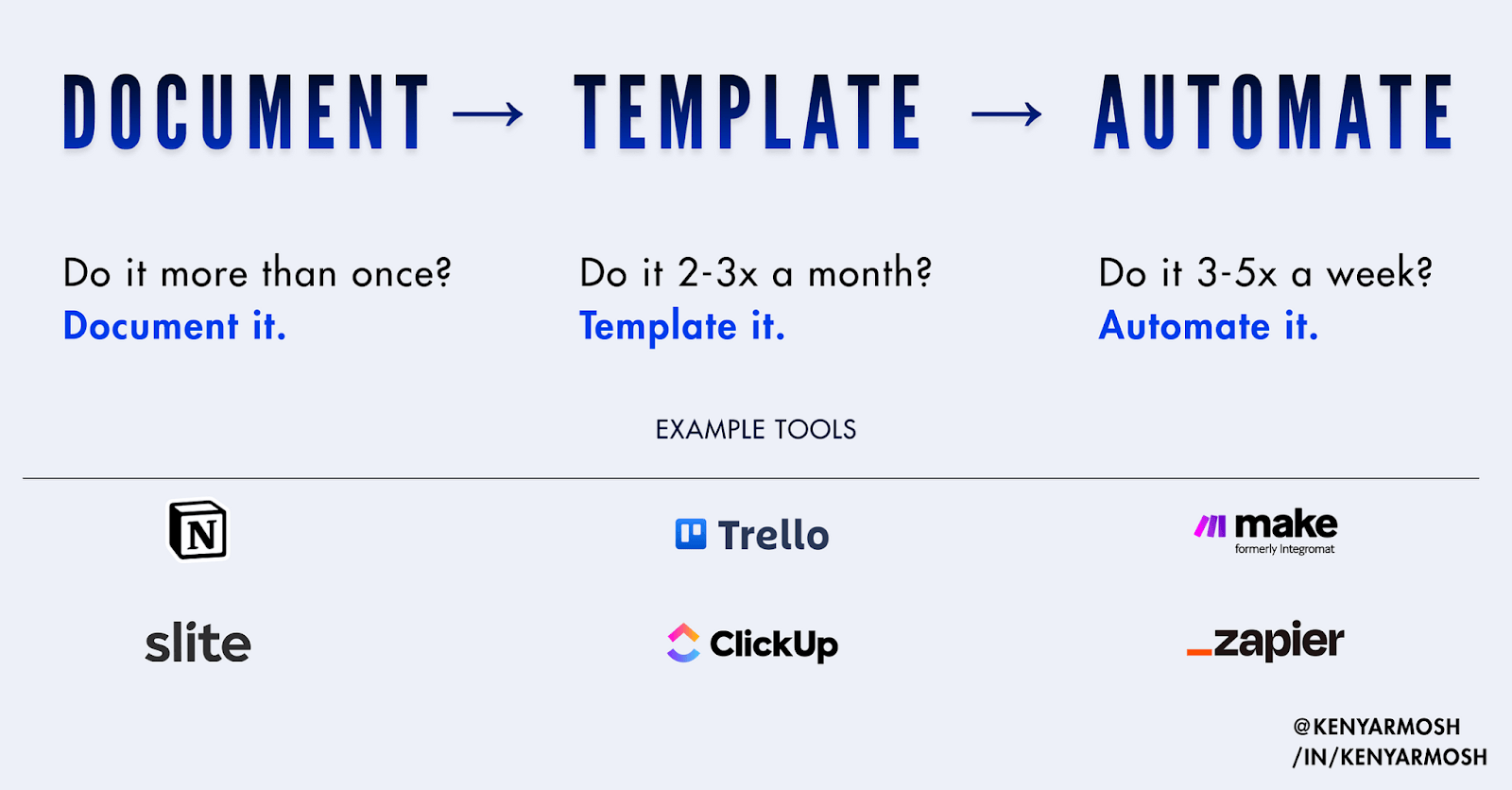
Your goal: codify your expertise into systems that AI can help run at scale. Document → Template → Automate. That framework applies to AI just as it does to everything else in your business.
Specialize your stack with your business context
When I want to write an app script, I turn to Claude Code—not ChatGPT. When I finish a sales call, Fathom provides me with a specialized GPT to process transcripts using proven sales methodologies. Not a general AI assistant.
Also, don't rely on general-purpose tools for everything. Build task-specific systems trained on your data, your workflows, your patterns. Here are a few examples:
- An offer development GPT built on your positioning.
- A content creation system trained on your writing style.
- A customer relationship tracker that understands your specific client journey.
The real opportunity isn't prompt magic. It's specialization.
Sequence before scale
I see solopreneurs trying to AI-ify everything at once. They end up scattered, overwhelmed, and no better off than before.
Focus on solving one business foundation at a time. It could be your authority and trust-based network first. Then, growth without headcount. Then, deeper AI systems integration.
Trying to solve everything at once leads to burnout, not growth. Pick the one system that would 10x your business if it ran without you. Start there.
The strategic benefits of AI for solopreneurs
Grow revenue without hiring
I built a seven-figure business with no employees. Not by working more hours. By creating AI systems that replaced what would have been a team.
Solopreneurs can now outperform teams of 10+ by working smarter, not hiring faster. The math has changed. One person with the right systems beats five people without them.
This is what I mean by a 2030 company. Lean. Fast. Iterating constantly.
How can you go faster without adding headcount? That's the question worth obsessing over.
Iterate faster, launch more
My Offers GPT isn't just a tool I built once. I use it regularly when launching new offers.
AI enables rapid offer creation, testing, and refinement. What used to take weeks now takes days. What took days now takes hours. The solopreneurs who can iterate faster will win—because they'll learn faster than everyone else.
Speed beats size in this era.
Reduce complexity while increasing output
AI assistants now handle tasks that once required teams of content writers, marketers, or analysts.
From managing content pipelines to client onboarding to predictive analytics on your sales funnel—systems powered by AI let you do more with less.
The goal isn't to be busy. The goal is to build leverage. Every AI system you create should remove tasks from your plate or dramatically speed up the ones that remain.
High-leverage use cases for solopreneurs
1. Offer development and positioning
This is where I started, and it's generated the most ROI for my clients and me.
Use AI to test angles, pricing models, and messaging rapidly.
Build a specialized GPT trained on your past wins, your lighthouse clients, and patterns of success. When you're developing a new offer, you want something that understands your specific market—not generic business advice.
My Offers GPT knows my positioning, my clients, and my frameworks. That's why it works.
2, Sales and lead generation workflows
Specialized AI systems can transform how you handle the entire sales process:
- Process sales call transcripts and extract key insights automatically
- Generate personalized follow-ups based on conversation context
- Maintain CRM hygiene without manual data entry
- Score leads using predictive analytics tied to your close patterns
I use Fathom for call processing. It integrates directly into my workflow and provides AI-assisted insights using proven methodologies—no downloading transcripts and pasting them into ChatGPT.
3. Content creation at scale without losing your voice
AI tools trained on your writing style can draft newsletters, posts, and marketing content at 80% fidelity. You or a trusted editor handles the final pass.
This preserves your brand and tone while eliminating the blank page problem. The key is specialization—an AI assistant trained on your specific voice, not a general-purpose content generator.
Natural language processing has gotten good enough that this actually works now. But only if you train it on your data.
4. Internal automation and task elimination
Look at your week. Find the high-effort, low-complexity tasks that drain your energy:
- Proposal generation from templates
- Email triage and initial responses
- Client onboarding sequences
- Meeting prep and follow-up documentation
These are prime candidates for workflow automation. I spend hours building systems that save hundreds of hours later. That's the trade-off worth making.
An AI-powered chatbot for initial client inquiries. Automated standard operating procedures for repeatable tasks. Digital products that deliver value without your direct involvement.
Every hour you reclaim is an hour for strategic work—or for your life outside the business.
How to start building an AI strategy that actually works
Ask: “What system would 10x my business if it ran without me?”
This is the north star question. Everything else should point toward this leverage point.
Not “what tasks can AI do for me?” That's thinking too small.
The question is about systems—repeatable processes that compound over time and create real separation between you and everyone else in your market.
Only you know where the bottleneck lives in your business. So, be honest about it and start from there.
Design AI around outcomes, not outputs
Don't optimize AI for tasks you could delegate to anyone. Focus it where it creates differentiation.
There's a difference between using AI to write another blog post and using AI to amplify your proprietary frameworks. One is commodity work. The other builds your competitive moat.
AI prompting matters less than AI positioning. What are you building that nobody else can replicate? That's where your attention belongs.
Invest in fluency, not just tools
You don't need to become an engineer. But you do need to understand how large language models work well enough to guide them strategically.
I was listening to a Y Combinator conversation recently—some of the top AI investors in the world. They said prompts aren't the crown jewels. The data is. The real-world context, the workflow knowledge, and the deep customer understanding are codified into systems.
That's the founder skill of the next decade. Not better AI prompting. Better systems thinking applied to AI.
Design the hammer. Don't just swing it.
Be the solopreneur that scales without hiring
Seventeen systems. Six figures from one GPT. Zero employees.
That's not a flex. That's a proof point for what's possible when you stop treating AI like an overpriced version of Google and start building specialized systems around your expertise.
The gap between general users and specialist builders is the entire story of the next decade. Which side are you on?
You don't need to grow headcount to grow impact. You don't need a team to compete with teams. You need AI systems that run without you—built on your data, your workflows, your patterns.
That's the 2030 company. Lean. Fast. Systemized.
And it starts with one question: What's the one system in your business that, if it ran without you, would 10x everything?
Go build that.
