
🚀 TL;DR
- AI isn’t replacing all consultants—it’s replacing those who sell information and outputs instead of outcomes.
- Information arbitrage is dead; generative AI can now produce reports, frameworks, and analysis instantly.
- Consultants who focus on execution, transformation, and measurable results remain valuable and defensible.
- The future belongs to specialists who build systems, proprietary IP, and trust-based networks.
- To stay irreplaceable, consultants must shift from using AI as a tool to designing AI-powered systems that compound their expertise.
I’ve lived through the dawn of the Internet, built the first websites, created the first apps, and always been a frontier dweller when it comes to innovation. So I can confidently tell you, the question isn't whether artificial intelligence will replace consultants. It's just clear which kind of consultant it will replace.
For decades, the consulting industry ran on information arbitrage. You knew something the client didn't. You had frameworks they hadn't seen. AI tools now generate those strategy documents, market analysis reports, and data processing outputs in seconds.
In 2024, I predicted that GPTs would replace the consultants who mainly just repackage information
That prediction is playing out faster than I expected.
In this article, I’ll explain how that happened and how to future-proof yourself in the AI era.
The real question isn't if—it's what kind of consultant will AI replace
The consulting model is already changing
The old playbook was simple: know more than your client, package that knowledge into deliverables, and charge a premium for access.
That game is over.
Generative AI now delivers in seconds what used to take human consultants hours. For example, summaries, strategy docs, marketing ideas, and competitive analysis. But clients aren't just buying information anymore. They never really were. They're buying transformation. They're buying outcomes.
We’ve seen it play out already.
Startups laid off whole teams. Contractors got cut. Hiring had to be justified by proving AI couldn't do the same thing. Suddenly, the market flooded with fractional everything—fractional CMOs, fractional COOs, fractional CFOs, all competing for shrinking budgets.
What used to be $20K monthly retainers turned into RFPs and bidding rounds.
Outputs are at risk, but outcomes still win
Here's the distinction that separates consultants who thrive from those getting squeezed:
Output-focused consultants deliver reports, frameworks, and one-size-fits-all strategy decks. They're the ones getting replaced. AI can generate a SWOT analysis faster than you can schedule the kickoff call.
Outcome-focused consultants deliver measurable transformations. They don't just advise—they implement. They don't just diagnose—they fix. Client satisfaction comes from results, not slide decks.
I've closed over $50M in consulting revenue across my career. Not once did a client write a check because my PowerPoint looked pretty. They paid because I could point to specific business outcomes: revenue increased, costs cut, systems built that ran without them.
That's the difference between a consultant and a vendor.
AI exposes value gaps
Most founders right now are throwing $500 of AI at $50,000-a-month problems.
They're using ChatGPT like a glorified Google search. They're chasing prompt engineering hacks instead of building actual systems. They're optimizing the wrong things.
AI didn't create the commoditization problem in consulting. It exposed it.
If your value was already fragile built on access to information rather than execution excellence, AI just accelerated your expiration date. The cracks were already there. Generative AI poured water into them.
The consultants feeling the most pressure right now? They're not victims of technology.
They're paying the price for years of selling outputs instead of building proprietary leverage.
What consultants must do to stay irreplaceable
Build a differentiated brand and trust-based network
You used to get discovered through referrals. Someone knew someone who knew someone, and a lead dropped in your lap.
That's not a strategy. That's luck with a business card.
In an AI-saturated market, you need to stand for something specific. Personal brand used to be a nice-to-have. Now it's a must-have. Not influencer-style personal branding—I'm not asking you to dance on TikTok or chase viral content. I'm talking about authority in the right circles.
Kevin Kelly wrote about a thousand true fans. There's real wisdom there. You don't need millions of followers. You need the right audience—people who trust you, refer you, and think of you first when a specific problem comes up.
I've built my business without massive audiences.
Instead, I focused on trust-based networks: curated spaces where people ask, "Who do you know that does X?" and your name comes up. That's worth more than 100K followers who scroll past your posts.
The key elements:
- Authority in a specific domain (not generalist "business consulting")
- Visibility in channels where your ideal clients actually spend time
- Trust-based networks that work for you even when you',re not actively selling
Grow without hiring and scale through systems
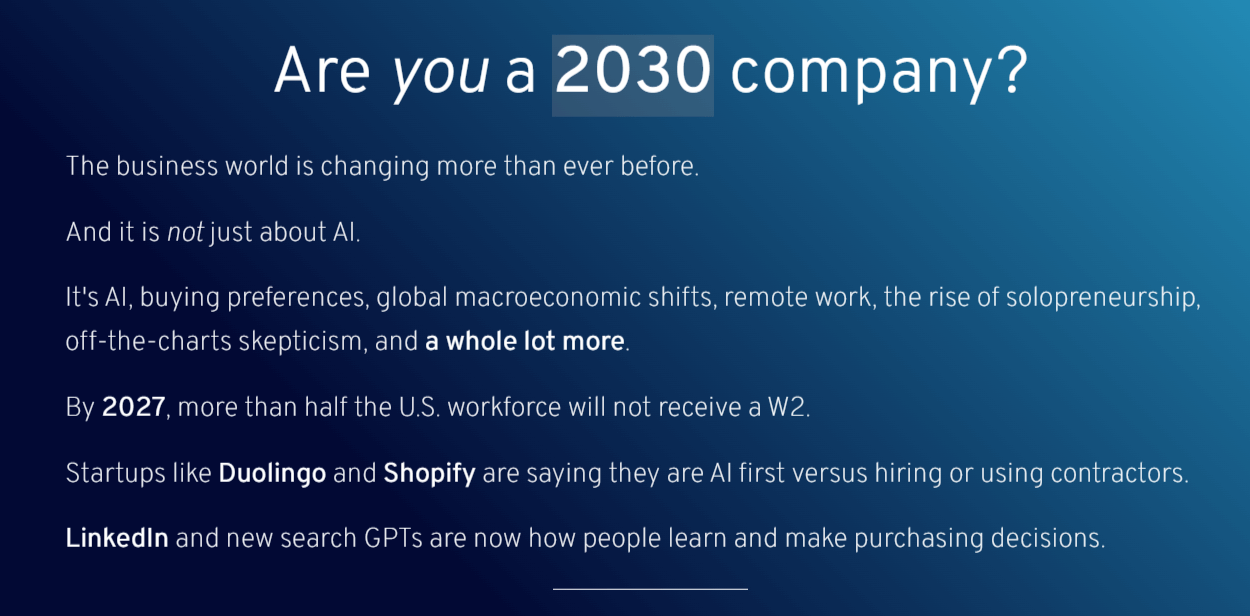
Here's my "2030 Company" thesis: small teams, or even solo consultants, can outcompete large agencies by leveraging AI, not labor.
We're entering the age of growth without headcount.
I ran a $5M agency with nearly $300K monthly payroll. Dozens of people. And you know what I spent most of my time doing? Managing people. Checking in. Coordinating. Every small change to the homepage became a multi-week project.
Today, I have a fraction of the overhead and more clients than ever. The difference? Systems.
I've built 17 specialized GPTs trained on my own data such as my frameworks, my processes, my client patterns.
One of them, my Offers GPT, has generated six figures this year alone. Not because AI is magic. Because I codified my expertise into something that compounds.
Become the architect, not the assistant
The consultant of the future doesn't just use AI tools. They design the workflows that run with or without them.
This is the shift from swinging the hammer to designing the hammer.
Most consultants I talk to are still in "user" mode—throwing prompts at ChatGPT, hoping for good outputs. That's not leverage. That's dependency.
The real opportunity is building AI-powered systems around your proprietary methodology. Your frameworks. Your unique approach to solving problems. That's what AI can't replicate—because it requires your first-party data, your knowledge, your pattern recognition from years in the trenches.
For instance, when I finish a sales call now, I don't manually process the transcript. Fathom gives me specialized AI analysis using proven sales methodologies right in the interface. That’s what specialized AI usage means.
Don’t use the spray and pray method for AI
I had a client show me a beautifully engineered AI setup recently. It looked excellent.
One problem: it was built to optimize a part of their business that didn't matter.
They'd lovingly built a Ferrari engine to power a golf cart.
This is the trap I see constantly. Consultants chase novelty. They build clever prompt stacks. They obsess over which AI assistant is better. They optimize $100 problems with $1,000 worth of effort.
Meanwhile, the one system that would actually 10x their business? Never gets built.
Focus your AI on the areas that compound:
- Client delivery systems that scale without you
- Sales processes that qualify and convert consistently
- Marketing engines that generate leads while you sleep
Everything else is a distraction dressed up as innovation.
You either choose to evolve, or get replaced
If you don’t make a clear choice now, your business will be in trouble. Here’s how you can avoid that:
Let go of the generalist mindset
Generalists will be the first to go.
When AI can do "a little bit of everything," the consultant who also does "a little bit of everything" becomes redundant. You're competing against a tool that works 24/7, doesn't charge by the hour, and never needs a coffee break.
Specialists, on the other hand, can train AI on their domain. They can build systems around proprietary methodologies. They create a moat that generative AI can't cross because it requires context, nuance, and first-party data that doesn't exist in any training set.
We're entering the specialist era of AI. The gap between general users and specialist builders is the story of the next decade.
Pick your lane. Go deep. Become the only answer to a specific question.
Replace hustle with intelligent systems
Success in consulting used to mean working harder. More hours. More clients. More hustle.
That model breaks now.
It breaks because there are only so many hours. It breaks because you become the bottleneck in your own business. And it breaks because AI-powered competitors can now deliver similar outputs without the burnout.
The new model: systems that compound your expertise.
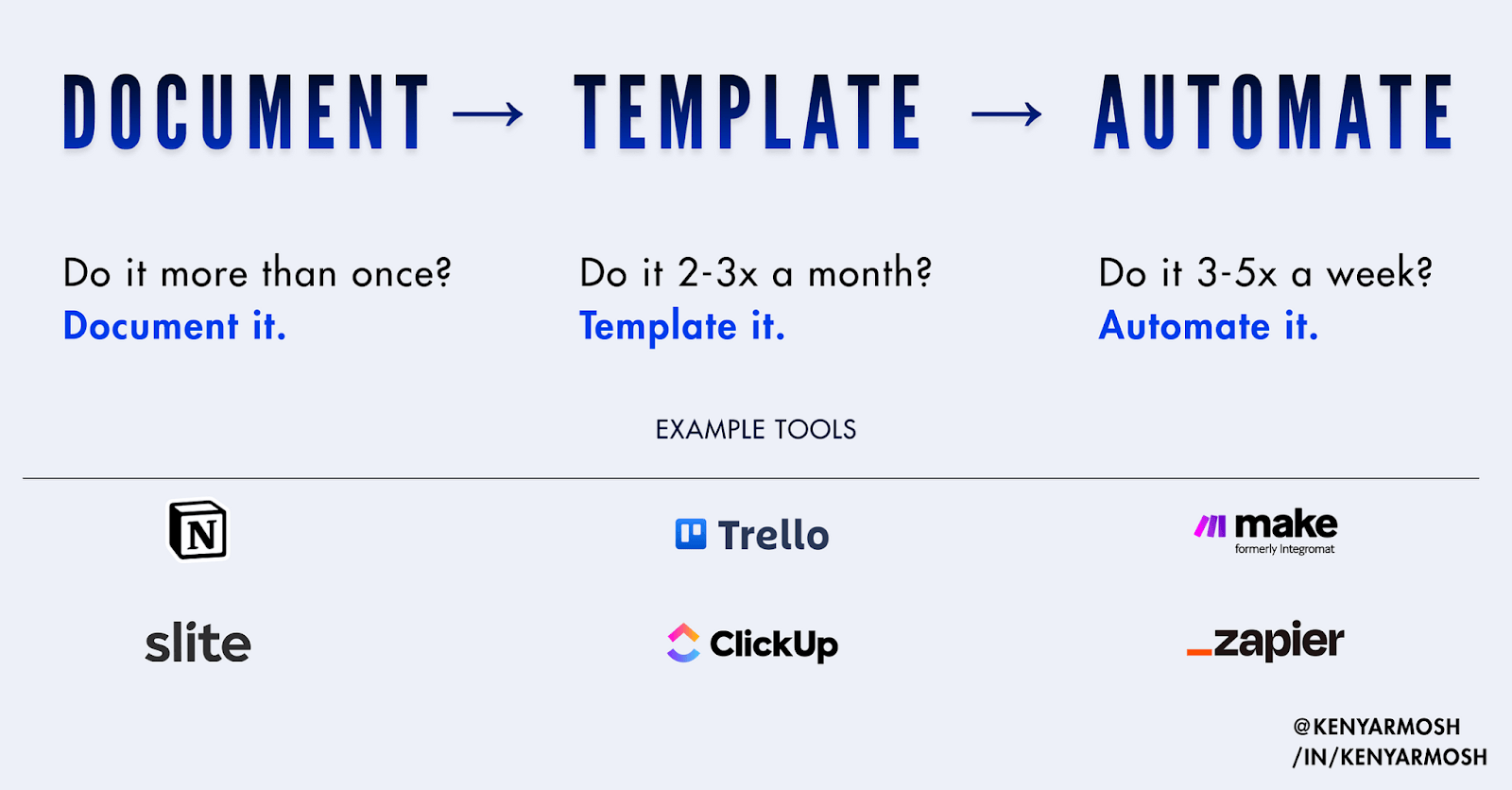
One specialized GPT could replace dozens of repetitive tasks you've been wrestling with for years. Not by working harder—by building smarter. Document your process, template what repeats, and automate what doesn't require your judgment.
I call this the DTA framework: Document → Template → Automate. It's how I've scaled to more clients than I ever had with a full team, without adding headcount.
Ask yourself: What's the one system in your business that, if it ran without you, would 10x everything?
Build that.
Accept that the game has changed
If you're still operating like it's 2018, where you’re relying on referrals, long retainers, or packaging knowledge into deliverables you won't make it to 2030.
I don't say that to scare you. I say it because I've watched it happen before.
When mobile apps emerged, agencies that couldn't adapt went under. When social media shifted algorithms, consultants who relied on organic reach saw their pipelines dry up overnight. Every cycle creates winners and losers.
This cycle is moving faster than any before it.
But there's a flip side. For those willing to rethink how they work, serve, and scale, this is the greatest opportunity in a generation. AI doesn't just threaten the old model. It rewards the new one.
AI won't replace you, but it will punish your complacency
AI is a mirror, not a monster.
It reflects where your value is and where it isn't. It exposes the consultants who were already coasting on access to information rather than the ability to drive outcomes. It accelerates the timeline for those who never built systems, IP, or scalable offers.
The consultants who will thrive through 2030 share three things in common:
- They codified their expertise into systems that run without them.
- They built trust in the right networks, the rooms where decisions get made.
- They embraced specialized AI as a force multiplier rather than a threat to resist.
If your offer is built around access to information, AI is coming for your lunch. The value is in execution, relationships, and proprietary leverage.
Build the leverage. Design the systems. Become irreplaceable—not because AI can't do what you do, but because what you do can't be reduced to a prompt.
That's how you make it to 2030.
