
🚀 TL;DR
- Single-price models leave revenue and relationship depth on the table by ending client engagements too early.
- Tiered pricing creates multiple entry points, clearer positioning, and natural upgrade paths.
- Well-designed tiers reflect different levels of transformation—not just “more or less” of the same work.
- Three tiers usually work best: entry, core, and premium.
- Each tier must be profitable on its own and simple to understand.
- Tiered pricing turns one-off projects into long-term client journeys.
One of the most frustrating mistakes I see service providers make is related to their pricing.
This is what I’ve spent years watching: they land a great client, deliver exceptional work, and then let that client walk away after one “project.” They never provide an option to continue that journey or upgrade if needed.
You leave these opportunities on the table because of your pricing model. But you also miss chances to deepen relationships with clients who would have gladly invested more.
That's why I recommend an offer-based or tiered pricing model to capture that value.
Tiered pricing isn't just for SaaS companies. For service providers, it's how you create multiple entry points and natural upgrade paths.
This guide shows you how to design pricing tiers that work without complicating your business or confusing your buyers.
What are the benefits of using tiered pricing?
Single-price models give your prospects a take it or leave it option. You also force yourself to choose between serving budget buyers or premium clients. You can't do both profitably.
Tiered pricing solves this by creating distinct entry points. A brand strategist charging $5,000 for brand strategy can add a $2,000 “intro” package to get foundations in place and a $15,000 premium tier for clients who need broader design systems support. It's the same core expertise, but three options to meet your clients where they are.
The math is straightforward. If you close 10 clients per year at $5,000, you earn $50,000. With tiers, you might close 5 at $2,000, 8 at $5,000, and 3 at $15,000—that's $95,000 from 16 clients. You get more revenue, better client fit, and a more precise positioning.
But the real advantage is that these tiers create natural upgrade paths.
A client who starts at your entry level and sees results will move up when they're ready. You're not starting from scratch with every engagement, and you're deepening existing relationships.
The pricing strategy also clarifies your value proposition. Instead of explaining everything you do and hoping prospects "get it," you present options that guide them toward the right fit. Decision-making becomes easier for both parties.
How to design a tiered pricing structure for your solo business
Designing tiers isn't about slapping three price points on your services page. It's about matching your delivery model to customer needs at different investment levels.
Step 1: Start with defining your core customer segment
Your clients aren't all the same. You want to target a singular “Lighthouse Client.”
Some aren’t ready to invest aggressively. Others feel the pain more or have larger budgets Map out who you're actually serving:
- What industry, revenue, level, and comparable company criteria.
- What they typically need help with or are challenged by.
- How you’ve grown with them over time.
Don't invent a segment based on what sounds good.
Look at your last 20 clients and notice the patterns:
- Who paid quickly?
- Who needed more hand-holding?
- Who asked for additional services?
That's your market research.
Step 2: Define value and deliverables per tier
Each tier needs a clear reason to exist. Avoid the trap of making your lowest tier "everything but less." That's lazy pricing design.
Structure tiers around different transformation levels. Your entry tier might solve one specific problem. Your mid-tier addresses that problem, plus some amount of implementation. Your premium tier includes ongoing optimization and priority support.
The key is separation. If tiers feel too similar, clients default to the cheapest option.
Step 3: Set pricing that reflects real value
Your lowest tier should cover your time and costs—but pricing strategy isn't about cost-plus calculations. You're pricing based on the value delivered and the customer lifetime value of that segment.
I've seen service providers underprice their entry tier so much that it becomes a trap. They get flooded with low-budget clients and have no capacity for premium work. Your entry point should still be profitable.
For the premium tier, think beyond hours worked. What's the business impact? What's the alternative cost if they don't work with you? Offer-based pricing means charging for the outcome, not the effort.
Step 4: Keep tiers manageable
Three tiers work for most service businesses. Two feels limiting. Four or more creates decision fatigue.
You want the choice to be between different levels of support, but not at the cost of overwhelming the prospect and your business.
Three tiers usually hit the sweet spot because they give enough choice without paralysis.
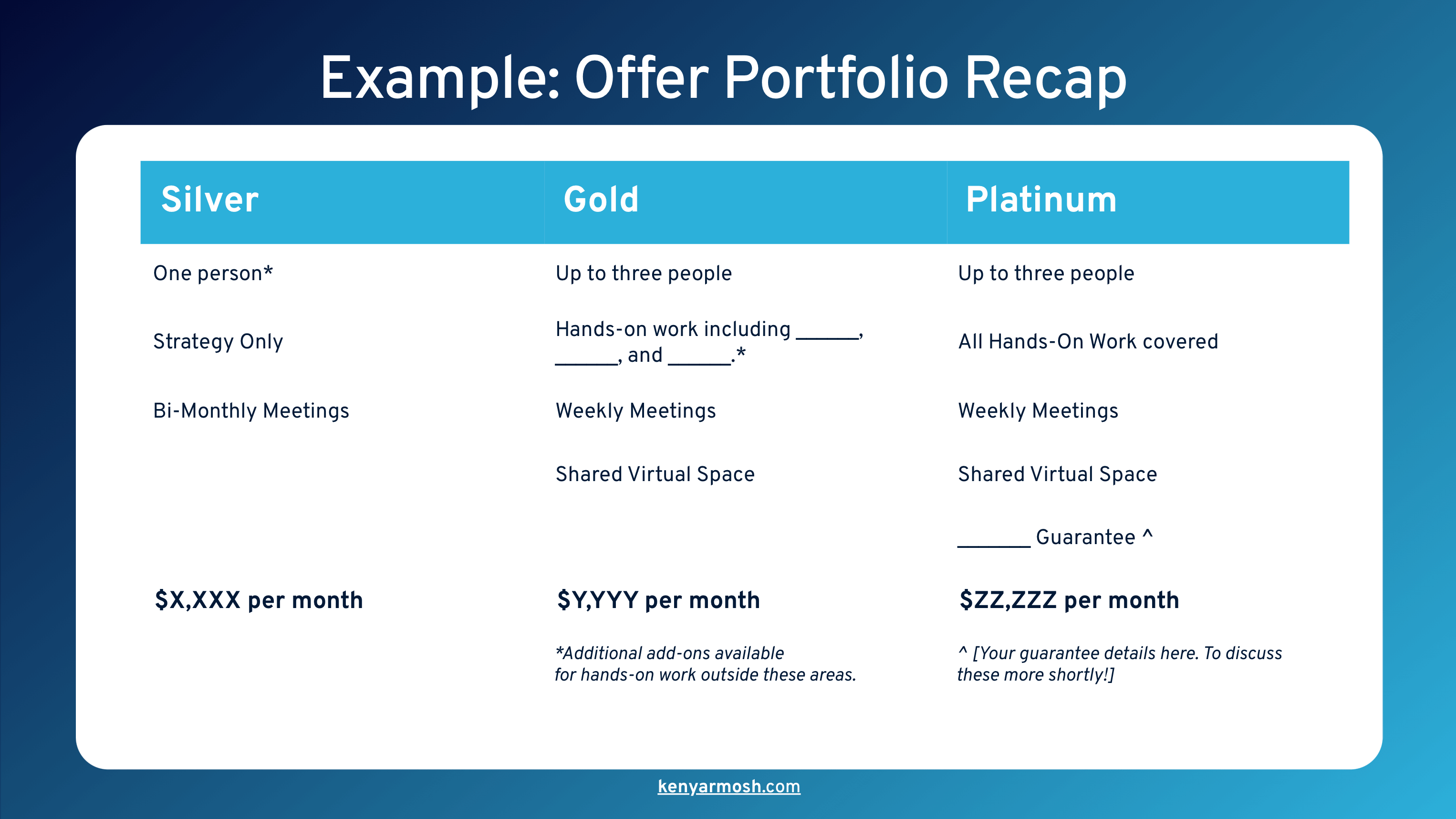
Step 5: Communicate clearly
Your pricing tiers should be instantly understandable. Use simple tier names that signal the level, such as Build, Growth, and Scale.
List what's included using benefit-first copy. Not "3 revision rounds" but "Refine your positioning until it resonates." The client needs to see themselves in the description.
Also, make your preferred tier obvious. Most buyers gravitate toward the middle option, so structure your tiers to make that your target. This is anchoring, where you use market conditions and perceptions to guide your decisions.
Step 6: Monitor and iterate
Launch your tiers and watch what happens. Track which options clients choose, where upgrades happen, and what questions come up during sales conversations.
If 90% of clients pick your lowest tier, you've either underpriced it or made the jump to mid-tier too steep. If nobody picks the premium option, it's not compelling enough or poorly positioned.
I review my pricing model quarterly. Small adjustments such as changing deliverables, repositioning value, and tweaking price points can significantly shift your revenue streams. This isn't a set-and-forget system. It's an ongoing system.
What pitfalls do you need to avoid with tiered pricing?
Tiers can accelerate growth or create operational chaos. Here's what trips up most service providers:
1. Watch your time cost
Premium tiers should increase your revenue without trapping you in more labor. I've watched consultants create "VIP" packages that included unlimited calls, same-day responses, and custom deliverables. They made more per client but worked 60-hour weeks.
Structure tiers so higher prices come with better margins, not just more work. Your premium tier might include faster delivery or priority support, but not unlimited scope. Usage limits exist for a reason.
2. Avoid cannibalization
If your entry tier solves the core problem too well, nobody will upgrade. This kills your revenue potential.
The fix: reposition the entry tier as a starting point, not a complete solution. It should create an appetite for more, not satisfy the entire need.
3. Keep it simple
Every tier you add increases operational complexity. Different deliverables mean different workflows, templates, and ways of communicating. That's mental overhead.
When I scaled past seven figures, I ran lean on purpose: three tiers, clear boundaries, and standardized delivery. Simplicity lets me focus on client results instead of managing internal confusion.
4. Use premium to elevate your brand
Even if a few clients choose it, a premium tier raises perceived value across your entire pricing model. It makes your mid-tier look reasonable by comparison.
This is basic anchoring psychology. A $3,000 service feels expensive on its own. Next to a $10,000 option, it becomes the "smart choice." SaaS companies do this instinctively—you should too.
5. Design for upgrades
The best tiered pricing models include natural progression paths. A client starts small, sees results, and moves up when they're ready for more.
Build this intentionally. Your entry tier should demonstrate your methodology. Your mid-tier expands the scope. Your premium tier adds an ongoing partnership. Each solves a bigger version of the same problem.
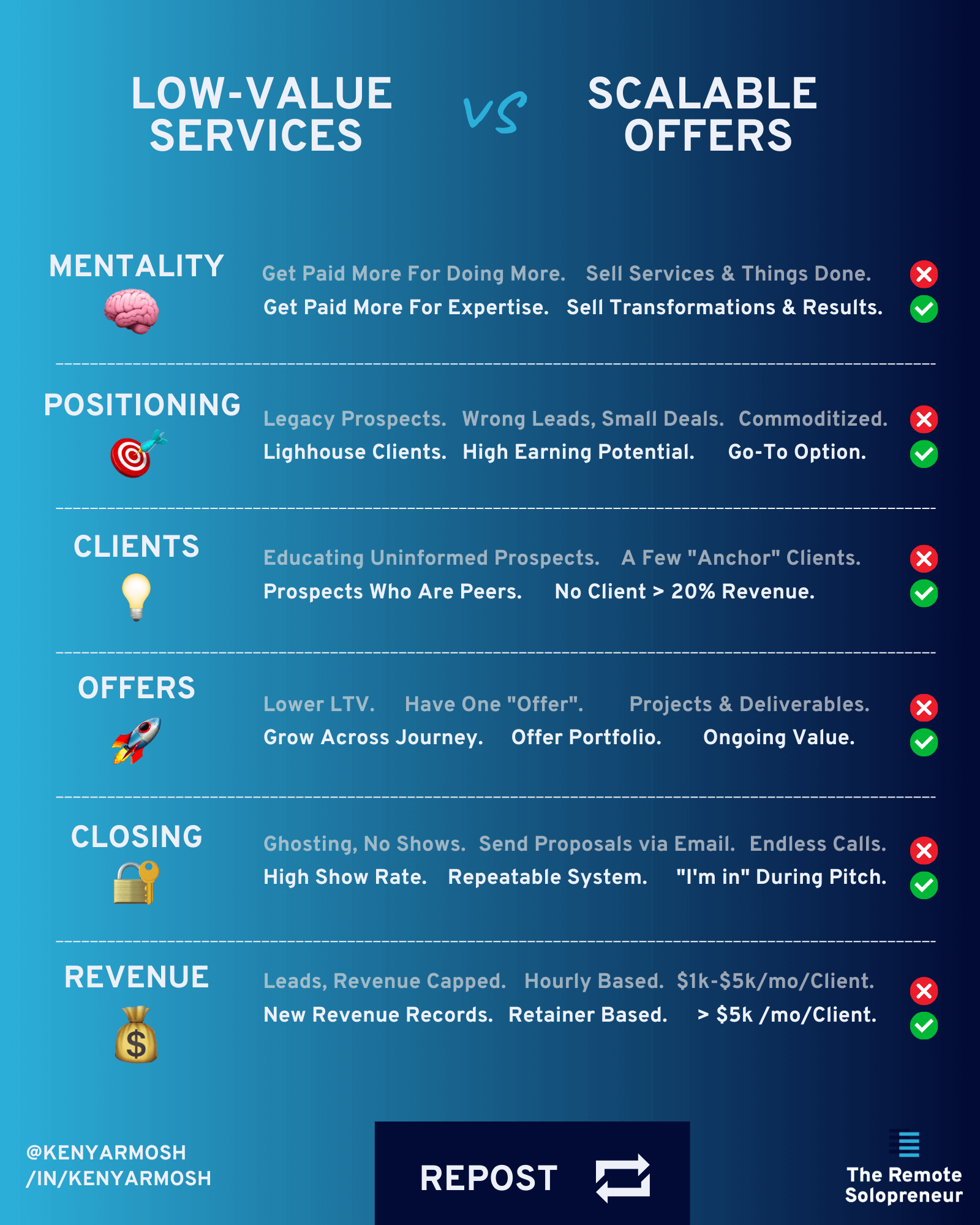
I've had clients start with a single workshop and eventually move into year-long mentoring relationships. That only happens when your pricing strategy anticipates growth.
6. Differentiate or lose customers
Tiers that blur together push clients toward the cheapest option. If they can't quickly spot the difference, they’ll default to choosing you based on pricing.
Make the separation obvious. Use different deliverable formats, access levels, or timelines. Your basic tier might be self-guided templates. Your standard tier adds group coaching. Your premium tier includes one-on-one implementation.
8. Cover your costs—always
If your base tier isn't profitable, everything breaks. Don't use entry-level pricing as a loss leader, hoping clients upgrade later.
I've seen subscription-based pricing models where the lowest tier barely covered customer support costs. They needed 80% of users to upgrade just to break even. That's not a pricing strategy—it's a gamble.
Price each tier to stand alone profitably.
Build tiers that scale your service business
Single-price models force you to turn away clients who don't fit your pricing. Tiered pricing lets you serve different customer segments while increasing revenue per relationship.
The key is intentional design. Your tiers should reflect different levels of transformation, not arbitrary feature lists. They should create natural upgrade paths, not decision paralysis. And they should simplify buying decisions rather than complicate them.
Start small. Launch with three clear tiers. Watch which options clients choose and where they get stuck. Adjust based on actual behavior, not assumptions about what "should" work.
Essentially, you're building a system that grows client relationships over time instead of starting from scratch with every engagement. That's the real leverage.
