
🚀 TL;DR
- Hourly billing breaks down in an AI-driven world because efficiency reduces revenue instead of increasing it.
- AI isn’t labor—it’s leverage that collapses the relationship between time and output.
- Clients don’t pay for time spent; they pay for outcomes, risk reduction, and judgment.
- As execution becomes commoditized, strategic insight and decision-making command premium pricing.
- Outcome-based pricing and systemized expertise let consultants scale without racing to the bottom.
I’ve been consulting since 2004 and I’ve never charged by the hour.
Even when I scaled my agency to $5M, I priced on outcomes. It felt obvious to me: clients pay for results, not for how long something takes.
But I totally get I’m in the minority. It’s something I help clients with almost daily. Most consultants still default to hourly rates because it's what clients expect. It's what procurement understands.
Then artificial intelligence changed the math.
When you can solve a $500,000 problem in 20 minutes using machine learning and specialized systems, hourly billing breaks down. Faster delivery should mean more value, not less revenue.
Hourly pricing rewards slowness. It penalizes efficiency. AI just makes that contradiction impossible to ignore.
The real question isn't whether hourly billing still works.
It's whether it ever made sense for expertise in the first place.
Hourly pricing breaks when your leverage goes up
AI is leverage, not labor
Most business owners treat AI like a faster employee. Ask it questions. Get answers. Save a few hours here and there.
That's thinking too small.
AI isn't labor you're replacing. It's the leverage you're adding. The difference matters for how you price.
When I built 17 specialized systems over the last year using my own data and frameworks, I wasn't saving time on tasks. I was multiplying my capacity to deliver outcomes. My Offers GPT alone generated six figures—not because it worked more hours, but because it helped me create better client results faster.
Generative AI collapses the relationship between time and output. Computer vision, predictive modelling, data science tools—they all do the same thing. They let you deliver in minutes what used to take weeks.
If you're billing hourly, every efficiency gain cuts your revenue.
That's a pricing model fighting against itself.
Speed shouldn't mean less revenue
Here's where client expectations get twisted.
Clients see faster delivery and assume it should cost less. "You did it in two days instead of two weeks. Why am I paying the same?"
Because the outcome didn't change. The risk you removed didn't shrink. The cost savings you created didn't disappear because you created them quickly.
A surgeon who completes a procedure in 45 minutes rather than 3 hours isn't any less valuable. They're more valuable. Their speed comes from thousands of hours of training sessions and experience.
Consulting pricing should work the same way.
When your systems, expertise, and AI tools let you deliver faster, that's a premium. The digital transformation you enable doesn't become worth less because you enabled it efficiently.
Speed built on expertise commands higher rates. Not lower ones.
The strategic layer is where the value lives
As AI takes over execution, what's left for the consultant?
Everything that matters. Here’s what I mean:
Clients don't buy time rather, they buy judgment
Your role is shifting. You’re less of a manager and more of a brain donor.
Clients aren't paying for your hands on a keyboard. They're paying for:
- Pattern recognition from years in the field
- Technical discernment about what will actually work
- Industry-specific insight no general AI can replicate
- The ability to ask the right questions before building anything
AI can generate a strategy deck in minutes. It can't tell you which strategy fits this client's politics, risk tolerance, and market position. That requires judgment shaped by experience.
The consulting business is splitting into two tiers. Execution work—the stuff AI handles well—races toward commodity pricing. Strategic work commands premiums because it's irreplaceable.
If your consulting pricing is tied to hours, you're competing in the wrong tier.
The flood of fractional roles and the race to zero
By 2025, the market was saturated with fractional offerings.
Fractional CMO. Fractional CFO. Fractional everything. LinkedIn feeds are filled with RFPs and bidding wars. Everyone is scrambling for the same positioning.
The result? Price suppression and discount spirals.
When you compete on time-based pricing, clients can compare you side-by-side with dozens of others. "This fractional COO charges $200/hour, that one charges $175." Easy math. Easy negotiation.
Value-based pricing breaks that comparison. When you price on outcomes—revenue generated, costs reduced, problems solved—there's no hourly rate to haggle over. The conversation shifts from "how much time" to "what result."
That's how you stay out of the race to zero.
What to use instead of hourly pricing
Knowing hourly billing is broken doesn't help unless you have something better. Here's what actually works:
Build outcome-based, scalable offers
Stop selling time. Start selling transformation.
I've helped hundreds of consultants build offers that focus on client outcomes rather than activities. The shift changes everything about how you position, price, and deliver.
An outcome-based offer answers one question: what result does the client walk away with?
Not "20 hours of consulting." Not "weekly strategy calls." A specific outcome they can measure. Revenue increased. Costs cut. Problem solved.
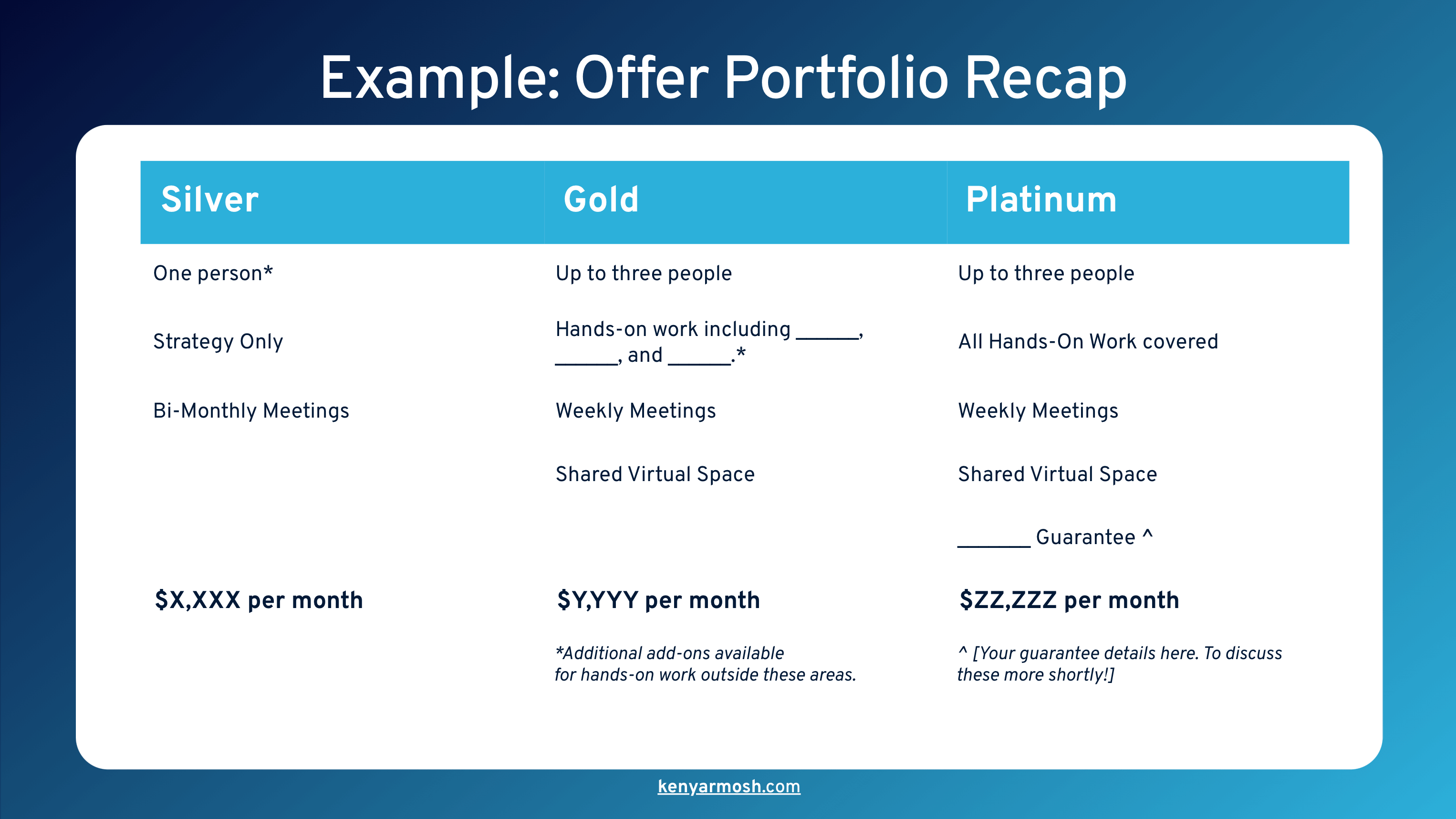
When you price on outcomes, your efficiency becomes your margin—not your penalty. The faster you deliver, the more profitable the engagement. AI becomes an asset instead of a threat to your billing.
Codify your value into systems
This is the real unlock for consultants in the AI era.
I've built 17 specialized systems trained on my own business data—not generic prompts, but tools built on my frameworks, my client patterns, my methodologies. One specialized system can replace 20 tasks you've been wrestling with for years.
The consultants pulling ahead aren't just using AI. They're building AI into their delivery. They're creating proprietary systems that:
- Systematize their diagnostic process
- Accelerate client onboarding
- Generate customized deliverables faster
- Scale their expertise without scaling their time
Prompts aren't the crown jewels. Your data is. Your context is. Your workflow knowledge is.
That's the founder skill of the next decade—deep customer understanding codified into systems that compound.
Position around outcomes, not outputs
The language you use shapes how clients perceive your value.
"10 hours of consulting" invites rate comparison. "Unlocking $500K in new margin" invites a different conversation entirely.
Reframe every offer around what the client gains:
- Not "market research" but "clarity on your next $1M opportunity."
- Not "strategy sessions" but "a roadmap that cuts acquisition cost by 40%."
- Not "AI implementation" but "systems that free 15 hours per week."
AI helps you achieve outcomes faster. Price the outcome, not the hours it took to get there.
Hourly was built for a slower world
The market is moving faster than ever. Pricing models built for 2015 won't survive 2030.
Hourly billing made sense when effort and output moved at roughly the same pace. You worked more, you delivered more, you billed more. The math was simple.
AI broke that math.
Now the consultants clinging to hourly rates are watching their revenue shrink every time they get more efficient. Meanwhile, those who've shifted to outcome-based pricing are compounding their leverage.
I never charged by the hour because it didn't make sense for the expertise. AI just proved the point.
You're not selling time. You're selling judgment, outcomes, and systems that compound.
Price accordingly.
