
🚀 TL;DR
- Your pricing model should evolve with your expertise and goals—high-earning freelancers sell leverage and outcomes, not hours.
- Offer-based (productized) pricing is positioned as the strongest long-term model because it creates leverage, predictable revenue, and clearer sales.
- Hourly and per-unit pricing are framed as “traps” that commoditize your work and cap income; use them only as short-term stepping stones if needed.
- Project fees and day rates can work for specific situations, but require tight scoping and boundaries to avoid scope creep and hidden labor.
- Equity/revenue share is rarely recommended unless paired with a base fee; the overarching advice is to stop overservicing underpaying clients and choose the model that supports scaling.
Growing an agency to $5M / yr, I've closed deals worth $500k+ for a single client. My multiple seven-figure businesses all came without settling into a single pricing model.
Your pricing strategy shifts with your expertise, market, and what you're building. When I started, I made every mistake—charged hourly, underpriced projects, tried equity deals that taught expensive lessons.
The highest-earning founders don't sell hours. They sell leverage.
After mentoring 550+ consultants around pricing, sales, and offers, I've seen what works and what quietly destroys businesses. The moment you sell your time, you cap your earning potential.
This guide breaks down every pricing model freelancers use in 2026—pros, cons, and which ones I recommend based on your goals.
Pricing models for freelancers: Comparison
1. Offer-based pricing
This is the model I push hardest with the consultants I mentor.
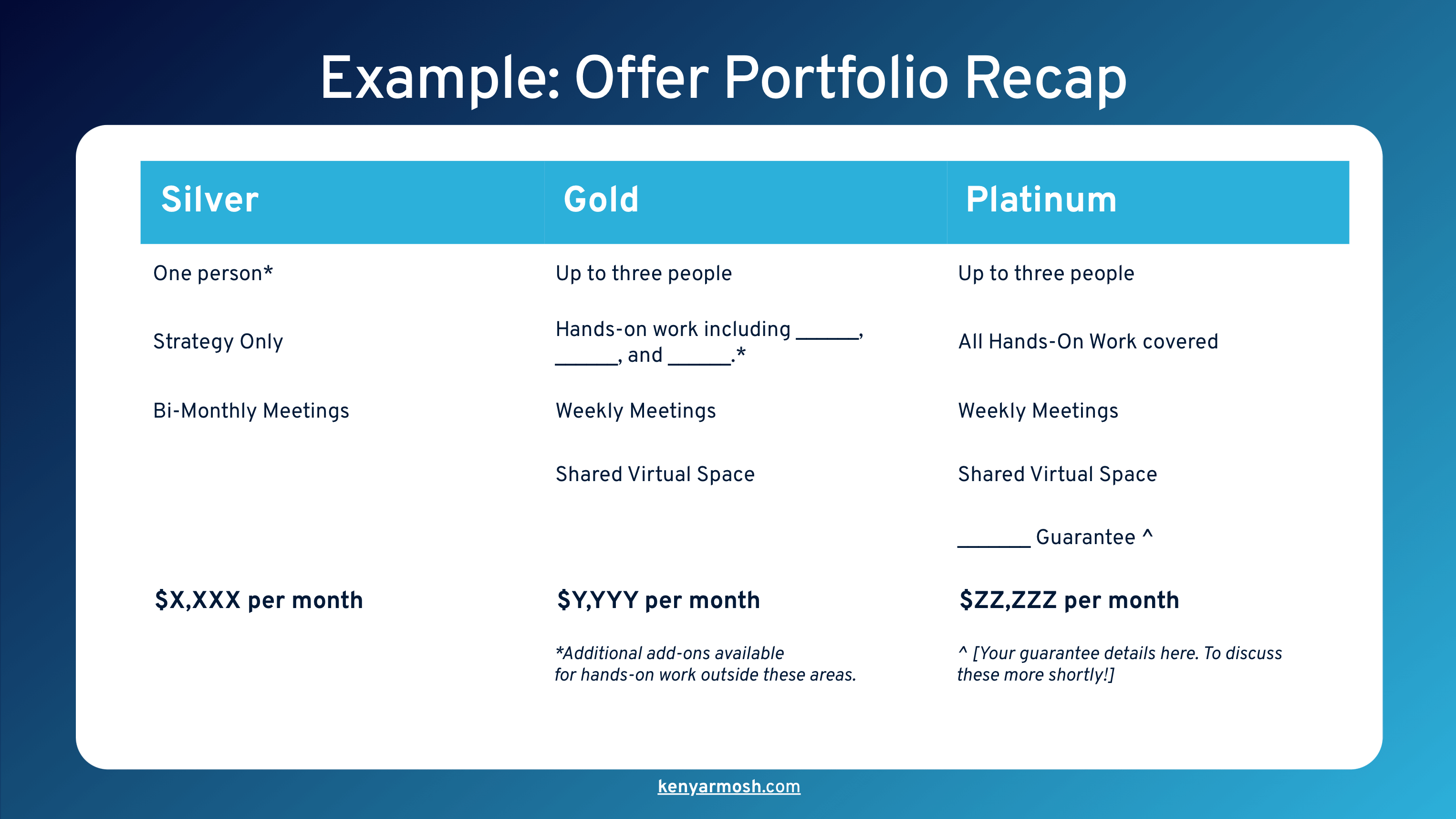
You create defined packages—clear deliverables, fixed pricing, and specific outcomes. Think of it like buying a product instead of hiring someone by the hour. Your clients know what they're getting and what it costs before committing.
Instead of charging hourly or project-based rates, you design offers that get the result faster, better, and more reliably. You build three tiers: an intro offer that solves a specific problem, a core package that delivers your flagship solution, and a premium option that includes everything plus additional support.
This is how you escape the time-for-money trap.
Pros
- Creates predictable revenue because you know exactly what each package generates
- Builds leverage since you're not reinventing solutions for every client
- Positions you as an expert rather than a hired hand
- Simplifies your sales process because pricing is clear upfront
- Allows you to refine and improve your delivery over time
- Makes it easier to scale without working more hours
Cons
- Requires upfront work to define your packages and pricing
- Some clients want custom solutions and resist standardized offers
- You need confidence to hold boundaries when clients request scope changes
- Takes time to dial in the right pricing for each tier
- May need to turn away work that doesn't fit your packages
Do I recommend this model?
Yes. I strongly recommend this pricing strategy for consultants and service providers who want to build sustainable profitability.
You're not just selling your time when you package your expertise into offers. You're selling a transformation. That shift changes how clients perceive your value and how much you can charge.
The freelancers who switch to offer-based pricing typically see their effective hourly rate double or triple within months. That's not because they're working more. They've finally structured their business around outcomes instead of inputs.
How to get started with offer-based pricing
Start by mapping the transformations you create for clients. What specific problem do they have when they hire you, and what result do they get when you're done?
Then do the following:
- Build your intro package first. Make it focused, achievable, and priced so it's accessible to prospects who need to test working with you. This package should deliver a clear win but leave room for deeper engagement through your core or premium tiers.
- Your core package is your flagship. This is where you deliver your best work—the full transformation clients need. Price it based on the value created, not the hours spent. If you help a client increase revenue by $100k, charging $20k isn't aggressive. It's fair.
- Your premium tier adds support, speed, or exclusivity. Monthly check-ins, faster turnaround, or direct access to you. This tier serves clients who want more hand-holding or have urgent needs.
Name your packages clearly. "Starter," "Pro," and "Elite" work fine, but industry-specific names work better. A fractional CMO might use "Market Entry," "Growth Acceleration," and "Market Dominance."
Test your pricing with three clients before you lock it in. You'll learn where you're underpriced, where scope creep happens, and what clients value most.
2. Hourly rate pricing
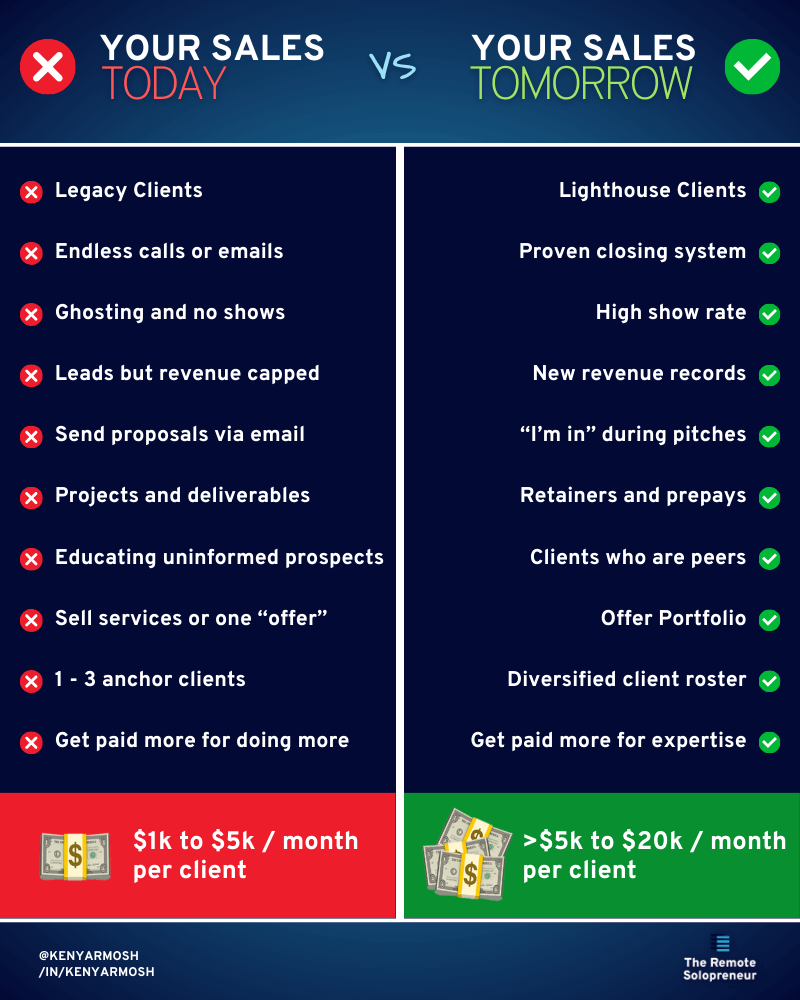
This is where everyone starts. You charge clients based on the hours you work—$50, $150, $300 per hour, depending on your expertise and market.
It feels safe because you're guaranteed payment for every hour you invest. It's also the easiest model to explain and the most familiar to clients with traditional employment structures.
But it's a trap. And I'll explain why.
Pros
- Simple to calculate and communicate to clients
- Guarantees you're paid for the time invested
- Works well for undefined projects where the scope is unclear
- Familiar to clients who understand time-based pricing
- Easy to adjust rates as you gain experience
Cons
- Caps your income at the hours you can physically work
- Penalizes efficiency because faster work means less pay
- Creates conflict when clients question how long tasks should take
- Requires tracking and billing time, which adds admin overhead
- Positions you as a commodity rather than an expert
- Invites scope creep because every new request extends billable hours
Do I recommend this model?
No. Not for anyone who wants to build a scalable consulting or freelancing business.
Hourly pricing traps you in a direct exchange: your time for their money. You can't scale that without working yourself into burnout. Every efficiency you create, template, system, or improvement, reduces your income because you finish faster.
The moment you sell your time, you cap your earning potential. You're playing someone else's game.
I've seen talented consultants stuck at $200k/year working 60-hour weeks because they refuse to move past hourly billing. Meanwhile, their peers with offer-based or value pricing models earn the same amount working 20-25 hours per week.
If you charge hourly, use it as a temporary stepping stone. Track your hours on the next three projects, calculate what you earn per client, and use that data to build fixed-price packages.
3. Project-based pricing (Flat fee)
You quote a fixed price for a defined project. The client knows what they'll pay upfront, and you deliver the agreed-upon scope of work.
This model works well for freelancers who can accurately estimate project requirements and want to avoid the hourly rate trap. It's common in graphic design, web development, and other creative fields where deliverables are tangible.
Pros
- Clients appreciate knowing the total cost upfront
- Rewards efficiency because you keep the difference when you finish early
- Eliminates time-tracking admin burden
- Creates an incentive to develop faster processes and templates
- Positions you as a problem-solver rather than a hired resource
Cons
- Scope creep destroys profitability if boundaries aren't clear
- Underestimating project complexity means you work for less than intended
- Difficult to price accurately without experience
- Clients may expect revisions or additions without additional payment
- Requires detailed scoping work upfront to protect margins
Do I recommend this model?
Partially. Project-based pricing is better than hourly rates, but still ties your income to delivering specific work rather than creating outcomes.
Use this model if you're transitioning from hourly billing or if your work naturally fits into discrete projects. But don't stop here. The goal is to move toward value-based or offer-based pricing where you're compensated for results, not just deliverables.
Fixed-fee projects work best when you've built enough experience to estimate accurately and when you've created systems to deliver efficiently. If you're constantly surprised by how long projects take, you're not ready for this model yet.
4. Retainer model
Clients pay a monthly retainer fee for ongoing access to your services. This might include a set number of hours, defined deliverables, or availability for specific needs.
Retainers create financial stability because you have a predictable monthly income. They also build deeper client relationships since you work together over extended periods rather than one-off projects.
Pros
- Generates consistent, predictable monthly revenue
- Reduces time spent on sales because existing clients renew
- Allows you to plan capacity and workload more effectively
- Builds deeper client relationships and understanding
- Creates compound value as you learn their business over time
Cons
- Clients expect consistent availability and responsiveness
- Scope creep happens easily without clear boundaries
- Can become a de facto employment relationship if structured poorly
- Requires managing client expectations around what's included
- May lock you into lower rates as your expertise grows
Do I recommend this model?
Yes, but only if you structure it correctly.
Monthly retainers work beautifully for ongoing services like fractional leadership, marketing support, or advisory work. The key is defining exactly what clients get each month. If you leave it vague, clients will treat you like an on-call employee and burn through your time.
I recommend "bucket retainers," where clients purchase a defined amount of value each month. This might be "four strategy sessions plus implementation support" or "one audit plus ongoing optimization." When they hit the limit, they either wait until next month or purchase additional services at your standard rates.
Never let retainer relationships drift into "I'm available whenever you need me." That's not a retainer. That's employment without benefits.
5. Value-based pricing
Your price is based on the value created for the client rather than the time or effort required. If you help a company increase revenue by $500k, you might charge $50k-$100k regardless of whether the work takes you 20 hours or 200 hours.
This pricing model unlocks high earnings for consultants who clearly articulate and deliver measurable outcomes.
Pros
- Decouples income from hours worked
- Rewards expertise and efficiency rather than time investment
- Allows for premium pricing when the value delivered is high
- Aligns your incentives with client success
- Positions you as a strategic partner rather than a service provider
Cons
- Requires a deep understanding of client economics and value drivers
- Difficult to quantify the value for some types of work
- Clients may resist paying for outcomes they can't measure immediately
- Demands confidence to hold pricing conversations
- Works best after you've proven results in your niche
Do I recommend this model?
No. This is where consultants and founders get tripped up regularly.
Value-based pricing is overly complex and outdated. Clients don’t like it and you don’t need it. When you focus on defining your target client deeply, the pricing will feel customized to them without making either party jump through a bunch of hoops.
There’s a false narrative that if you help clients increase sales, reduce costs, or improve efficiency, you can “quantify value” and charge more. But this slows down your sales process when you realistically already should be charging more…without suggesting to clients you should be charging them more due to “value-based pricing.”
When done properly, you can get value-based pricing rates with offer-based pricing. That’s what I do for my high-ticket consulting work. When I help a solopreneur restructure their offers and they go from $8k/month to $40k/month, charging $25k for that transformation isn't expensive. It's cheap.
The biggest barrier isn't convincing clients to pay based on “value.” It's having the confidence to name and hold the price during the sales conversation with offers that feel built specifically for them.
6. Equity, commission, or revenue share models
You take a percentage of revenue, profit, or equity instead of upfront payment. This model is common in startup advising, performance marketing, and strategic partnerships.
Some freelancers use this to access clients who can't afford their rates but offer long-term upside. Others use it to align incentives around client success.
Pros
- Creates potential for significant upside if the client succeeds
- Aligns your success directly with client outcomes
- Opens access to clients who can't pay market rates
- Can build passive income if structured as an ongoing revenue share
- Demonstrates confidence in your ability to drive results
Cons
- No guaranteed income means financial instability
- You're betting on client execution and market conditions beyond your control
- Equity in early-stage companies often becomes worthless
- Commission structures can create conflicts around attribution
- Takes time to realize value compared to an upfront payment
- Complicated legal agreements are required to protect both parties
Do I recommend this model?
Rarely. And only under specific conditions.
I've taken equity deals. Some worked out. Most didn't. The problem isn't the model itself—you're betting your income on someone else's ability to execute.
If you do equity or revenue share deals, follow these rules:
First, never replace cash entirely. Structure deals as "base fee plus equity," so you're not entirely dependent on long-term outcomes.
Second, only work with clients where you genuinely believe in the business and the founders. Equity in a company you don't trust is worthless before it fails.
Third, get legal agreements in place that define vesting schedules, exit terms, and what happens if the relationship ends.
Payment in crypto or equity might sound exciting, but cash in the bank pays your bills.
7. Per word, per page, or per image pricing
You charge based on specific units of output: $0.50 per word for writing, $500 per page for design, $200 per image for photography.
This model is standard among creative freelancers in content, design, and media production. It's simple to calculate and easy to communicate.
Pros
- Crystal clear pricing that's easy to quote and invoice
- Client knows exactly what they'll pay based on volume
- Scales naturally with larger projects
- Common enough in creative industries that clients understand it
- Reduces pricing negotiations since rates are standardized
Cons
- Incentivizes volume over quality
- Doesn't account for complexity or strategic value
- Penalizes efficiency because faster work means less income
- Commoditizes your work by reducing it to units
- Makes it challenging to command premium pricing
- Clients may negotiate rates based on market standards rather than your expertise
Do I recommend this model?
No. Not if you want to be seen as an expert rather than a commodity.
Per-unit pricing treats you like a production resource. It works fine for freelancers in early stages who need simple pricing structures, but it actively prevents you from capturing the full value of your expertise.
A $0.50/word content writer might spend 10 hours researching, interviewing, and writing a 2,000-word article. That's $1,000 for 10 hours of highly skilled work. Meanwhile, a consultant who packages that same expertise into a content strategy offer can charge $5k-$10k for a similar effort because they're selling outcomes, not words.
If you currently use per-unit pricing, transition to project-based or offer-based models as quickly as possible.
8. Day rate or half-day rate pricing
You charge a flat fee for a full day or half-day of your time. Depending on expertise and market positioning, common day rates range from $1,500 to $10,000+.
This model works well for workshops, intensive consulting sessions, or situations where clients need concentrated blocks of your time.
Pros
- Simplifies billing for intensive work blocks
- Clients appreciate knowing the cost for dedicated time
- Higher perceived value than hourly rates
- Encourages clients to prepare and maximize the session
- Works well for workshops, strategy sessions, or audits
Cons
- Still ties income to time rather than value
- Caps earnings at how many days you can work
- Doesn't account for preparation or follow-up work
- Geographic and industry market standards may limit rates
- Travel days often aren't compensated at the same rate
Do I recommend this model?
Sometimes. For specific use cases.
Day rates work well for intensive consulting, workshops, or facilitation where your physical presence creates immediate value. You can use day rates for in-person strategy sessions or when clients want concentrated time with me.
But I don't recommend structuring your entire business around day rates because it's still fundamentally time-based pricing. It's better than hourly billing but not as scalable as offer-based or value-based models.
If you use day rates, price them aggressively. Your day rate should reflect the hours you're physically present and the preparation, expertise, and opportunity cost of dedicating that time to one client.
9. Cost-plus pricing
You calculate your costs (time, overhead, materials, software subscriptions) and add a markup percentage to ensure profit.
This model is common in agencies and production-based businesses with significant direct costs. Depending on industry standards and competitive positioning, you might mark up costs by 20-50%.
Pros
- Ensures you cover all business expenses
- Provides predictable profit margins
- Easy to justify pricing based on actual costs
- Works well when client projects have variable expense requirements
- Creates transparency around pricing structure
Cons
- Requires detailed cost tracking across all projects
- Penalizes efficiency improvements since lower costs mean lower revenue
- Doesn't capture strategic value or expertise premium
- Clients may question your markup percentage
- Makes it difficult to command premium pricing
- Administrative overhead increases to track costs accurately
Do I recommend this model?
No. Not for knowledge-based services.
Cost-plus pricing makes sense if you manufacture products or run projects with significant hard costs. But for consultants, coaches, and most freelancers, your costs don't reflect your value.
Your biggest cost is your time and expertise. Marking that up by 30% doesn't change the fundamental problem: you're still selling time.
Focus on value-based or offer-based pricing instead.
10. Bundle pricing
You combine multiple services into a package and offer it at a single price. This might be "logo design + brand guidelines + social templates" for $8,000 instead of pricing each element separately.
Bundle pricing increases average deal size by encouraging clients to purchase more than they initially intended. It also simplifies decision-making by presenting a complete solution.
Pros
- Increases average transaction value compared to individual services
- Simplifies the buying decision by presenting one clear option
- Allows you to include high-margin services with lower-margin ones
- Creates perception of value through comprehensive solutions
- Reduces back-and-forth negotiation on individual components
Cons
- Some clients only want specific services and resist paying for bundles
- Requires careful structuring to maintain profitability across the package
- Can be difficult to price if component services have widely different values
- Clients may compare your bundle price to competitors' individual service prices
- Risk of including low-value services that drag down perceived expertise
Do I recommend this model?
Yes. When done thoughtfully.
Bundle pricing is a variation of offer-based pricing. You're creating a complete solution rather than selling individual services.
The key is ensuring your bundles solve complete problems rather than randomly grouping services. A website designer who bundles "design + copywriting + SEO setup" is solving the full problem of launching a professional site. That's valuable. Bundling "website + logo + business cards" just because those are the three things you offer doesn't create the same value.
Use bundles strategically to increase deal size and deliver complete transformations rather than partial solutions.
You don't have to pick just one model forever
Your pricing strategy should evolve as your business grows.
When you're starting, hourly or project-based pricing builds confidence. As you develop expertise, you move toward value-based or offer-based models.
The progression: time-based pricing to deliverable-based to outcome-based to offer-based. Each stage moves you away from selling time toward selling leverage.
Stop overservicing clients. Never overservice a client who underpays you.
Your pricing model determines how you position yourself, the clients you attract, and whether you're building a business that scales or one that traps you.
Pick the model that aligns with your goals. Then give yourself permission to change it.
