
🚀 TL;DR
- Pricing decisions are driven by psychology, not rational cost calculations—clients buy based on perception, identity, and emotion.
- For solopreneurs, pricing acts as positioning: it signals expertise, confidence, and who your offer is really for.
- Strategic pricing psychology helps filter for premium clients and prevents price-based comparison.
- Tactics like anchoring, tiered pricing, bundling, and framing shape how prices feel before clients consciously evaluate them.
- The goal isn’t cheaper pricing—it’s controlling context so your price feels inevitable and aligned with the transformation you deliver.
I've closed six and seven-figure deals per client. Built a $5M agency while most told me remote couldn't scale.
One thing I learned early? Price isn't rational.
People don't pay premium rates because you actually are worth it. They pay because they believe you're worth it. That shift from objective value to perceived value changes everything.
Most consultants price themselves into corners. Look at competitors, calculate costs, and add a margin. Then wonder why clients push back or compete on price alone.
You're playing by economic rules, while clients make decisions based on psychological ones. They're not calculating ROI. They're making gut calls based on how your offer makes them feel.
Think about your last premium purchase where you paid more than the sensible option.
You didn't just buy features. You bought identity, status, or peace of mind.
Your clients do the same.
Below, I'm breaking down psychological pricing tactics that actually work for service businesses—approaches I've used and taught 550+ solopreneurs to implement.
What is pricing psychology?
Pricing psychology studies how the human brain processes price information and makes buying decisions. It's the gap between what something costs to deliver and what someone's willing to pay.
When you bought that $7 coffee this morning, you weren't paying for beans and hot water. You paid for the experience, the environment, maybe the status of holding that cup. The actual cost? Probably $2.
That's pricing psychology at work.
Your brain doesn't evaluate price in isolation. It uses shortcuts—cognitive biases that help process decisions faster. These shortcuts influence everything from whether a price "feels" right to whether you even notice it at all.
For service providers, this matters because clients rarely understand the true cost of your expertise. They can't see your years of experience, failed experiments, or the systems you built. They see a number on a proposal and make a snap judgment based on context, comparison, and how that number makes them feel about themselves.
Why pricing psychology matters for solopreneurs
You don't have a marketing department running A/B tests on price perception. You don't have a sales team handling objections. You're the entire operation.
That means your pricing strategy carries more weight than it would at a larger firm. Here’s why:
Limited marketing budget means pricing is your positioning
When you can't outspend competitors on ads or brand awareness, your price becomes your primary positioning tool. It tells prospects where you sit in the market before you say a word.
I've watched solopreneurs with incredible expertise price themselves like junior freelancers. They attract budget-conscious clients who treat them like order-takers, not advisors. Then they wonder why they can't command respect or premium rates.
Your target audience makes assumptions based on price alone. Too low, and they assume you're inexperienced or desperate. Too high without proper positioning, and they assume you're out of touch.
The right pricing psychology tactics help you signal expertise without needing massive social proof or brand recognition.
Direct client relationships amplify trust and perception
Unlike retail and e-commerce environments, where transactions happen through shopping carts, you're face-to-face with clients. They're buying you—not just your service.
This makes pricing feel more personal. Get it wrong, and you create tension before the relationship even starts.
I've closed deals where the price seemed high on paper, but the client never flinched. Why? Because the psychological pricing tactics I used—anchoring, value-based positioning, and outcome framing—made the investment feel aligned with the transformation they wanted.
When clients see themselves in your premium branding, price becomes secondary. They're not comparing your rates to competitors. They're asking whether working with you gets them closer to who they want to become.
Every sale matters more
You don't have a sales team closing 100 deals a month. You might close 5-10 clients a year. Each one needs to count.
Poor pricing psychology doesn't just cost you one deal. It costs you the revenue that sustains your entire business model. An odd-priced discount might win you a client who negotiates everything, demands more than you quoted, and refers people just like them.
The pricing tactics you choose filter your audience. They determine who raises their hand, what conversations you have, and whether you're building the business you actually want.
Get this right once, and you attract Lighthouse Clients consistently. Get it wrong, and you spend years working harder for less.
7 pricing psychology tactics to use while building your offer
These are tactics I've used to close six-figure deals and taught hundreds of consultants to implement. Each one works differently depending on your positioning and target audience:
1. Anchoring
Anchoring sets a reference point that influences how prospects perceive all subsequent prices. The first number they see becomes the baseline for comparison.
When I present tiered offers, I always show the core or premium option first. A $25,000 engagement makes $12,000 feel reasonable, even if $12,000 was the original plan. The higher anchor shifted their price perception without changing the actual deliverables.
This works in proposals, too. Mention what similar transformations cost elsewhere, then position your price as the strategic choice. "Most agencies charge $50,000+ for this work. We've streamlined the process to deliver the same results at $18,000."
The anchor doesn't need to be your price. It can be competitor pricing, the cost of not solving the problem, or what they'd pay to build this capability in-house.
Use anchoring when you want to make your actual price feel more accessible or when you're introducing premium positioning to a market used to lower rates.
2. Charm pricing or odd-even pricing
Charm pricing uses prices ending in 7, 9, or 99 to create the perception of value and a sense of optimization. Odd prices trigger the left-digit effect—your brain focuses on the first number and underweights the rest.
$4,997 feels significantly cheaper than $5,000, even though the real difference is negligible.
When I'm closing $20,000+ deals with Lighthouse Clients, odd-number pricing undermines the premium perception I've built. Those clients aren't looking for deals—they're looking for transformation. But even in those cases, it can help you increase conversions.
3. Tiered and decoy pricing
Tiered pricing gives prospects options while guiding them toward your preferred choice. Decoy pricing strategically positions one option to make another look like the obvious winner.
Most solopreneurs offer one price and hope clients say yes. That forces a binary decision—buy or walk away. Tiering creates a different conversation: "Which option fits best?"
I structure offers in three tiers:
- Intro: Solves the immediate problem with clear boundaries. Priced to be accessible while ensuring profitability.
- Core: Everything in Intro plus implementation support, ongoing access, and better outcomes. This is where most clients land—and where I want them to be.
- Premium: Core plus white-glove service, faster timelines, or exclusive access. Priced high enough that only 10-20% choose it, but it makes Core look reasonable by comparison.
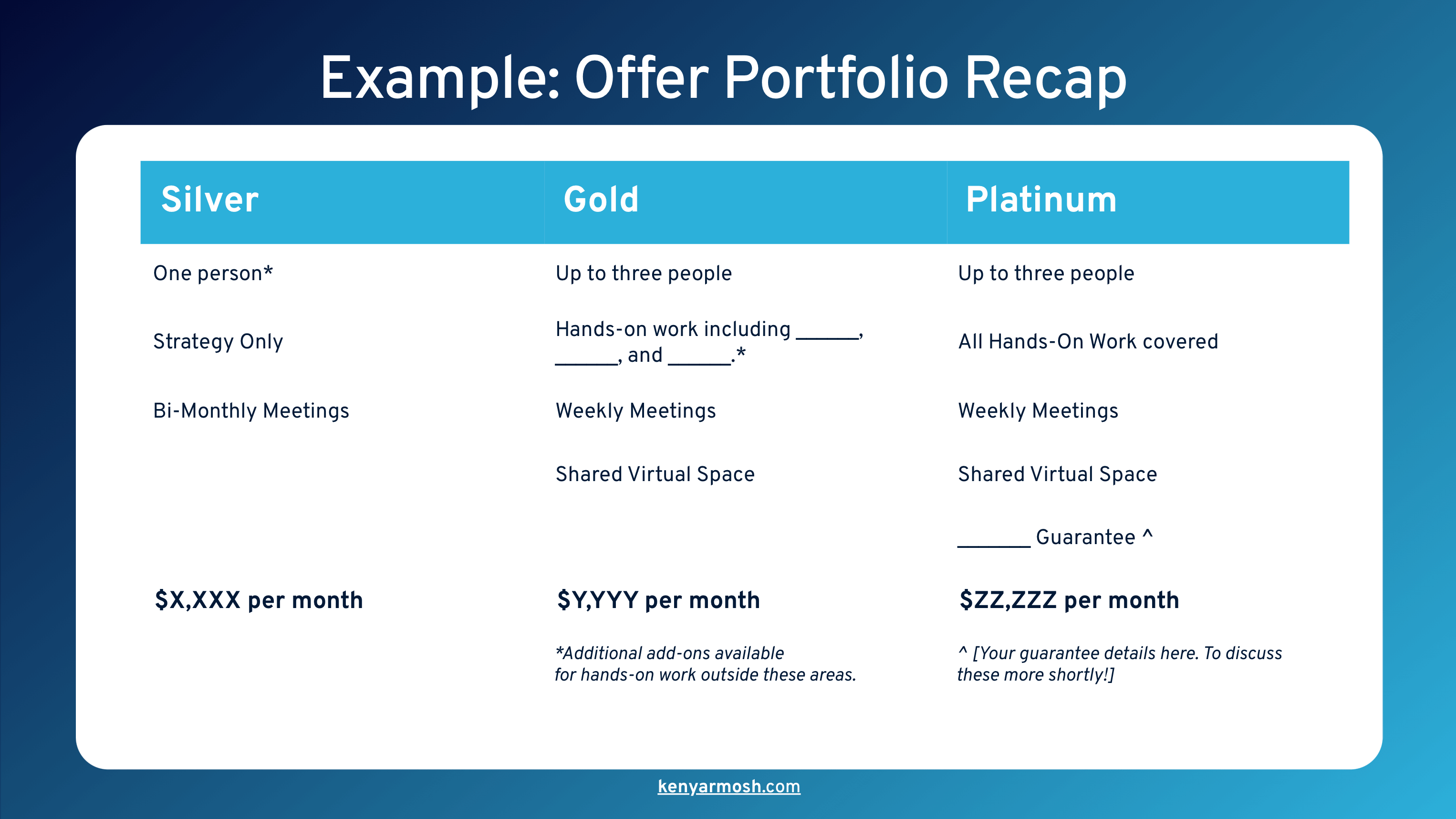
The Premium tier is often the decoy. It exists to make Core feel like the smart, balanced choice. Prospects see Foundation as "bare minimum," Premium as "maybe too much," and Core as "just right."
This works because the human brain avoids extremes. When you price strategically, you control which option feels like the natural middle ground.
4. Bundling and partitioning
Bundling combines multiple services into one price to increase perceived value. And partitioning breaks the price into components to justify the total and make transactions smoother.
When I bundle, I'm creating an offer where the whole feels greater than the sum of its parts. "Strategy + Implementation + Support: $15,000" signals comprehensiveness. Listing each service separately at lower prices might total the same amount, but it reduces perceived value.
Bundling works when clients want simplicity and you want to move them up-market. It's harder to negotiate bundles because you're not selling line items—you're selling an integrated solution.
Partitioning does the opposite. It shows exactly what they're paying for: "$15,000 broken down as: Strategy ($4,000) + Implementation ($8,000) + Support ($3,000)." This transparency builds trust and reduces price shock.
Use bundling for premium clients who value seamless delivery over itemized costs. Use partitioning when prospects need to see the real difference between your offer and cheaper alternatives.
5. Installments and payment framing
Breaking a large price into smaller installments reduces cognitive friction and gets consumers into action faster. "$12,000" feels heavy. "$1,000/month for 12 months" feels manageable.
It's about perception. The same client who balks at $12,000 upfront will commit to $1,000/month because the mental math feels different.
I offer payment plans whenever necessary. Not because clients can't afford the full amount, but because it removes the objection before it forms. They can say yes now instead of waiting for "the right time" that never comes.
Frame installments in terms that match your engagement model. Monthly retainers naturally fit monthly payments. Project-based work can be split into milestones. Even annual programs work when framed as "just $X per month."
This significantly increases conversion rates—sometimes by 30-40%—because you're reducing the psychological weight of the decision. Just make sure your payment terms protect your business. I structure agreements so the total commitment is clear and early termination doesn't leave me exposed.
6. Value-based pricing
Value-based pricing ties your fee to outcomes rather than effort but can also drive complexity in your sales process. This method requires you to collect considerable information upfront and then demonstrate why you can charge more to a prospect. But it’s harder than most realize to build a value equation that makes sense to prospects
Instead of value-based pricing, which is overly complex, I recommend offer-based pricing.
For example, when I work with solopreneurs who tried value-based pricing, they love the simplicity of offer-based pricing comparatively. It gets the same result without having to do value equations. They no longer battle to convince prospects that they're worth more due to outcomes. When you can tie your work to measurable business outcomes, use offer-based pricing instead.
7. Context and comparison
How prospects perceive your price depends entirely on what they're comparing it to. Control the comparison, and you control the conversation.
I never let clients compare my services to commodity alternatives. When positioning, I compare my approach to building the capability in-house, hiring full-time, or the cost of not solving the problem at all.
"You could hire a full-time strategist at $150,000/year plus benefits—or we solve this in 90 days for $30,000." Suddenly $30,000 isn't expensive. It's efficient.
Context also means sequencing. In proposals, I present the scope and transformation first, then the investment. By the time they see the number, they've already imagined the outcome. The price becomes a bridge to that future, not a barrier.
Pricing examples from your industry matter too. If competitors charge $3,000 for similar work, acknowledge it—then explain why you're different. "Most consultants charge $3,000 for a generic playbook. We charge $15,000 because we customize everything to your business and stay with you through implementation."
You're not justifying the price. You're reframing the comparison so they see a real difference, not just a number.
Use pricing psychology to attract the clients you actually want
Price isn't rational. Your clients aren't doing cost-benefit analyses before they decide. They're asking whether the investment makes them feel like the person they want to become.
When you understand that, everything changes.
You stop justifying every dollar and start positioning with confidence. You stop competing with cheaper alternatives and start controlling the comparison. You stop hoping the right clients find you and start filtering for them with strategic pricing.
The solopreneurs who master pricing psychology build better businesses with clients who value their expertise.
Use these tactics to position yourself strategically, filter for premium Lighthouse Clients, and finally charge what you're worth.
Because at the end of the day, the price you set is a reflection of the value you believe you create. When you believe it—and price it accordingly—your clients will too.
