
🚀 TL;DR
- New consultants get stuck because they price for safety (low rates) instead of pricing with a clear strategy tied to outcomes.
- You don’t need years of experience to justify your rates—you need clarity on the problem you solve, the result you deliver, and what the client walks away with.
- Start with a simple model (hourly or project) to build momentum, then evolve toward retainer or offer-based pricing as you gather proof and refine scope.
- Anchor your price to business impact (value) rather than credentials, and make the first offer low-friction with tight scope, clear deliverables, risk reducers, and a short timeline.
- Use early clients to build evidence (testimonials + metrics), then raise prices when traction proves the offer is stronger—aiming for a healthy close rate, not instant yeses.
I've mentored over 550 consultants, and the ones who struggle most aren't the ones with weak or no sales skills. They're the ones who price for safety instead of pricing to grow.
When you're starting your consulting business with no case studies or client testimonials, pricing feels like guessing. You look at what others charge and wonder if you're allowed to ask for the same. So you lower your hourly rate, trim your project fee, and hope someone will take a chance on you.
That’s the wrong way to go about it.
Your lack of a track record isn't the problem. Your lack of a clear pricing strategy is.
I've been building businesses since 2005 and scaled multiple seven-figure operations. The consultants who win aren't the ones with the longest résumés. They're the ones who know how to position their value from day one.
You don't need three years of client work to justify your consulting rates. You need clarity on what you're solving and a pricing model that aligns value with the scope of work.
In this guide, I’ll show you how to price consulting services whether you feel you have “no experience” or have been an entrepreneur for years, in just 7 steps.
1. Clarify what you're actually selling
You can't rely on proof when you have no portfolio or case studies. You can depend on clarity.
New consultants talk about themselves—their process, methodology, and approach. Clients don't care about that until they understand what they're getting.
Lead with the outcome.
If you're a marketing consultant, you're not selling "strategic marketing advice." You're selling more qualified leads. If you're a fractional COO, you're not selling "operational support." You're selling smoother workflows that save 10 hours a week.
Strip your offer down until it's obvious:
- What problem you solve
- What result the client gets
- What they walk away with
Your pricing strategy starts there, not with hourly rates or fixed fees, but with a clear understanding of the transformation you're creating. Once you know what you're selling, pricing reflects that outcome—not a guess based on what you think you're worth.
Clients don't buy hours. They buy results.
2. Choose a simple, low-friction pricing model
New consultants overcomplicate pricing. You don't need retainer fees or performance-based structures on day one.
You need momentum.
Although it’s not what I ultimately recommend, start with project-based pricing or hourly pricing. Both give you flexibility while learning what your market will pay and how long work takes.
Project-based pricing works when you have a defined scope of work and clear deliverables. You name the project fee upfront, the client knows what they're getting, and you're not nickel-and-diming them with hourly billing. Write a solid statement of work to protect against scope creep.
Hourly pricing makes sense when the scope isn't clear or clients want ongoing support without a full retainer. The downside is that hourly billing ties income directly to time, limiting your ability to scale. Use it as a stepping stone, not forever.
Avoid complex models early on. Cost-plus pricing, dynamic pricing, penetration pricing—these are distractions. You don't have enough data yet.
Once you've completed a handful of consulting projects, evolve toward retainer or offer-based pricing and keep steering clear of value based pricing. Those models reward simplicity and outcomes instead of hours worked or pricing complexity.
For now, pick the model that gets you moving fastest.
3. Anchor your price in value, not credentials
Nobody pays for your time. They pay for the outcome.
When you feel inexperienced, your instinct is to undercharge. Don't. Instead, build a clear bridge between your price and the result you help deliver.
You're not pricing yourself. You're pricing the problem you solve.
If you help a client increase revenue by $50,000, your consulting rates shouldn't be based on how many years you've been consulting. They should be based on a fraction of that $50,000 gain. If you help them avoid a $20,000 mistake, that's your anchor point.
Here's how to think about it:
- Identify the financial impact of the problem you're solving
- Price at 10-20% of that value as a starting point
- Communicate this clearly in your proposal
Client expectations shift when you tie your price to the client's outcome instead of your résumé. They're no longer evaluating your credentials. They're considering whether the result is worth the investment.
This approach works even without case studies because you focus the conversation on their situation, not your history.
Value-based pricing isn't just for experienced consultants. It's for consultants who understand what they're solving.
4. Design an offer that's easy to say yes to
When you don't have a track record, your best play is to reduce friction.
Package your services into something that feels low-risk but high-reward. Clarity plus specificity plus trust-building equals conversion.
Make your first offer an obvious yes:
- Define the scope tightly. Don't promise to "fix everything." Focus on one specific outcome. A 30-day LinkedIn visibility audit. A pricing model overhaul with three tested options. One sales process documented from lead to close.
- Include a clear deliverable. Clients need to know exactly what they're getting. A strategy document. A system blueprint. A prioritized action plan with next steps.
- Add a risk-reducer. This could be a money-back guarantee, a pilot phase at a reduced rate, or a "pay for results" structure where part of your fee is contingent on hitting agreed metrics.
- Cap the timeline. Fixed timelines reduce perceived risk. A two-week engagement feels manageable. A six-month commitment feels like a marriage.
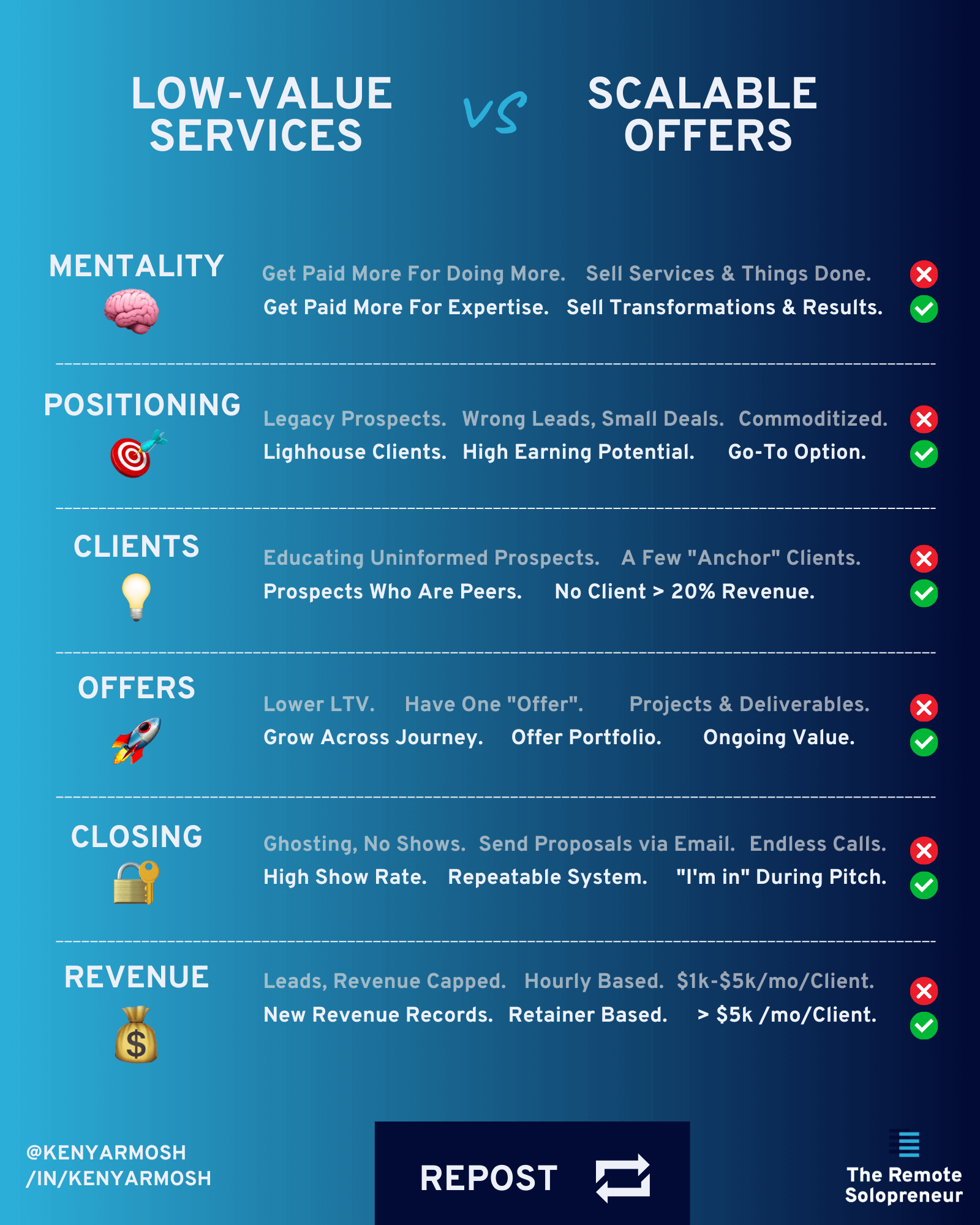
The goal is to make the decision easy. When clients can clearly see what they're buying, what it costs, and what happens next, hesitation drops.
Your offer becomes a no-brainer—not because it's cheap, but because it's clear.
5. Study the market, but don't copy it
You should know what others in your niche charge. But don't let it dictate your price.
Use competitive research to inform your strategy, not to fuel imposter syndrome.
Look at industry averages to understand the range.
Are fractional CMOs in your target market charging $150/hour or $300/hour? Are consulting projects typically $5,000 or $25,000? This gives you a baseline, but it's not your ceiling.
Market research shows you what's usual. Market positioning shows you how to charge more than normal.
Here's what matters more than industry benchmarks:
- The urgency of the problem you're solving
- The confidence you can deliver something meaningful
- The clarity of your offer
I've seen new consultants charge premium pricing from day one because their positioning was tight. They weren't competing on credentials. They were competing on specificity.
If every other consultant in your space offers "general business strategy," and you offer "a scalable pricing model for SaaS companies under $2M ARR," you can charge more. Specificity creates perceived value.
Don't anchor yourself to what others charge just because you're new. Anchor yourself to the outcome you deliver and the client's alternative options.
6. Use early clients to build proof, not just cash
The first few clients aren't just revenue. They're data.
Treat early projects as leverage-building tools. Capture testimonials, distill wins, and use those results to justify raising your price.
After every engagement, ask for:
- A written testimonial (specific results, not generic praise)
- Permission to use their name and company (if possible)
- Metrics that show impact (even small wins count)
These become your proof. When you can say "I helped a client increase their close rate by 15% in 30 days," you're no longer selling without a track record. You're selling with evidence.
Document everything. The problems you solved, the systems you built, and the objections you overcame. This becomes your case study library—even if you only have three clients.
Early consulting work is your testing ground. You're learning what resonates, delivers results, and what clients are willing to pay. Each project should make the next one easier to sell and more expensive to buy.
Don't stay in "building proof" mode forever. After 3-5 clients, you have enough evidence to raise consulting rates and shift your positioning.
Think of these first engagements as your market research budget. You're getting paid to learn what works.
7. Raise your price when the offer deserves it
Don't raise prices just because you "want to." Raise them because the offer has evolved.
As your positioning sharpens and results accumulate, your pricing power grows. The real signal isn't time. It's traction.
Here's when to increase consulting rates:
- You're closing deals consistently (low resistance means you're underpriced)
- You have testimonials and measurable outcomes
- Your offer is more defined than when you started
- You're turning away work because you're at capacity
If prospects say yes immediately without pushback, you leave money on the table. A healthy close rate for premium consulting is around 30-50%. If you're closing 80% of deals, raise your price.
Market conditions matter too. If demand in your niche is rising or if you're getting referrals without effort, that's a signal to adjust pricing upward.
Don't apologize for raising rates. Position it as a reflection of the value you've now proven to deliver. Clients who've worked with you understand. New clients only see the current offer and current pricing.
Increase project rates by 20-30% after every 5-10 clients until you hit resistance. Then you've found your market ceiling—for now.
Your revenue goals should guide this, too. If you want to hit $100K annually and can realistically handle 20 consulting projects, your average project fee is $5,000. Work backward from the goal.
Confidence isn't a luxury—it's a strategy
Pricing isn't just a numbers game. It's a clarity game.
You don't need years of experience to price confidently. You need a clear offer, a simple pricing model, and the ability to articulate the outcome you deliver.
The consultants who struggle with pricing are the ones still guessing. The ones who win stopped treating their rates like a personal worth statement and started treating them like a business decision.
You're not "charging as a beginner." You're solving problems with precision.
Start with clarity, pick a low-friction pricing model, and anchor your price in the value you create. Your first few clients will give you the proof you need to raise consulting rates and refine your positioning.
Confidence doesn't come from experience. It comes from knowing exactly what you're selling and why it's worth the price.
