
🚀 TL;DR
- Hourly billing caps income and ties growth directly to time worked.
- It penalizes efficiency by paying experts less as they get faster and better.
- Clients and consultants end up misaligned, creating friction, mistrust, and constant scope debates.
- Market shifts like automation and AI make hourly pricing increasingly obsolete.
- Offer-based pricing replaces time with outcomes as the unit of value.
- Standardized, scoped offers create leverage, predictability, and higher margins.
You may not realize it but hourly billing penalizes you for getting better at your job.
The more efficient you become, the less you earn. Master your craft in half the time? You just cut your income in half.
I’ve watched this pricing model destroy hundreds of talented consultants over the years. They fill their calendars with billable hours, hit an income ceiling, and realize the only way forward is to work longer or raise rates, only to have clients push back.
That’s why you need to stop selling time and start selling outcomes.
In this guide, I'll show you why hourly billing doesn’t work for solopreneurs and what to do instead.
Why hourly billing doesn't work for solo businesses
It ties growth to your time
You have 168 hours in a week. Sleep takes 56. Personal life takes another 40 if you're lucky. That leaves 72 hours at most for billable work—and nobody actually bills 72 hours a week without burning out.
Let's say you bill $150 per hour and manage 30 billable hours weekly. That's $4,500 a week, $234,000 annually. Sounds solid until you realize you've hit your ceiling. The only way to earn more is to work more hours or raise your rate high enough that prospects start walking.
I've seen consultants push to 40, then 50 billable hours per week. They burn out within months. The ones who survive long enough to raise rates discover that clients have internal budget caps tied to hourly billing. Once you cross $200 or $250 per hour, procurement teams start asking questions.
Your growth is literally capped by the clock.
It punishes efficiency and expertise
Here's the part that breaks most consultants: getting better at your work costs you money.
Hourly billing creates an incentive structure in which slow, inefficient work pays more than fast, expert work. You're financially rewarded for taking longer and penalized for developing mastery. That's not a business model. That's a trap disguised as transparency.
The better you get, the less you should work.
It creates unpredictability and risk
Clients hesitate to approve additional work because they don't know if it'll cost $500 or $5,000. You hesitate to dive deeper into problems because you're worried about scope creep and client pushback. Every conversation about expanding the project becomes a negotiation instead of a collaboration.
I've watched consultants spend more time defending their hours than actually delivering value.
Time tracking becomes the primary evidence of work done, not outcomes achieved. That shifts focus from "Did we solve the problem?" to "Did you really need 12 hours for that?"
This also makes your income unpredictable. You can't forecast revenue reliably because billable hours fluctuate based on project complexity, client responsiveness, and dozens of variables outside your control. Cash flow management becomes guesswork.
It misaligns incentives with clients
Your clients want projects done quickly and efficiently. You get paid more when projects take longer. That fundamental misalignment shows up everywhere.
When a client asks, "How long will this take?" you're incentivized to pad your estimate. When you find a faster solution, you're financially punished for implementing it. When the scope expands, you benefit while your client's budget shrinks.
This creates a trust gap that's hard to overcome.
Your clients scrutinize your time sheets, question your efficiency, and push back on hours every single time. You eventually start feeling defensive about your time investment and resentful when clients challenge your billing.
The entire relationship becomes transactional instead of collaborative. You're not partners solving a problem together—you're a contractor watching the clock while your client watches the budget.
Market and technology shifts make it worse
Automation and AI are making services faster to deliver. For hourly billers, that's a nightmare.
As tools let you accomplish in 2 hours what used to take 20, your revenue drops proportionally—even though the client outcome remains identical.
Clients increasingly expect fixed pricing and a clear scope of work. They've been burned by open-ended hourly engagements that spiraled out of control.
The market is evolving away from hourly billing, while most consultants remain stuck in it. That gap is creating a two-tier market: consultants who sell outcomes at premium prices and consultants who sell time at commodity rates.
Time is getting commoditized. Expertise and outcomes are what command premium pricing now.
How to move away from hourly billing to offer-based pricing
The highest-earning consultants I know don't charge by the hour. They sell offers—scoped, packaged, and priced around outcomes rather than effort.
This shift requires rethinking how you structure, position, and price your work. Not incrementally adjusting your hourly rate, but fundamentally changing what you sell and how clients buy it.
Start with the outcome, not the activity
When you lead with hourly rates, you're positioning yourself as labor. When you lead with outcomes, you position yourself as the solution to a specific problem. That distinction changes everything about how clients perceive your value.
Start by identifying what your clients actually want:
- Revenue growth
- Operational efficiency
- Market positioning
- Risk mitigation
- Competitive advantage
Then frame your work around delivering that outcome. Not "I'll spend 40 hours on your marketing strategy." Instead, "I'll create a go-to-market strategy that generates qualified leads within 60 days."
Turn your service into a named offer
When someone asks what you do and you say, "I'm a consultant," they have no idea what that means or who to refer you to. When you say, "I run the Revenue Recovery Intensive for SaaS companies losing deals in the final stages," they immediately understand your value and can spot opportunities.
Give your offer a name that signals the transformation:
- 90-Day Positioning Intensive
- Revenue Recovery Program
- Operations Overhaul Sprint
A named offer does three things. It forces you to clarify what you're actually selling. It creates referability, and people can remember and repeat it. It positions you as someone with a methodology, not just generic skills.
Price your offer based on the outcome
Value-based pricing means charging for the outcome you create, not the hours you invest.
If you help a client generate an additional $500K in revenue, your fee should reflect that value—not the 30 hours you spent creating the strategy. If you save them six months of operational mistakes, that's worth significantly more than your billable hourly rate.
When pricing transformation, consider:
- What's this outcome worth to the client financially?
- What would it cost them to figure this out on their own?
- What's the cost of not solving this problem?
- What premium should expertise command over effort?
Your pricing should reflect the value created, not the labor costs involved. This is how you escape the income ceiling that hourly billing creates.
Limit the scope of the project
Fixed-fee contracts work when you define clear boundaries around what's included and what's not.
Scope creep kills profitability for consultants who don't set boundaries. That's why you need a crystal-clear scope definition with additional work priced separately.
Define your scope around:
- Specific deliverables (one strategy document, three revision rounds, two implementation calls)
- Clear timeline (90-day engagement with defined milestones)
- Communication boundaries (weekly check-ins, async updates via email)
- What's explicitly excluded (ongoing management, additional research, tech implementation)
I use what I call "Scalable Service Offers." Everything fits in a defined container with clear inputs, processes, and outputs. Clients know exactly what they're getting. I know exactly what I'm delivering. There's no ambiguity about where the project ends.
When clients want more, that's a separate conversation with separate pricing. You're being professional about the scope of work and profit margin.
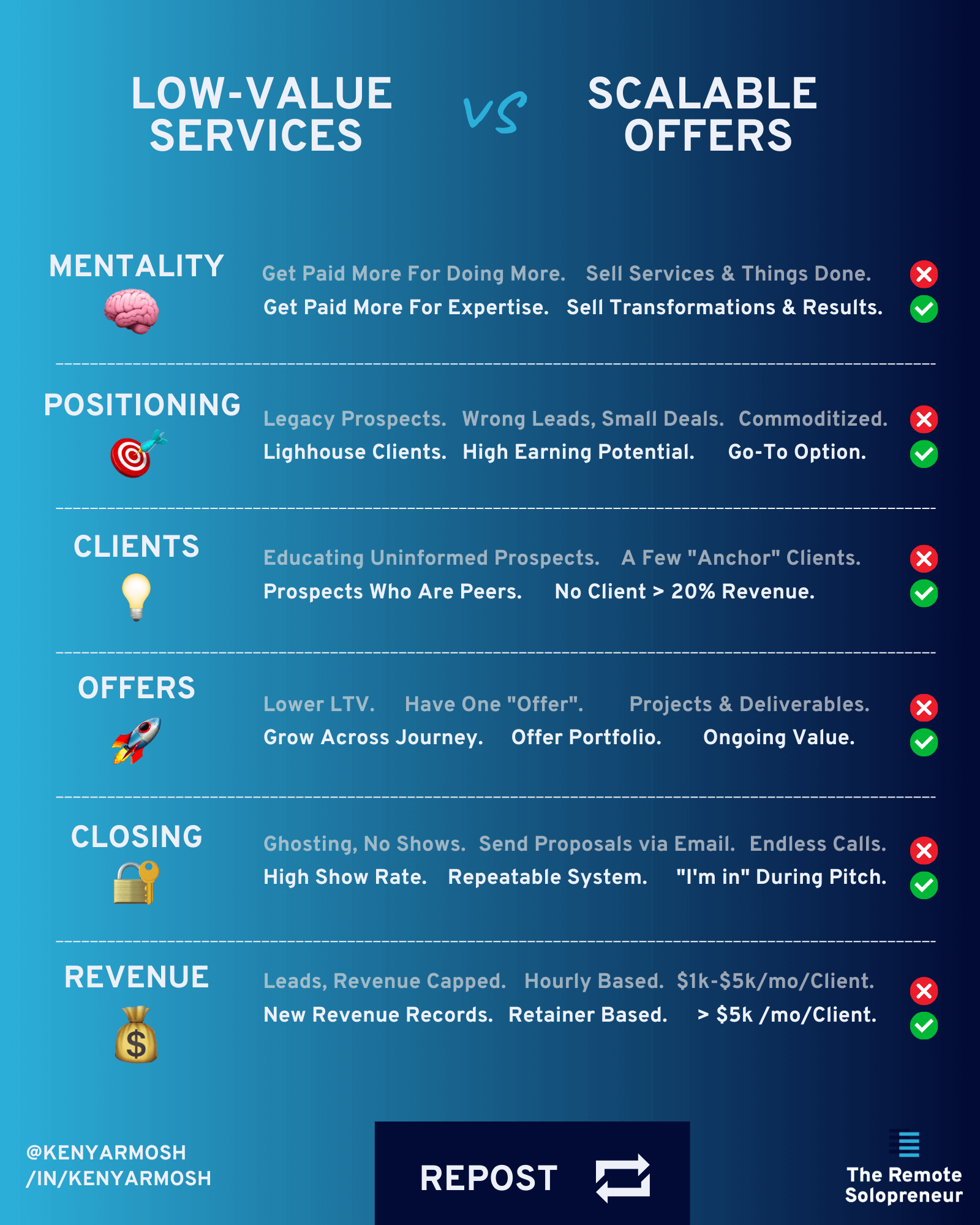
Make the offer as clear as possible
Your offer should pass the "Can my prospect explain this to someone else?" test. If they can't clearly articulate what they're buying, they won't buy it.
Make your offer immediately clear:
- What problem does this solve?
- Who is this for specifically?
- What's included in the engagement?
- What's the timeline from start to finish?
- What outcomes can they expect?
When prospects understand exactly what they're buying and why it matters, price objections drop significantly.
Stop customizing everything
I’ve seen solopreneurs customize everything for every single prospect they work with. Every client got a bespoke approach, unique deliverables, and tailored processes. But in reality, it just stops them from building any leverage.
The shift: standardize 80% of your delivery and customize the remaining 20%.
Your core methodology, frameworks, and deliverables should be consistent across clients. The customization comes in application—how you adapt your proven approach to their specific situation. This gives clients the benefit of your experience and expertise while maintaining your efficiency and profit margin.
When I work with consultants on their offers, we identify:
- Core frameworks that apply across all clients
- Standard deliverables that can be templated
- Processes that can be systematized
- Areas where customization actually adds value
Standardization isn't about cookie-cutter service. It's about delivering proven approaches efficiently so you can focus your expertise where it matters most.
Stop selling time, start selling transformation
Hourly billing looks safer than it is. The transparency feels good. Clients understand what they're paying for. You can track everything precisely.
But that safety comes at the cost of growth, leverage, and sustainability.
The transition from hourly billing to offer-based pricing requires rethinking your entire business model. You need to fundamentally change what you sell and how you sell it.
Take one service you currently bill hourly. Package it as an offer this week. Name it. Define the outcome. Set a fixed price. Pitch it to your next prospect.
That's your first step out of the hourly billing trap.
