
🚀 TL;DR
- Most consultants use AI like a faster Google, which amplifies chaos instead of building leverage.
- AI delivers real ROI only when embedded into systems trained on your workflows, data, and expertise.
- Chasing tools, prompts, and novelty distracts from building the few systems that actually compound.
- Generic AI assistants produce generic results; specialization is the competitive advantage.
- The consultants who win in 2030 will architect AI-powered systems, not just use AI tools.
15% of the working world is using AI tools. Almost nobody is using them in a way that will actually build a 2030 consulting business.
As a lifelong technologist hired by PBS, Levi’s, Toyota, and more, I'm now watching an industry of smart consultants throw thousands at artificial intelligence in the name of subscriptions, plugins, automation stacks, only to feel more overwhelmed than before. They're treating AI like an overpriced version of Google. Asking for summaries. Content ideas. Quick fixes.
"AI isn't working for my business."
I hear this constantly. And they're half right.
AI is working exactly as designed. It's amplifying the absence of systems. Scaling whatever you feed it —which, for most consultants, is chaos wrapped in clever prompts.
The founders pulling away aren't asking AI to solve tasks. They're integrating AI systems into their workflows. Building specialized tools trained on their business, their clients, and their patterns.
That's the specialist era of AI. And the gap between generalist users and specialist builders?
That's the story of the next decade.
Here are some of the most common mistakes I see solopreneurs, founders, and consultants make with AI and how to fix them:
1. Treating AI like an overpriced version of Google
You open ChatGPT. You ask it to summarize something, draft an email, or give you marketing ideas. It spits out an answer. You copy-paste. Move on.
That's not AI adoption. That's expensive Googling.
The consultants stuck in this pattern are solving surface-level problems while ignoring the deeper operational gaps in their consulting business. They're getting answers without building anything that lasts.
How to fix it:
Stop using AI for one-off tasks and start using it to build systems. The real ROI from generative AI comes when you design tools that integrate into your workflow—not when you chase clever prompts that feel productive but create nothing durable.
Ask yourself: What's one repeatable process in my business that AI could run without me? Start there. Build that. Then move to the next one.
2. Solving $50,000 problems with $500 of effort
I’ve seen clients build beautiful AI setups, but for something that’s not even a core part of their business.
They'd lovingly built a Ferrari engine to power a golf cart.
This happens constantly. Consultants get excited about AI implementation and pour hours into automating something that has zero impact on revenue, client results, or business strategy.
How to fix it:
Before you build anything, ask: Does this actually matter to my business? Is this a $500 problem or a $50,000 problem?
Be disciplined about where you deploy AI solutions. Only implement where it accelerates or compounds results.
If automating a task won't meaningfully change your income, client experience, or capacity—skip it. Your time is an asset. Spend it on AI projects that move the needle.
3. Chasing novelty instead of building durable systems
New AI tools drop weekly. New prompting techniques. New plugins. New "game-changing" features.
And consultants chase all of it.
They optimize for $500 problems but want to hit $50,000 months. They build clever prompt stacks instead of solving real bottlenecks. They're so busy experimenting that they never actually finish anything.
Meanwhile, the one system—not the 27 clever hacks—that would erase their biggest problem entirely? Never gets built.
How to fix it:
Don’t treat prompts like the crown jewels. You need three things:
- Data
- Real-world context
- Workflow knowledge
Stop chasing AI updates and start codifying what you actually know.
Build specialized GPTs trained on your consulting expertise, your client patterns, and your frameworks. That's product development that compounds.
One system that runs without you beats fifty clever prompts you have to babysit.
4. Using one generic AI assistant for everything
When I want to write an app script, I turn to Claude Code, not ChatGPT. When I finish a sales call, I don't download the transcript and push it into a generalized AI chatbot. Fathom gives me a specialized GPT for processing sales call transcripts using proven methodologies right in its interface.
Most consultants do the opposite. One AI assistant for proposals, client emails, research, content, and operations. They're asking a generalist to do specialist work and wondering why the output feels generic.
How to fix it:
Create a fleet of specialized assistants, each trained for specific business functions. One for sales conversations. One for content generation. One for client delivery.
This is the era of AI ecosystems, not one-size-fits-all tools.
The Big Four consulting firms figured this out years ago with their internal systems. You can build the same thing—smaller, leaner, tuned to your consulting expertise.
5. Thinking tools will save you without systems thinking
AI tools are only as good as the systems you build around them.
I see this constantly: consultants buy the subscription, watch the tutorials, and even get some early wins. Then nothing changes. They're still doing things manually "because it's easier" than properly setting up the automation.
The tool sits there. Unused. Another line item on the credit card.
This isn't a technology problem. It's a systems problem.
Without documented workflows, clear inputs, and defined outputs, even the best AI solutions become expensive shelfware.
How to fix it:
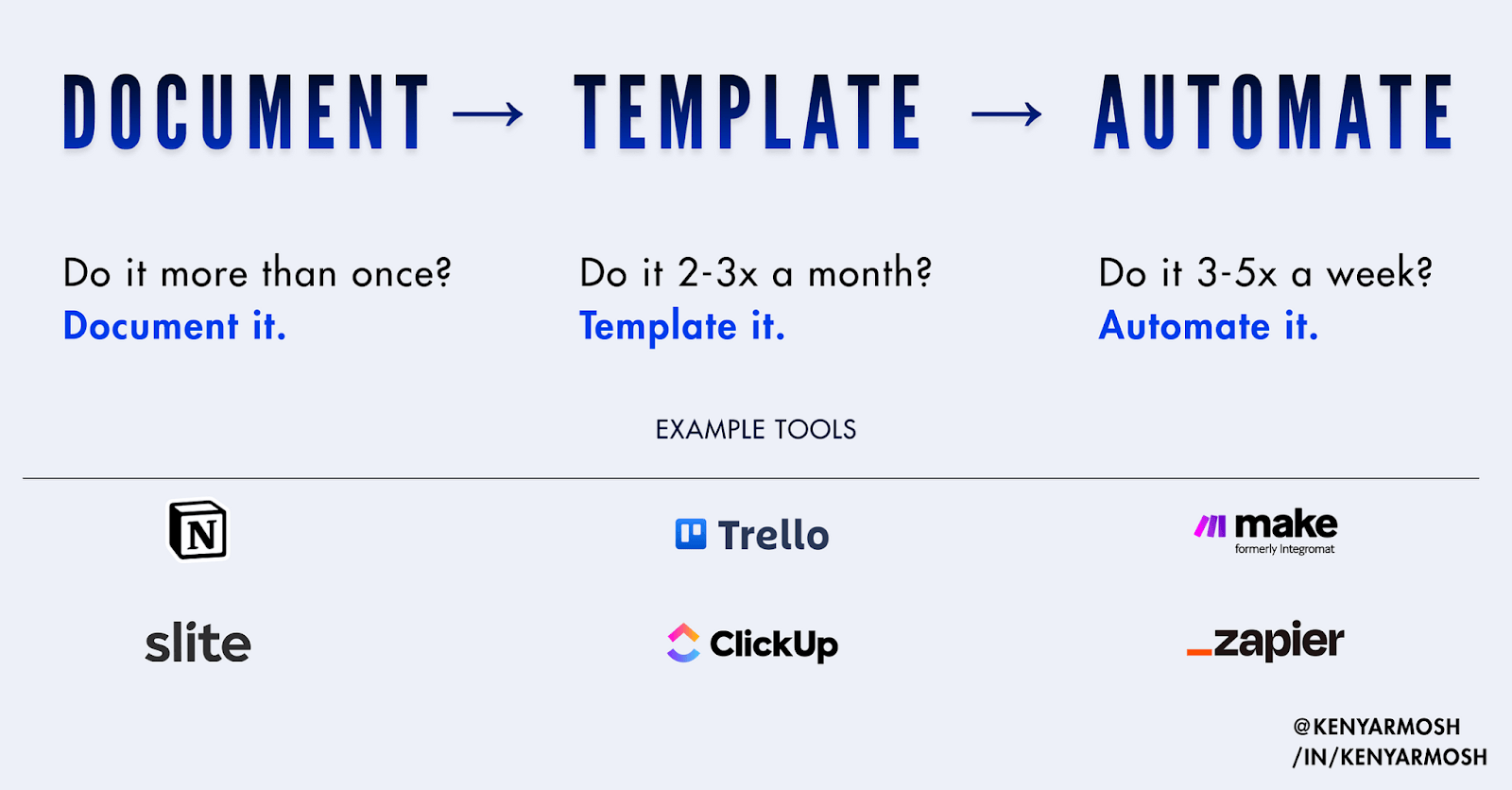
Before you automate anything, document it. What are the inputs? What decisions get made? What's the output?
My Document → Template → Automate framework exists for exactly this reason. You can't automate what you haven't defined. Build once, then scale. That's how system integration actually works—not by throwing AI at undefined processes and hoping for clarity.
6. Not building around your Lighthouse Client
Generic AI systems produce generic results. And generic results don't win premium clients.
Most consultants build AI workflows for "clients" in the abstract. They're not thinking about the specific transformation their best-fit prospects actually pay for.
So their AI-generated content sounds like everyone else's. Their proposals miss the mark. Their delivery systems don't match what Lighthouse Clients actually value.
How to fix it:
AI systems become powerful when they're tuned to the patterns of your ideal client. Stop building for the average. Start building for the specific.
What problems does your Lighthouse Client wake up worried about? What language do they use? What does success look like in their world?
Feed that into your AI. Train your systems on real client conversations, actual proposals that closed, and delivery frameworks that got results. Data quality matters more than prompt cleverness.
That's how you build AI that sounds like you serving them.
7. Delegating too soon or too late
Some consultants try to scale before they've codified anything. They hire VAs, bring on contractors, or bolt AI onto workflows that don't exist yet. Chaos multiplied is still chaos.
Others wait too long. They're doing everything manually until things settle down, while competitors build leverage that compounds month after month.
Both paths lead to the same place: stuck.
How to fix it:
The sequence matters. Document first. Then template. Then automate. Then and only then, consider whether you need human oversight or additional help.
I've been able to grow without hiring by using AI to replace headcount until it's truly needed. And for most consulting businesses, that point comes much later than you'd think.
AI agent systems can handle more than you're giving them credit for. But only if you've done the work to define what "handling it" actually means.
8. Believing that using AI is the same as being fluent in AI
You use ChatGPT. Great. So does your neighbor's kid.
Using AI tools doesn't mean you understand how to deploy them strategically. There's a massive gap between asking an AI chatbot for help and architecting AI initiatives that change how your business operates.
Most consultants are stuck at the "swinging the hammer" stage. They can use the tool. They can't design it.
How to fix it:
You don't need to become a technologist. But you do need to understand AI conceptually—enough to direct it, evaluate it, and improve it over time.
Move from "AI as a toy" to "AI as infrastructure." That means understanding how large language models actually work, what they're good at, what they're terrible at, and how to feed them the context they need.
Just because you're using ChatGPT doesn't mean anything transparently. You need to move from learning how to swing the hammer to designing the hammer.
9. Confusing output with outcome
AI makes it easy to produce more stuff. And consultants love feeling productive. So they crank up the output—more AI-generated content, more deliverables, more volume.
But output isn't outcome. Your clients don't pay for more stuff. They pay for results.
When you optimize for speed and volume, you often sacrifice the thinking that actually creates value. The supply chain of ideas gets faster, but the quality drops.
How to fix it:
Focus on outcome-oriented systems, not output-heavy sprints. Before you use AI to speed something up, ask: Does doing this faster actually help my client win?
Sometimes the answer is yes—faster turnaround on a pilot project matters. But sometimes the answer is no, and the extra time you save just means you're delivering mediocre work more efficiently.
The real win is when AI helps you deliver better results, not just faster tasks.
Build AI systems as a solopreneur, not stacks
Most consultants will keep treating AI like an overpriced version of Google. They'll chase the next tool, build clever prompt stacks, and wonder why nothing compounds.
You don't have to be like most consultants.
The specialist era rewards those who stop throwing AI at everything and start architecting systems that run without it. One specialized GPT trained on your expertise beats fifty generic assistants. One documented workflow, automated properly, beats a hundred hours of manual effort.
The question isn't whether AI works. It's whether you'll design systems worthy of what AI can actually do.
What's the one system in your business that, if it ran without you, would change everything?
Start there.
