
🚀 TL;DR
- Pricing is one of the strongest signals you send to the market—generic pricing turns you into a commodity, while differentiated pricing positions you as a category of one.
- Pricing differentiation means structuring offers and prices around customer segments, needs, and willingness to pay—not racing competitors to the bottom.
- Tiered offers (intro, core, premium) are the simplest and most effective way for solopreneurs to capture more margin and serve different buyers.
- Most consultants should avoid cost leadership and instead compete on expertise, clarity, outcomes, and positioning.
- When pricing is intentional and clearly communicated, growth comes from higher margins—not more leads or longer hours.
As an agency founder, my average deals were over $200,000. Now as a remote solopreneur, I close six figures in a single month without chasing more leads or working longer hours.
The difference isn’t a better funnel. It's not more traffic. It’s clarity around my pricing differentiation. Specifically, it is how I price my offers and what that pricing communicates to prospects before we ever get on a call.
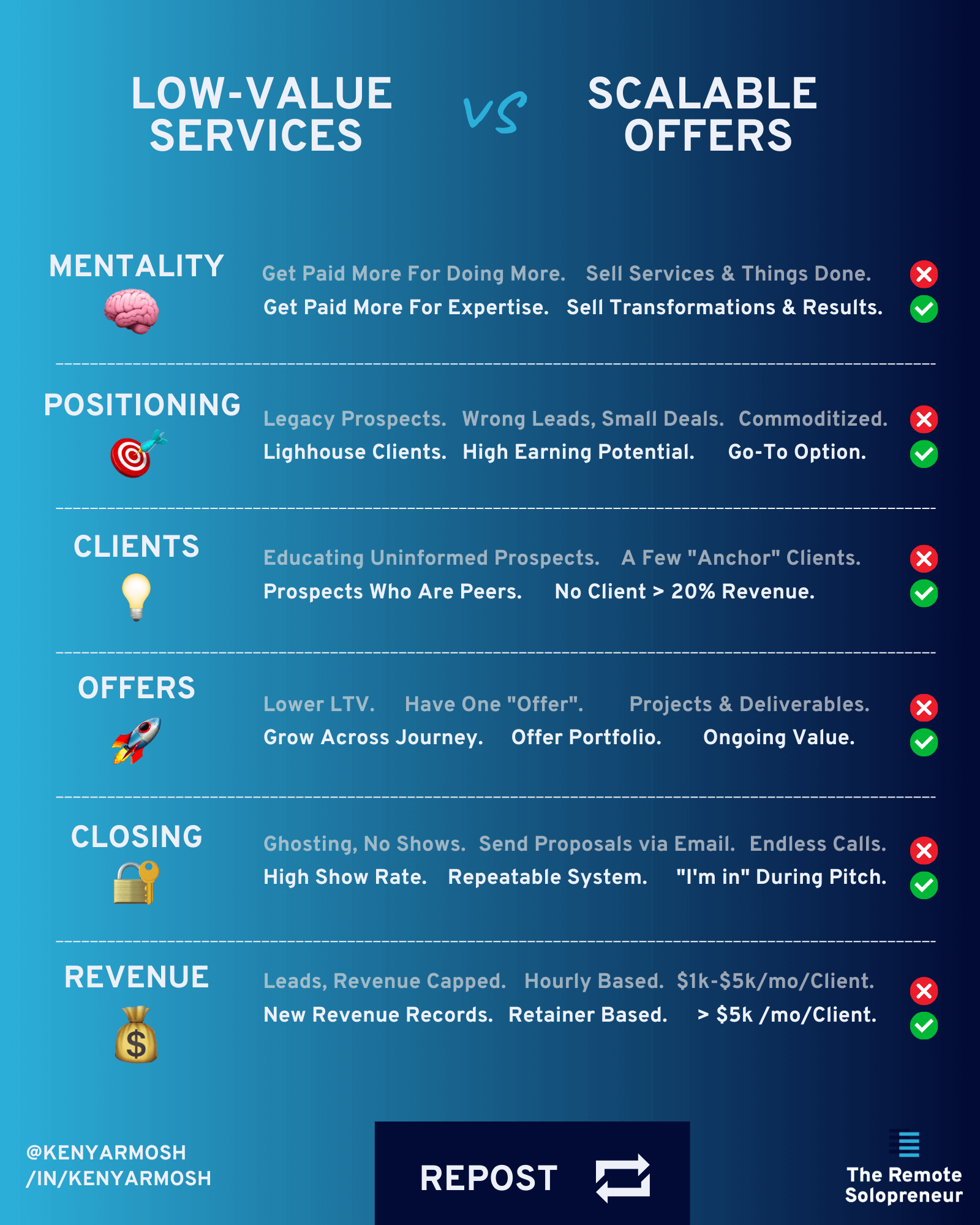
Most service providers treat pricing as an afterthought. Something you figure out by checking what competitors charge, then pricing slightly lower to "stay competitive." That approach turns you into a commodity. And commodities attract price shoppers.
Your price is a signal. It tells the market who you're for, what you stand for, and whether you're worth the conversation.
In this guide, I'll show you how to use pricing as a differentiation strategy and position your offer so it's impossible to compare.
What is pricing differentiation?
Price differentiation means charging different prices or structuring different packages for the same core service based on who's buying, what they need, or the context of the engagement.
Think of it as market segmentation applied to your pricing structure.
A brand strategist might charge $3,000 for a positioning framework, $8,000 for a logo overhaul, and $25,000 for full-service brand development. It’s the same expertise but at different price points based on how deeply the client wants to engage.
Why many solopreneurs default to generic pricing
Fear, mostly.
When solopreneurs start out, they price based on what feels "safe." They look at competitors, pick a number in the middle, and hope nobody will push back. That's how most service providers operate. They anchor to the market instead of anchoring to value.
One-size-fits-all pricing feels simpler. One offer, one price, less to explain. But it leaves money on the table in both directions.
Premium clients who are willing to pay more are undercharged. But budget-conscious clients who need a lighter option get priced out entirely.
Generic pricing is a symptom of unclear positioning. If you don't know exactly who you serve and what outcome you deliver, you default to commodity pricing. And when your offer looks like a commodity, you attract price shoppers who compare you to everyone else.
Why solopreneurs should use pricing differentiation as a growth lever
The easiest path to growth isn't more leads. It's more margin.
When I work with solopreneurs in The Club, one of the first things we examine is their pricing architecture. You need to know how those numbers are structured across different customer segments and willingness to pay.
Differentiated pricing lets you:
- Capture more revenue from clients who value premium experiences
- Serve price-sensitive customers without devaluing your core offer
- Create natural upsell paths as clients see results and want more
- Build customer loyalty by meeting people at their current stage
This is the difference between a cost strategy (racing to the bottom) and a value-based pricing approach. You're not trying to be the cheapest.
You're designing offers that command what they're worth—and giving buyers options that fit their situation.
What are the core approaches to differentiated pricing and positioning strategies?
Not all pricing differentiation looks the same. The approach you choose depends on your market, your offer, and how your customers make buying decisions.
Here are the core strategies that actually work for service providers:
1. Segmenting by customer needs or willingness to pay
Your customers have different amounts of maturity and sophistication. Some need more guidance . Others want to move fast. Some have budget constraints. Others have time constraints and are willing to pay a premium to skip the line.
Customer segmentation starts with understanding these differences.
Group your buyers by where they are in their journey. A consultant might segment by:
- Clients who need implementation support.
- Companies who need strategic guidance.
- Growth-focused businesses that want to go faster.
While the same client type—a Lighthouse Client—each segment has different needs and different willingness to pay.
The goal isn't to serve everyone. It's to serve a distinct client type intentionally, with offers and price points that match their situation.
2. Tiered and versioned offerings
Product versioning is one of the simplest ways to implement price differentiation. You create multiple versions of your core offer—each with clear differences in scope, access, or deliverables.
I recommend three tiers for most service providers:
- Intro tier: A focused, accessible entry point. It's priced lower, has a narrower scope, and is designed to solve one specific problem. This is where price-sensitive buyers start.
- Core tier: Your flagship offer. It’s a comprehensive solution, clear deliverables, and gives buyers the full experience of working with you. This is where most of your revenue should come from.
- Premium tier: Everything in Core, plus extras like faster turnaround, direct access, additional support, or exclusive features. This captures customers who want the best and are willing to pay for it.
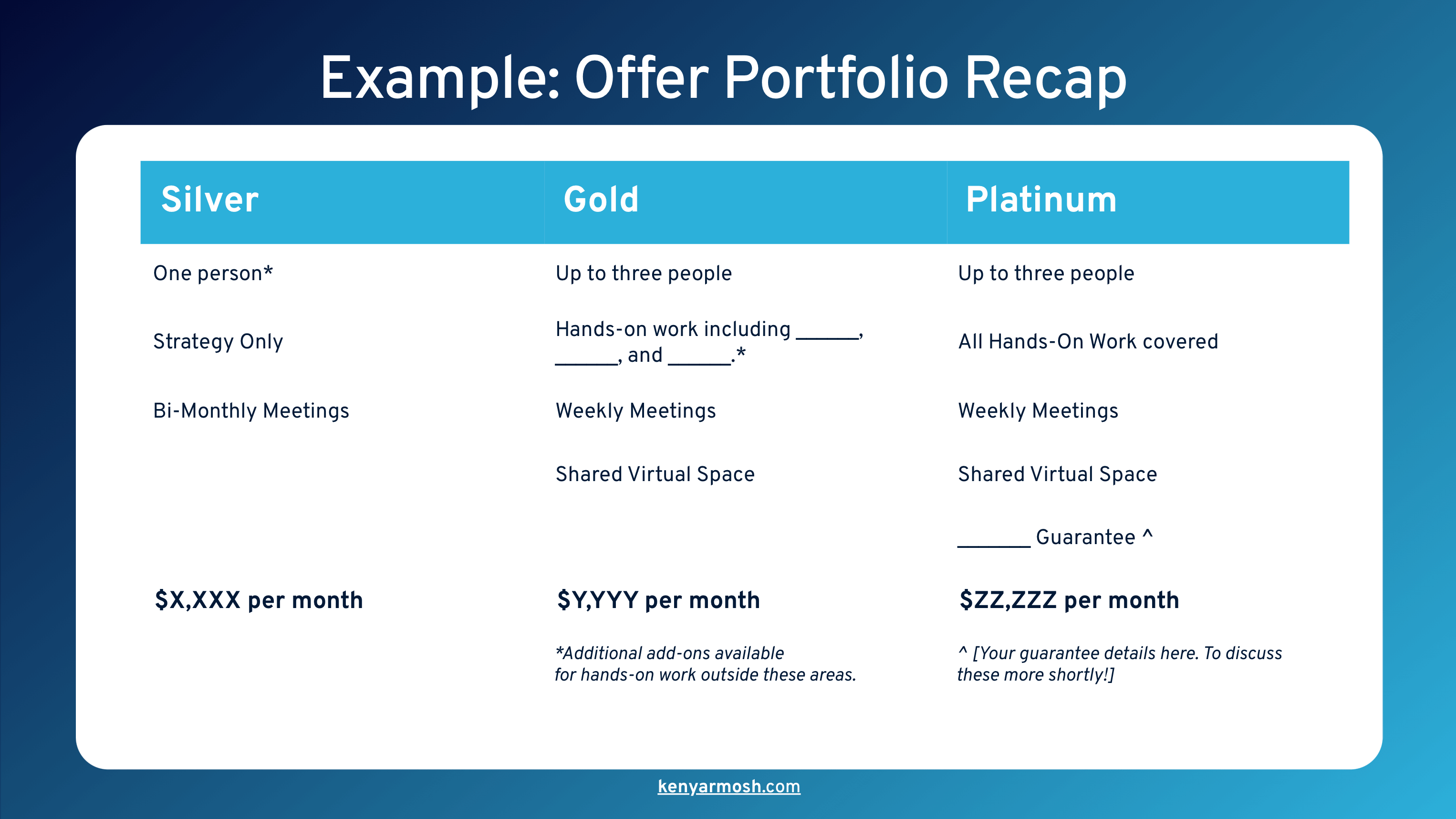
The key is ensuring each tier has a differentiated offering, not just a different price tag.
3. Value-based pricing
Value-based pricing attempts to ask: what is this result worth to the customer?
If your marketing strategy helps a client land $200K in new business, a $15K fee isn't expensive. It's a bargain.
This requires you to understand the customer experience deeply, for example:
- What problem are you solving?
- What does that problem cost them if it remains unsolved?
- What's the upside of getting it right?
That’s where the benefit of value-based pricing ends. In fact, many consultants and founders find it overly complex and difficult to communicate. Instead, I recommend you focus on offer-based pricing., Only then, will you stop competing on cost-effectiveness and start competing on impact. That's a much better position to defend.
4. Differentiation through non-price elements
Price isn't the only way to differentiate. Sometimes, brand differentiation does the heavy lifting.
Consider what else signals value to your target customer segments: product quality, customer service, speed of delivery, depth of expertise, and exclusivity of access. These brand traits compound over time into brand recognition that justifies premium pricing.
I've built my business on being hyper-involved with the people I mentor. That's not a price differentiator—it's a positioning differentiator. It shapes brand perception before price ever enters the conversation.
Your unique value proposition isn't just what you charge. It's how you show up, what you stand for, and how that resonates with the right buyers.
When pricing differentiation works—and when it doesn't
Pricing differentiation isn't a universal fix. It works brilliantly in some situations and backfires in others.
Knowing the difference saves you from expensive mistakes. Here are a few things to keep in mind:
Ideal conditions for solopreneurs
Differentiated pricing works best when your market has natural variation. Different buyers with different needs, different budgets, different levels of urgency.
You're in a good position if:
- Your service solves problems at multiple levels of complexity
- Customers have varying willingness to pay based on their business size or stakes
- You can clearly articulate value differences between tiers
- Your market dynamics support premium positioning for some segments
The more variation in your customer base, the more opportunities there are for price segmentation to capture value you're currently leaving behind.
Avoid confusing customers and undermining brand trust
More tiers don't mean more revenue. Sometimes it means more confusion.
I've seen solopreneurs create five or six pricing options, thinking they're being comprehensive. What they're actually doing is overwhelming prospects and diluting their brand perception. When buyers can't quickly understand which option is right for them, they often choose none.
Over-segmenting also sends mixed signals. You can't claim to be a premium provider while also offering a budget option that undercuts your positioning.
Pick a lane. If you're building a differentiation strategy around quality and expertise, your pricing architecture needs to reflect that—not contradict it.
Trade-offs versus cost leadership or uniform pricing
Differentiated pricing isn't the only competitive strategy. Some businesses thrive as cost leaders with simple, uniform pricing.
If your market is highly price-sensitive and commoditized, competing on cost position might make more sense. A single, transparent price can build trust with buyers who are skeptical of tiered structures.
But for most service providers reading this, cost leadership is a trap. You don't have the cost structure to win a race to the bottom. Your competitive advantage is expertise, not efficiency. That means differentiation pricing—aligned with clear positioning—is usually the smarter play.
5 steps to implement pricing differentiation as a solopreneur
Here's how to actually build a differentiated pricing structure into your business:
Step 1: Understand your value and customer segments
Before you touch your prices, get clear on two things: what you actually deliver and who you deliver it to.
Map out the outcomes your service creates. Not the tasks you perform—the results clients walk away with. Then look at your past clients and identify patterns. Who got the most value? Who was easiest to work with? Who paid without flinching?
These patterns reveal your natural customer segments. It could be by business size, industry, problem urgency, or the amount of support they need. Understanding these segments is the foundation of everything that follows.
Step 2: Create tiered or versioned offers
Now build offers that match those segments.
Start with your core offer. It’s the thing you do best, packaged with clear deliverables and a defined scope. This becomes your anchor.
Then create variations. A lighter version for clients who need less (or have smaller budgets). A premium version for clients who want more access, faster results, or additional deliverables.
Each tier needs a distinct value proposition. The difference shouldn’t be in terms of just "more hours" or "extra calls." The real differences in what the client gets and what outcome they can expect. If the only difference is price, you haven't created product differentiation—you've just created confusion.
Step 3: Price according to offer, not cost
Forget what it costs you to deliver. Focus on what it's worth to them.
A positioning engagement that helps a consultant land their first $50K client is worth far more than the hours it took. So, price the outcome, not the input.
This requires confidence. It also requires you to understand how to monetize value from the buyer's perspective. What does this problem cost them monthly? What's the upside of solving it? What would they pay to make it go away?
When you anchor to value, your pricing stops feeling arbitrary and starts feeling inevitable.
Step 4: Communicate differentiation clearly
Your pricing page isn't just a menu. It's a positioning statement.
Each tier should immediately answer: who this is for, what they get, and why it's worth this price. Buyers should be able to self-select without a sales call.
Avoid vague descriptions. "Premium support" means nothing. "Direct async access with two business day response time" means something. Specificity builds trust and helps buyers understand the real differences between options.
The clearer your communication, the less you have to "sell." The right buyers see themselves in the right tier and move forward.
Step 5: Monitor and adjust based on feedback
Your first pricing structure won't be perfect. That's fine.
Pay attention to which tiers sell and which don't. Listen to objections on sales calls. Track where prospects drop off. This data tells you whether your price segmentation matches the market's actual willingness to pay.
Dynamic pricing doesn't mean changing prices daily. It means staying responsive to what you're learning. If nobody buys the premium tier, either the value isn't clear or the gap between your core offer and it is too wide. If everyone buys premium, you might be underpriced—iterate based on reality, not assumptions.
What are the most common pricing differentiation mistakes?
Pricing differentiation is powerful, but it's easy to get wrong. Here are the pitfalls I see most often:
Over-segmenting or creating too many tiers
Three tiers are usually enough. Four is pushing it. Five or more is almost always a mistake.
Every additional option increases cognitive load for buyers and operational complexity for you. If you catch yourself building elaborate pricing matrices, step back. Simplicity sells.
Undercommunicating differences
If you change the price without changing the perceived value, it’s a recipe for skepticism.
If your tiers look nearly identical except for the number at the bottom, buyers will assume you're just trying to extract more money. Each tier needs visible, meaningful differences.
Otherwise, you're not doing product bundle pricing—you're doing trial pricing without the trial.
Ignoring customer feedback and elasticity
Your pricing exists in a market, not a vacuum.
If prospects consistently balk at a specific tier, that's data. If one option never sells, that's data. Ignoring this feedback because you "know" your value is how you end up with a beautiful pricing page and an empty calendar.
Stay curious. The competitive situation shifts regularly, so your pricing should be able to shift with it.
Failing to deliver the promised value
If your premium tier promises a premium experience and delivers the same thing as your core offer with a fancier label, you'll destroy trust fast.
Clients talk so overpromising and underdelivering on a differentiated offer is worse than never differentiating at all.
Match your delivery to your pricing. Always.
Pricing differentiation as a strategic growth lever
Your price is a signal.
It tells the market whether you're a commodity or a category of one. It attracts specific buyers and repels others—by design. When you treat pricing as a differentiation strategy rather than an afterthought, you stop competing on cost and start competing on clarity.
Th six-figure months I mentioned at the start didn't come from more leads. It came from high-margin offers, clear messaging, and pricing that reflected the value I deliver.
Build your pricing with intention, and you build a business that's impossible to compare.
