
🚀 TL;DR
- Solopreneurs leave money on the table by treating pricing as a one-time decision.
- Pricing optimization is about leverage, not finding a “perfect” number.
- Outcome-based pricing expands the gap between your pricing floor and ceiling.
- Fix the offer and positioning before changing the price.
- Tiered, standardized offers increase margin and customer lifetime value.
- Regular pricing audits and delivery leverage (async, group) unlock scalable income.
Every solopreneur I've worked with has left money on the table at some point.
Not because they delivered bad work. Not because their clients didn't see results.
They left money on the table because they treated pricing like something you set once and never touch again.
I ran a $5M agency before becoming a solopreneur. We had a $296K monthly payroll. I've closed $200K+ deals. Through all of that, I learned something most "pricing experts" won't tell you.
Pricing optimization isn't about finding the perfect number. Your pricing creates leverage in your business. When you price your services the right way, you’ll scale your income without constantly feeding The Hungry Dragon of more hours or more clients.
In this article, I'm walking you through 12 pricing optimization techniques to avoid that.
The basics of pricing for solopreneurs
Solopreneurs operate with fundamentally different economics than agencies or traditional businesses.
When I ran my agency, I had $296K in monthly payroll before a single dollar hit my personal account. Salaries, benefits, health insurance—all overhead that ate into margins before we could even think about profit.
As a solopreneur, those constraints disappear. Your cost structure is lean. Your decision-making is fast. You're not navigating committee approvals or justifying pricing to a board.
That creates both an advantage and a trap.
The advantage is obvious. Lower operating costs mean you can be more profitable with lower revenue. A $200K solopreneur business with minimal overhead can generate more take-home income than a $500K agency with high fixed costs.
The trap is subtler. Many solopreneurs price like freelancers by anchoring to hourly rates, copying competitor pricing, or using cost-plus formulas that cap their earning potential.
Solopreneur pricing isn't about covering costs plus a margin. It's about positioning, leverage, and the transformation you create for clients.
Think about your pricing floor and ceiling:
Your pricing floor includes:
- Direct operating costs (tools, software, contractors)
- Time and energy investment per client
- Opportunity cost of saying yes to one project over another
- Mental bandwidth and decision fatigue (the hidden costs most solopreneurs ignore)
Your pricing ceiling is determined by:
- Market demand for your specific solution
- Customer willingness to pay based on perceived value
- How well you've positioned yourself as the expert
- The transformation you deliver versus alternatives
The gap between your floor and ceiling is where pricing optimization lives.
When you price based on outcomes rather than inputs, everything shifts. You're no longer selling hours or deliverables. You're selling transformation. That reframing allows you to charge premium rates while working less because your value isn't tied to time spent.
12 tips to optimize the pricing of your offers
1. Fix the offer before touching the price
If prospects show resistance to your pricing, it usually means your offer doesn't feel necessary or urgent to them.
If you’re discounting immediately, you’re treating the symptom, not the disease. I've seen solopreneurs double their prices after fixing their offer—and close more deals at a higher rate.
Before adjusting pricing, ask:
- Does my offer clearly articulate the specific problem I solve?
- Does it demonstrate urgency?
- Does it show the exact transformation the buyer will experience?
If you can't answer yes to all three, start with offer design, not price adjustment.
2. Stop selling to the wrong people
Legacy Clients shop on price. Lighthouse Clients pay for transformation.
Your pricing looks broken when you're selling to the wrong audience.
I've helped solopreneurs who thought they had a pricing problem discover they actually had a targeting problem. Once we shifted their positioning to attract Lighthouse Clients, pricing objections disappeared.
Different market segments have different buying behaviors and price sensitivity. You can't command premium pricing while attracting budget-conscious buyers.
3. Use your offer’s quality to justify premium pricing
When I closed $200k+ deals, prospects weren't buying deliverables or hours. They were buying a specific outcome that would fundamentally shift their business.
Offer quality comes from clarity, specificity, and demonstrated expertise. You're not selling "marketing consulting"—you're selling a 40% increase in qualified pipeline within 90 days using a proprietary framework.
That specificity makes the value concrete and positions you as the specialist who has repeatedly solved this exact problem.
4. Avoid random price hikes and build leverage first
You don't raise prices to get leverage. You build leverage, and then pricing increases become natural.
Leverage comes from:
- Systems that reduce your time investment per client
- Documented processes that ensure consistent outcomes
- Reusable assets like frameworks and templates
5. Tier your offers intentionally
A single flat-rate offer leaves money on the table.
Different clients have different budgets, urgency levels, and support needs. Tiered pricing creates choice while guiding prospects toward your preferred option.
Structure offers in three tiers:
- Intro: Solves a specific problem with defined boundaries
- Core: Your flagship comprehensive solution (position as best value)
- Premium: Everything in core plus additional support, speed, or exclusivity
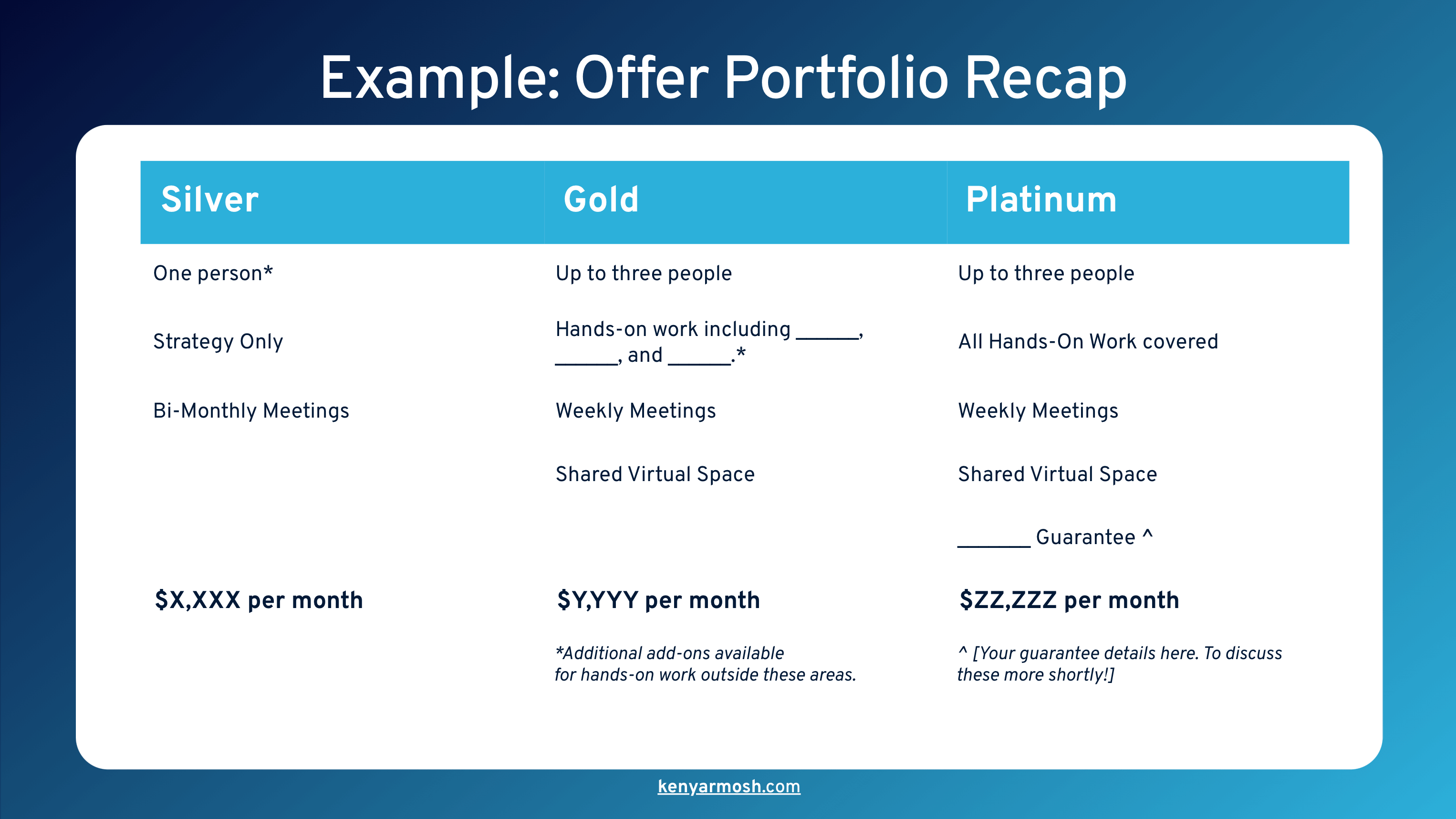
Each tier should target a different buyer psychology and budget reality.
6. Avoid customization traps
Every custom solution kills your margin and scalability.
When you rebuild everything from scratch for each client, you're trading maximum time for every dollar earned. I've watched solopreneurs work 60+ hours weekly while earning less than they should because every engagement is a snowflake.
Use my Document → Template → Automate (DTA) framework:
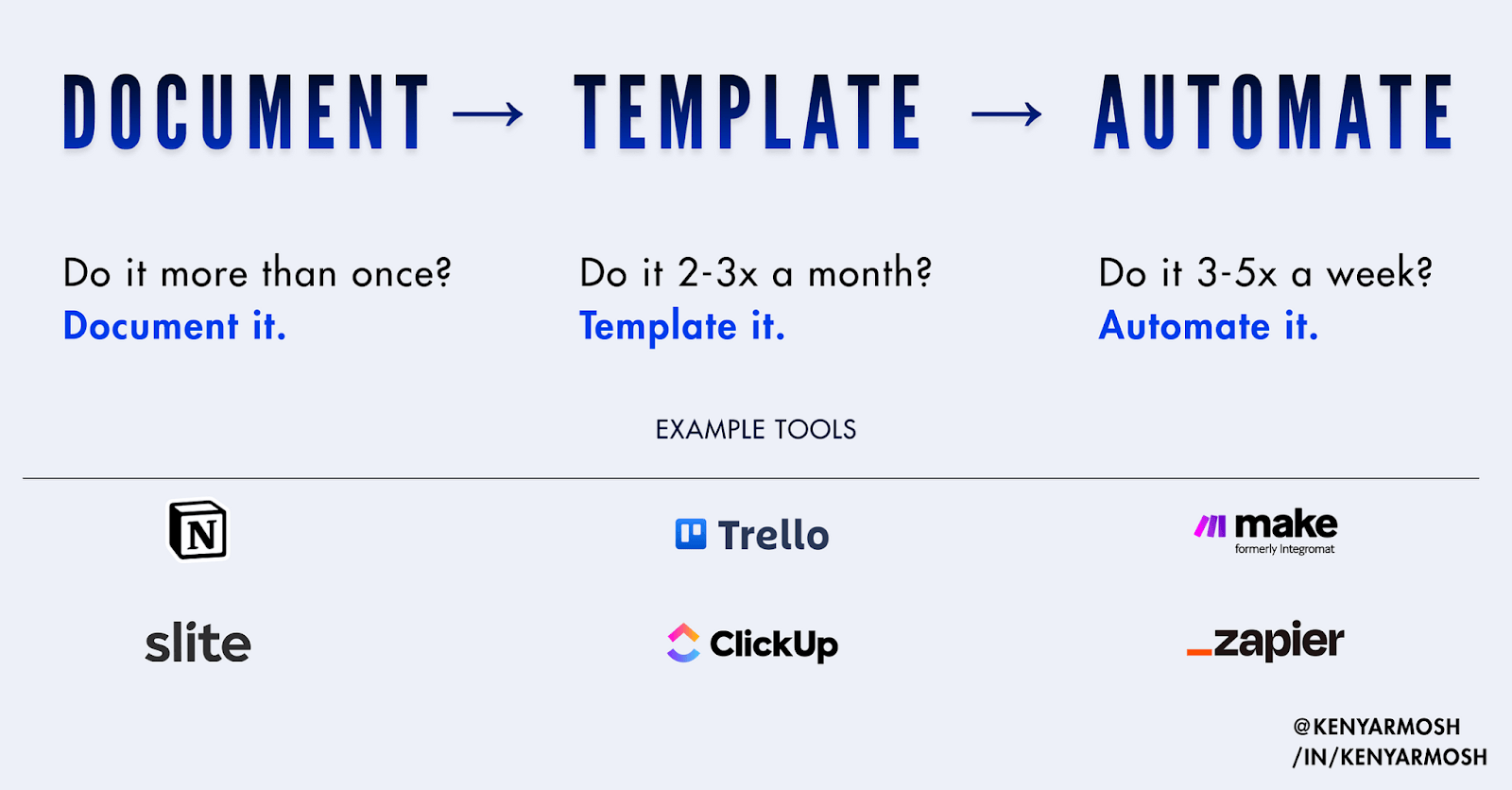
Customize the application of your process, not the process itself.
7. Create an intro offer that builds toward your premium offer
Your Offer Portfolio should take your clients on a growth journey
Structure this as Intro → Core → Premium. The intro offer solves a specific problem at an accessible price point. Once clients experience success, they naturally move to your core comprehensive offer. Your premium tier becomes the obvious choice for those wanting deeper support.
This increases customer lifetime value while making each sale easier.
8. Use pricing to filter prospects
Your pricing should actively filter out Legacy Clients who will drain your energy and shop on competitive rates.
When you price too low, you attract exactly the clients you don't want. I've seen solopreneurs raise prices, lose a few bottom-tier clients, and suddenly their business becomes more profitable and enjoyable.
Strategic pricing signals your market positioning and sets expectations for the caliber of your work.
If you're worried about scaring away prospects, ask yourself: Are these prospects I actually want to work with?
9. Don't underprice your energy
Your time isn't the only cost—your mental bandwidth matters too.
Some clients energize you. Others drain you, even when the work isn't particularly difficult.
When you price based purely on time and deliverables, you're underpricing the psychological cost of serving demanding clients.
I factor this in. Clients who require constant communication or create unnecessary complexity pay more—not as a penalty, but because serving them genuinely costs more in total resources.
10. Audit your pricing quarterly
Your business evolves. Your pricing should too.
I review pricing every quarter to assess whether current pricing aligns with the value I'm creating, the market position I want, and the clients I'm attracting.
Ask yourself:
- Are my current rates attracting the right clients?
- Have my systems improved enough to justify higher pricing?
- Am I leaving money on the table?
- Do my prices reflect the outcomes I'm delivering?
Regular reviews prevent you from being dramatically underpriced as your expertise matures.
11. Leverage async or group delivery to increase margin
The biggest pricing constraint for solopreneurs is the 1:1 delivery model.
Async delivery lets you serve clients through recorded videos and written feedback rather than scheduled calls. This reduces your time investment per client while maintaining outcomes. Group delivery works similarly—you're delivering expertise to multiple clients simultaneously.
A group program at $5,000 per participant with 10 people generates $50,000 for roughly the same time as a $10,000 1:1 engagement.
Match the delivery model to both client needs and your capacity constraints.
12. Make the value obvious to the buyer
When the transformation is clear, the price becomes secondary.
I've closed six-figure deals where prospects barely mentioned price. The value was crystal clear. They understood exactly what problem I'd solve and how the transformation would impact their business.
That clarity comes from:
- Specificity in outcomes (not vague promises)
- Social proof showing you've delivered this exact transformation
- Positioning that makes your approach unique
Your job isn't to have the lowest price. It's to make the value so obvious that your price feels like a smart investment.
Pricing is a tool to build leverage in your business
Pricing optimization is about building a dynamic system that evolves as your business matures and your experience increases.
Every solopreneur leaves money on the table at some point. The difference between those who break through and those who stay stuck is treating pricing as a strategic lever rather than a static decision.
You now have 12 techniques you can implement. Pick one this week. Maybe you'll audit your current offers and realize you're selling to Legacy Clients when you should target Lighthouse Clients. Or you'll restructure your delivery model to build in more leverage.
Whatever you choose, remember that pricing optimization compounds. Small adjustments create momentum. Better clients lead to better outcomes, which justify higher rates, which attract even better clients.
Start treating your pricing like the powerful growth lever it actually is.
