
🚀 TL;DR
- Most solopreneurs burn out not from too much work, but from weak pricing boundaries that erode respect and margins.
- Discounting, scope creep, and fear-driven concessions teach clients how to treat you—and rarely in your favor.
- Pricing boundaries collapse due to fear of rejection, comparison to peers, thin pipelines, and tying self-worth to sales outcomes.
- Strong pricing conversations are built on outcome-led positioning, preparation, silence, and pre-defined boundaries.
- Holding firm on pricing attracts better clients, protects your energy, and creates a more scalable, sustainable business.
From decades of working with entrepreneurs, many talented service providers burn out not from the work itself, but from their inability to price to grow.
They say yes when they should say no. They trim rates to "make it easier." They add scope when clients ask for "just one more thing."
What starts as flexibility becomes resentment.
I've built multiple seven-figure businesses, and one truth has held across every single one: your pricing boundaries define how clients treat you. Weak boundaries attract clients who squeeze. Strong boundaries attract clients who respect.
In my agency days, I had a $296k monthly payroll. I couldn't afford to budge on pricing. But even now, as a solopreneur, I hold firmer boundaries than I did back then.
In this article, I’ll explain how you can maintain those boundaries while proposing or negotiating rates.
Why solopreneurs struggle with sticking to their prices
Pricing boundaries collapse for predictable reasons. Most service providers think it's about confidence or charisma, but watch what happens when someone questions your rate.
Your brain starts running calculations. You start wondering if you're worth it. You begin justifying before they've even objected.
Understanding why you cave matters because you can't fix what you don't see clearly. Here are a few reasons why:
1. Lack of confidence in their value
When you can't articulate what makes your offer worth the price, your prospects sense it immediately.
I see this constantly with talented consultants. They've delivered incredible results for past clients, but they hedge when it's time to state their rate. They use qualifiers. They apologize with their tone before the words even come out.
Signs you're failing:
- You struggle to explain your value without listing features or deliverables
- You trim your price to "make it easier to say yes" before they ask
- You compare yourself to cheaper alternatives in your pitch
- You find yourself over-explaining what's included instead of leading with outcomes
The fix isn't affirmations or mindset work. It's building a clear value story that connects what you do to business outcomes that matter.
Price follows clarity. Until you believe it's worth it, they never will.
2. No external validation
Operating in a vacuum creates pricing paralysis. You set a rate based on gut feeling, then second-guess it every time someone doesn't immediately say yes.
Without data on close rates, market positioning, or peer benchmarks, you're flying blind. That uncertainty seeps into every pricing conversation.
Signs you're failing:
- You keep asking peers, forums, or social media if your pricing "seems right"
- You change your rates every few months based on individual responses
- You have no idea what your actual close rate is at your current pricing
- You can't point to similar service providers who command your target rates
Build a baseline. Track your close rates at different price points. Get real feedback from prospects who said no—not just the ones who said yes.
Data removes the emotional weight from pricing decisions. Trust numbers more than feelings.
3. Fear of rejection
The moment a client hesitates, you instinctively lower your rate. You'd rather close the deal at a discount than risk hearing "no."
This fear doesn't come from nowhere. For most service providers, client relationships feel personal. A pricing rejection registers as a personal rejection, even when it's purely a business decision.
Signs you're failing:
- You reduce your rate when a prospect goes quiet, even before they object
- You offer payment plans or discounts unprompted to "help them say yes"
- You'd rather work for less than walk away from a warm lead
- You tell yourself, "at least it's revenue," when accepting below your rate
Real leverage comes from your willingness to walk away.
If fear drives your pricing decisions, you've already surrendered your value. The clients worth having respect boundaries. The ones who don't will drain you regardless of the discount.
4. Comparison to others
You see another consultant announce a win on LinkedIn and immediately question your own pricing. You benchmark against peers without understanding their business models, experience levels, or client types.
This constant comparison creates a race to the middle where nobody wins.
Signs you're failing:
- You adjust your prices every time you see a peer's rate or package
- You position yourself as "more affordable than" instead of "different from"
- You use competitor pricing as your primary pricing reference point
- You change your strategy based on trending LinkedIn advice
You're not building their business. You're building yours. Boundaries start with a strategy you believe in, not what's trending in someone else's feed.
Your pricing should reflect your positioning, results, and business model—not whatever you scrolled past this morning.
5. Pressure to close every deal
When your pipeline is thin, every prospect feels precious. You can't afford to lose them, so you bend. You discount your rates or add to the scope to sweeten the deal.
This desperation shows up in your language, timeline, and willingness to accommodate every request.
Signs you're failing:
- You say yes to any client who has a pulse and a credit card
- You chase prospects long after they've ghosted because you "need the revenue."
- You offer discounts proactively to "remove price as an objection"
- You accept clients who don't match your ideal profile because revenue is revenue
A full pipeline gives you the confidence to hold your ground. When you've got three qualified prospects for every spot, pricing objections don't trigger panic. They trigger qualification.
Work on your lead generation before you work on your close rate—because confidence comes from options.
6. Confusing sales with self-worth
A "no" on price feels like a personal rejection, not a business decision. You tie your self-worth to your close rate, which makes every pricing conversation feel high-stakes.
This emotional entanglement destroys your ability to hold boundaries.
Signs you're failing:
- You feel personally hurt when prospects choose someone cheaper
- You replay pricing conversations obsessively, wondering what you did wrong
- You take price objections as commentary on your professional value
- You need external validation after losing a deal to feel okay again
Pricing is business. It's tied to results, positioning, and market dynamics—not your identity. Detach, or you'll always discount yourself emotionally before you ever discount financially. The best pricing conversations happen when you're neutral about the outcome.
10 tips to maintain your ground while discussing pricing
Holding pricing boundaries isn't about memorizing scripts or perfecting your pitch. It's about building systems that make saying no easier than saying yes to the wrong deals.
These tips come from two decades of closing deals, running agencies, and mentoring hundreds of founders:
Tip 1: Lead with the outcome, not the offer
Stop listing what you do. Start with what changes for them.
When I closed $200k+ deals, I never led with deliverables. I led with the business problem we'd solve and the measurable impact they'd see. Clients don't buy hours or features—they buy results.
Frame your pricing conversation around the outcome they'll achieve, not the work you'll perform. "We'll increase your qualified pipeline by 40% in 90 days" hits differently than "We'll implement a new lead generation system."
People pay premium rates for clarity about what they're getting, not confusion about what you do.
Tip 2: Name your price, then shut up
State your rate clearly. Then stop talking.
This is the hardest thing for service providers to do. The silence after you name your price feels uncomfortable, so you fill it with justifications, explanations, or worse—preemptive discounts.
That silence is where the sale happens. Let them process. Let them think. Let them respond.
The more words you use after your price, the more you erode its power. I've watched consultants talk themselves out of deals they'd already won simply because they couldn't tolerate ten seconds of quiet.
Tip 3: Use anchors and stop apologizing
Frame your price next to a higher-value reference point or a strong ROI comparison.
Never lead with "I know this might be a lot…" because you're training the client to question your confidence before they've even formed their own opinion.
Instead, anchor against value: "The average client sees a 3x return in the first six months" or "This represents about 15% of the revenue increase you're targeting."
Tip 4: Script objection-ready boundaries
Know in advance how you'll respond when someone asks for a discount or "flexibility."
Pre-decided responses reduce the emotional load and make it easier to hold the line. You're not improvising under pressure—you're executing a plan.
For example, when a prospect says, "That's outside our budget," I don't negotiate. I say, "I understand. Let's look at which outcomes matter most and design something that fits." That's a scope conversation, not a pricing conversation.
Or I disqualify: "If the budget's not there, we're probably not the right fit right now. Let's reconnect when the timing makes more sense."
Tip 5: Disqualify fast to stay in control
The fastest way to protect your pricing power is to stop wasting energy on wrong-fit clients.
Use disqualifiers early in the conversation. I use a process called "Progressive Qualification" where I ask about:
- Budget ranges
- Decision-making authority
- Timing
- Reasons for reaching out
If they're not qualified, exit gracefully.
When someone says, "I need to think about it," I ask, "What specifically are you thinking about?" That question surfaces the real objection or reveals they're not serious.
As I tell my clients, they're not ready if you need to convince them. Lighthouse Clients—the ones who value your expertise—don't need convincing. They need clarity.
Tip 6: Create a 'take it or leave it' option
When appropriate, have a no-negotiation offer. Clear, flat, and firm.
This isn't about being rigid. It's about clarity and efficiency. Some of my highest-converting offers have zero flexibility built in. The price is the price. The scope is the scope. You're either in or you're out.
Boundaries signal strength, not inflexibility. Clients who respect systems respect this approach. Clients who want to negotiate everything will always find something to negotiate—even after you've bent once.
Tip 7: Don't price in isolation—price within a tiered system
Your offer should sit inside a clear system, not float around as a custom quote every time.
I recommend building three tiers: an entry point, your core offer, and a premium option. This gives prospects a choice without creating negotiation theater.
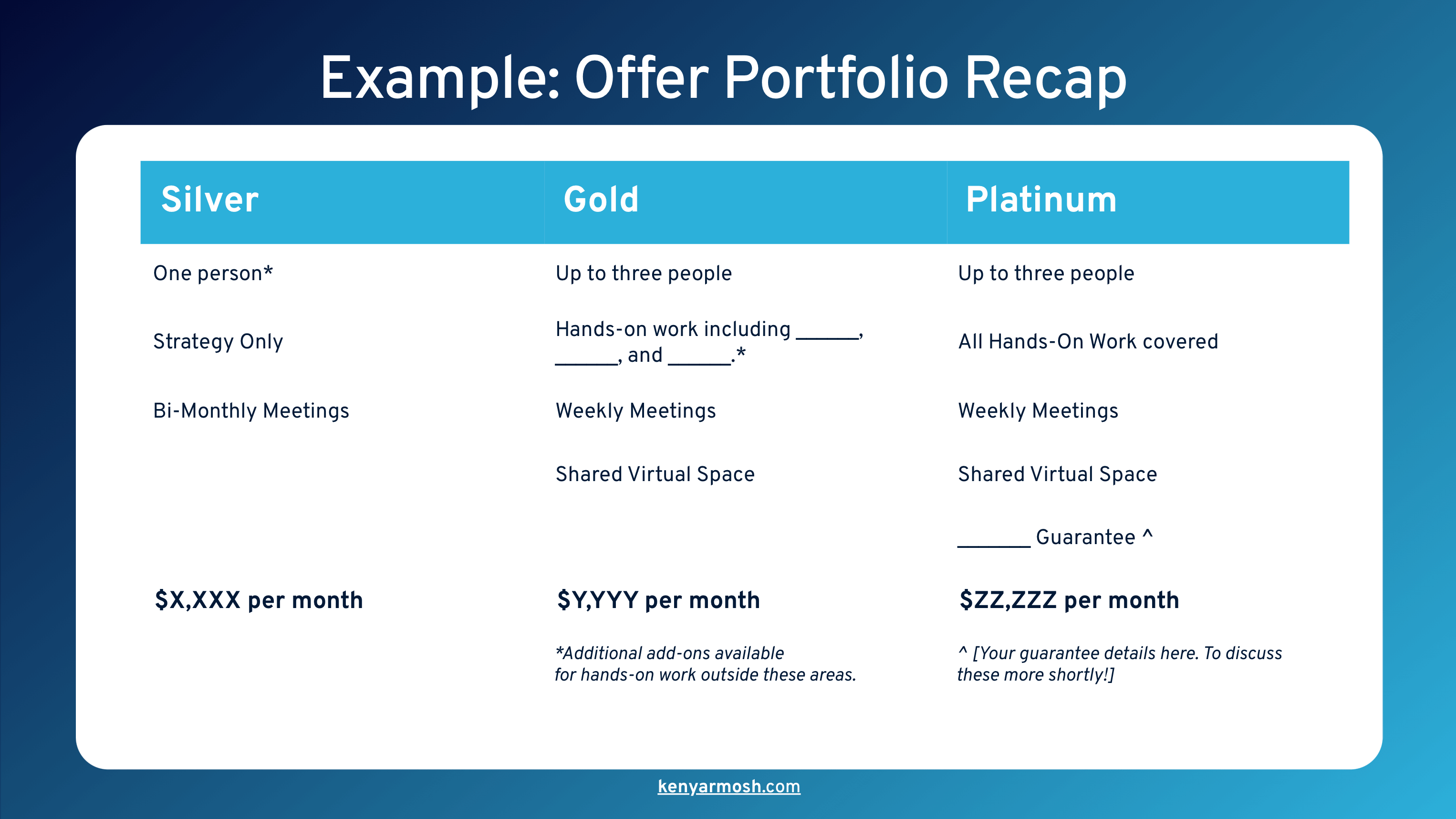
When someone asks for a discount, I don't lower the price. I say, "Here's what the next tier down includes." That's a value conversation, not a discount conversation.
Premium businesses don't start from scratch for every lead. They guide buyers through a consistent path where pricing makes sense in context.
Tip 8: Set expiry dates on proposals
Pricing should come with boundaries around time, not just money. When I send a proposal, it's valid for seven days. After that, we revisit scope and pricing because market conditions change, my availability shifts, and their delay signals either indecision or lack of priority.
A price without a timeline invites limbo, not action. Expiry dates force decisions, which separate serious prospects from tire-kickers.
Tip 9: Use strategic trade-offs instead of discounts
Instead of lowering your price, reduce scope or deliverables. Maintain your rate.
If someone says the price is too high, I ask, "What if we started with phase one and added phase two once you see results?" That's a scope adjustment, not a discount.
If you offer a discount without adjusting the value, you train clients to expect more for less. That's a losing game that erodes your margin and your positioning.
I've walked away from prospects who insisted on discounts. Some came back three months later at full price because they realized cheap isn't the same as valuable.
Tip 10: Practice saying no with zero explanation
You don't owe everyone access to your time, pricing, or rationale.
"No" is a complete sentence. When a prospect doesn't fit, I say, "This doesn't seem the right fit," and leave it there. No apologies. No lengthy explanations. No guilt.
In my world, pricing boundaries are strongest when they're clean, short, and unapologetic. The right clients respect that. The wrong clients wouldn't respect you even if you gave them everything they wanted.
Pricing boundaries build better businesses
Every time you bend on pricing to ease discomfort, you're building a leaky business.
I've seen talented consultants burn out not from overwork but from under-charging clients who drain their energy and question their value. The resentment compounds until the business stops being worth it.
Boundaries don't repel good clients. They attract them.
When I held the line on my $296k payroll, I couldn't afford weak boundaries. With zero employees, I hold firmer boundaries than ever because I understand what you're learning now: pricing power doesn't come from charm or scripts.
It comes from clarity, positioning, and the courage to walk away from wrong-fit deals.
Strong boundaries create space for the right clients—the ones who respect your rates, process, and time. Those are the relationships worth building.
