
🚀 TL;DR
- Most aspiring fractional CMOs fail because they sell availability instead of executive authority.
- Fractional CMOs must lead strategy and outcomes, not execute tasks or bill hourly.
- Specialization, outcome-based offers, and clear boundaries are essential to avoid recreating employment.
- Warm networks, proof of results, and executive-level positioning land the first high-quality client.
- The goal is a fractional business that compounds leverage, not one that consumes time.
I've watched too many talented marketing leaders make the same mistake.
They leave corporate. They call themselves a "fractional CMO" because it sounds senior. Then they spend 18 months competing with cheaper freelancers, saying yes to everything, and wondering why they feel busier than when they had a full-time job.
The fractional model is powerful. Companies get top-tier marketing leadership without full-time payroll. You get freedom, focus, and high-margin income.
But most people sell availability instead of authority. They list on fractional networks. They quote hourly rates. They let clients define the terms. And they recreate employment—without the security.
Becoming a fractional CMO isn't about being cheaper than a full-time hire. It's about positioning yourself as the marketing executive who drives outcomes.
In this guide, I'll walk you through the skills, steps, and challenges of building a fractional CMO business that compounds rather than consumes you.
What skills do you need to become a fractional CMO?
You don't need to be an expert in every marketing channel. But you do need to lead like an executive—not execute like a contractor.
The companies hiring fractional CMOs aren't looking for someone to run their Google Ads or write their email sequences. They're looking for marketing leadership.
That requires a specific mix of hard and soft skills:
1. Strategic marketing leadership experience
This is non-negotiable. You need a track record of owning a marketing strategy—not just executing tactics defined by someone else.
Founders hire fractional CMOs to lead, not to be managed. If you've spent your career waiting for direction, this role will expose that fast. You should be comfortable setting the marketing vision, building the roadmap, and defending your recommendations to a leadership team that may not understand marketing as well as you do.
The best fractional CMOs I've seen come from roles where they owned P&L responsibility, managed budgets north of six figures, and reported directly to founders or C-suite executives. That experience shows.
2. Cross-functional collaboration and team leadership
Marketing doesn't happen in a vacuum.
As a fractional CMO, you'll work across departments constantly. Sales needs pipeline. Product needs positioning. Customer success needs retention campaigns. You're the connective tissue between what the market wants and what the company builds.
You'll also lead people who don't report to you. Internal marketing teams, agencies, freelancers—they all need direction. Your job is to align everyone around a coherent marketing strategy without the authority of a direct reporting line.
This is where many marketing consultants struggle. They know tactics but can't navigate the politics, priorities, and personalities that come with executive-level work.
3. Data-driven decision-making and analytics fluency
Clients expect you to tie marketing to business outcomes.
You should be fluent in the metrics that matter:
- CAC and LTV by channel
- Funnel conversion rates at each stage
- Pipeline velocity and deal attribution
- Marketing's contribution to closed revenue
This doesn't mean you need to spend all day in dashboards. But when the CEO asks why demand generation isn't working, you'd better have an answer rooted in data.
4. Expertise across core growth channels
You don't need to be hands-on in every channel. But you need to know enough to lead people who are.
Paid media, SEO, content marketing, email marketing, social media marketing—you should understand how each drives results and when to deploy them. You're building the marketing strategy, not the Google Ads campaigns. But if you can't evaluate whether your paid media contractor is doing good work, you've got a problem.
The best fractional CMOs have deep expertise in one or two areas and working knowledge across the rest. That's what lets you build a coherent digital strategy instead of a collection of disconnected tactics.
5. Communication and client management
Half this job is marketing. The other half is managing founders.
You'll lead meetings. Present roadmaps. Defend your marketing strategy to stakeholders who think they know better because they saw a competitor's LinkedIn post. You need to communicate with confidence—not arrogance—and translate marketing speak into business outcomes.
Client management is where fractional work gets tricky. Founders test boundaries. They'll ask for "just one more thing." They'll Slack you at 10 PM. Your ability to hold the line on scope while maintaining trust determines whether this becomes a sustainable business or a nightmare with multiple bosses.
5 steps to become a fractional CMO
The path from marketing executive to fractional CMO isn't complicated. But it requires intention.
Here’s what you need to do:
Step 1: Choose your niche and marketing positioning
Pick a lane. Early-stage SaaS. E-commerce brands doing $5-20M. B2B professional services. Healthcare startups. Whatever it is, choose.
Generic positioning is a race to the bottom. When you try to serve everyone, you compete on price and availability—exactly what we're trying to avoid.
Your niche should sit at the intersection of:
- Where you have proof and results
- Where you have genuine expertise
- Where clients have a budget and urgency
This is where your Lighthouse Client comes in. What’s the ideal company you want to serve? Get specific with industry, stage, revenue range, and buying committee. The clearer you are, the easier everything else becomes—your messaging, your outreach, your content strategy.
Step 2: Define your offer based on outcomes, not hours
Stop selling time. Start selling results.
"I'll work 15 hours a week on your marketing" is not an offer. It's a cost center waiting to be cut.
Instead, think about what business outcomes you deliver in 90 days. A go-to-market strategy for a new product launch. A demand generation engine that produces a qualified pipeline. A brand positioning overhaul that changes how the market sees the company.
Package that. Price it based on the value of the outcome, not the hours it takes you to deliver. This is how you escape the hourly rate trap that keeps most marketing consultants stuck.
Step 3: Set up your pricing and engagement model
There's no single right way to structure fractional CMO services. But there are wrong ways.
Hourly billing? Wrong. It penalizes efficiency and caps your income.
Here's what actually works:
- Tiered packages — different levels of involvement at different price points. Maybe $5k/month for strategy-only, $10k for strategy plus team leadership, $15k+ for full interim CMO responsibilities.
- Flat monthly retainer — a set fee for defined strategic deliverables and availability. Clean, predictable, easy to scope.
- Project-based engagements — fixed fee for a specific outcome like a brand identity overhaul or marketing automation implementation.
I recommend tiered packages or what I call the “Scalable Service Offers” framework since it’s the most sustainable model.
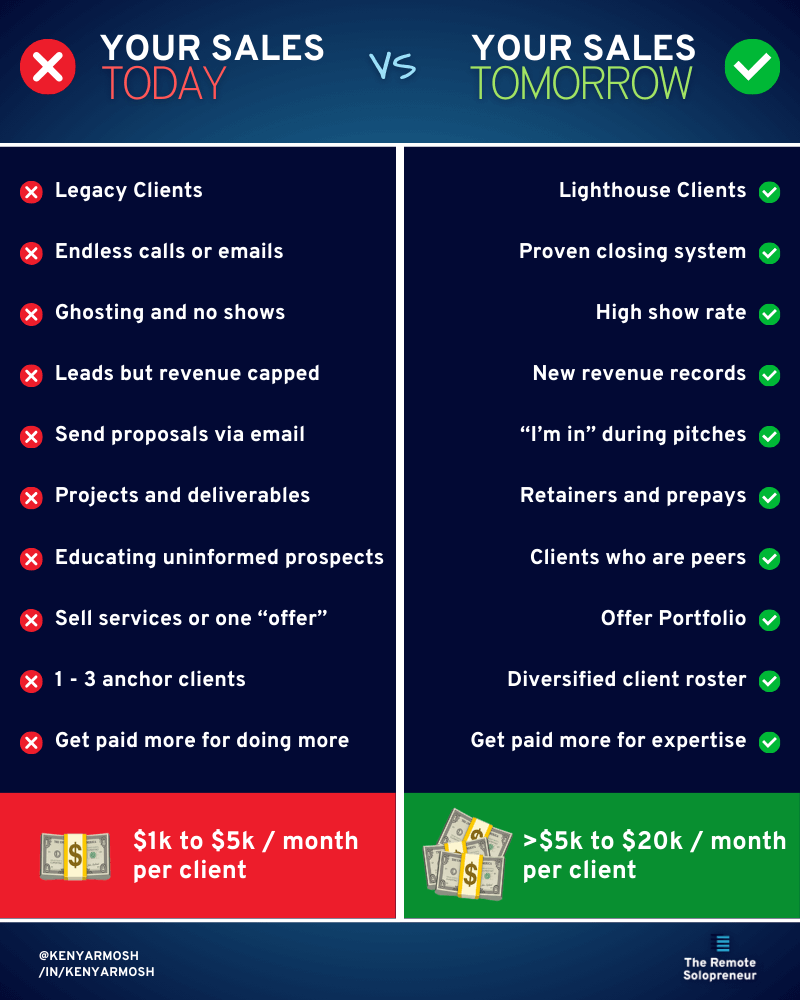
The frame matters too. Position your retainer against the cost of a full-time CMO (often $250-400k fully loaded) and suddenly $8-15k/month looks like a bargain. That's anchor pricing. Use it.
Step 4: Build credibility with proof and assets
You don't need a fancy website. You need clarity and proof.
Start with the basics:
- 2-3 case studies showing measurable results (pipeline generated, revenue influenced, customer acquisition improved)
- A one-page PDF that explains your offer, who it's for, and what outcomes you deliver
- A LinkedIn profile that positions you as a marketing executive, not a freelancer
That's it. You can build all of this in a weekend.
The case studies matter most. Founders hiring fractional CMOs want evidence you've solved their problem before. Specific numbers beat vague claims every time. "Increased MQLs by 340% in 6 months" lands differently than "improved lead generation."
Step 5: Land your first client through warm outreach
Cold outreach is a grind. Don't start there.
Your first fractional CMO client is probably someone you already know. A former colleague who started a company. A past client who moved to a new role. Someone in your network who's been watching your content and thinking, "I should talk to them."
Make a list of 20 people who:
- Run or work at companies that match your niche
- Have budget authority or influence over marketing decisions
- Already trust you professionally
Reach out personally. Not with a pitch—with a conversation.
"Hey, I'm building a fractional CMO practice focused on [niche]. Curious if that's something you're seeing demand for, or if you know anyone who might benefit."
One good client can fund your entire transition. I offered a fractional COO retainer at $25k/month early on—that single client funded everything else I built.
Challenges to expect while building a solopreneur business
Let's be honest about what you're signing up for.
The fractional model is powerful, but it's not easy to use. You're building a business, not taking a job. That means marketing yourself, selling your services, delivering results, and managing clients—all at once, with no safety net.
Here's what trips up most people:
Managing your time across multiple clients
Three clients sounds manageable until all three need you on the same Tuesday.
Without clear boundaries, fractional work becomes a scheduling nightmare. You're constantly context-switching. Every client thinks they're your priority. Your calendar fills with "quick syncs" that eat your strategic thinking time.
The fix is structure. Set specific days or blocks for each client. Use project management software to track deliverables instead of relying on memory. Standardize your delivery systems so you're not reinventing the wheel every engagement.
And protect your non-client time ruthlessly. If you're always in delivery mode, you'll never work on business development—and your pipeline will dry up exactly when you need it most.
Learning how to sell yourself as a strategic partner
You've spent your career marketing products and companies. Now you have to market yourself.
This is uncomfortable for most marketing executives. Talking about your own expertise feels like bragging. Asking for the sale feels pushy. So you hedge, downplay your experience, and wait for clients to come to you.
That doesn't work.
You need to develop a CEO-to-CEO communication style. Speak to business outcomes and position yourself as a peer to the founders you're selling to. The shift is subtle, but it changes everything about how prospects perceive you.
Dealing with client scope creep and unclear expectations
"Can you just take a quick look at this?"
Famous last words.
Without clear boundaries, clients will treat you like an in-house marketing team with unlimited availability. They'll add you to Slack channels you don't need to be in. They'll loop you into projects outside your scope. They'll expect you to manage things you never agreed to manage.
This is on you to prevent. Your contracts need teeth—clear deliverables, defined communication channels, explicit boundaries on what's included and what's not. Your onboarding process should set expectations before the engagement starts, not after problems emerge.
When scope creep happens (and it will), address it immediately.
"That's outside our current agreement—happy to discuss adding it as a separate engagement."
Say it early. Say it often. The clients worth keeping will respect the boundary.
Finding your ideal balance between income and freedom
Here's the tension nobody talks about: more clients means more money but less freedom.
Two high-paying clients at $10k/month each give you $240k annually with breathing room. Four clients at $5k/month gets you the same revenue but double the context-switching, meetings, and mental load.
Decide early what you're optimizing for.
Some fractional CMOs want maximum income and don't mind a packed calendar. Others want time independence above all else. They'd rather make $180k working 25 hours a week than $300k working 50.
There's no wrong answer. But if you don't make the choice consciously, you'll drift into a client roster that serves no one, least of all you.
Maintaining expertise while scaling your offer
The market doesn't stand still. Neither can you.
AI tools are reshaping marketing technology and martech stacks. Search engine optimization looks different from what it did two years ago. Social media platforms rise and fall. The digital marketing campaigns that worked last quarter might flop next quarter.
As a fractional CMO, you're selling expertise. That means staying sharp—reading, experimenting, talking to other marketing professionals, and watching market trends.
But you're also running a business, which means client delivery, sales conversations, and admin work compete for that learning time.
Build development into your schedule, or it won't happen. Block time weekly for market research, testing new AI tools, consuming content from people doing interesting work. Your value compounds when you stay ahead of the curve. It erodes when you coast on what you knew three years ago.
Build authority, not availability
The fractional CMO model works. But only if you build it right.
That means positioning yourself as marketing leadership. It means selling outcomes, not hours. It means setting boundaries that protect your time and sanity while delivering real results for clients who value what you bring.
Most people get this backwards. They compete on price and availability, then wonder why they've recreated employment without the security.
You don't have to make that mistake.
Build something that compounds. Build authority.
