
🚀 TL;DR
- The traditional agency model is breaking as AI commoditizes work that once required large teams and high retainers.
- Agency 3.0 replaces headcount-heavy, hourly-based models with lean, remote-first, system-driven operations.
- Growth in the next decade comes from leverage—systems, automation, and AI—not from hiring more people.
- One-person and boutique agencies can now reach seven figures by productizing offers, delivering asynchronously, and codifying expertise.
- The agencies that win by 2030 will prioritize outcomes over deliverables, optionality over overhead, and playbooks over payroll.
I ran a $5M per year agency with a $296,463.65 monthly payroll. Twenty-plus people. The whole deal.
And I still called myself a remote solopreneur.
When I look back on it, those employees weren't building. They were executing my playbooks. My systems. My intellectual property.
The agency world is going through a reckoning. Generative AI is rewriting what's possible. Marketing agencies that charged massive retainers for work AI now handles in minutes are scrambling. And most are asking the wrong question.
Creating an Agency 3.0 version of your business is simply a requirement if you want to still be in business by 2030.
The advertising and specialist agencies that dominate the next decade won't look anything like those that dominated the last.
Let's get into what's actually coming.
The 3 eras of the agency model – where we've been, and where we're going
Understanding the past is the only way to see where the future is headed. The agency model has gone through three distinct eras, and most shops are still stuck somewhere between the first two:
Agency 1.0: The Mad Men era (1950s–1990s)
This was the golden age of charm and martinis. Agencies operated on relationships, not results. The delivery model was simple: pitch, disappear for weeks, then show up with a big reveal.
TV, radio, print. Lunches that stretched into dinners. Golf courses where deals got done. Everything was opaque by design because opacity protected margins.
There were no dashboards. No attribution models. No way for clients to peek behind the curtain. And frankly, nobody asked. The agency had the expertise, the client had the budget, and everyone stayed in their lane.
Politics mattered more than performance. If the client liked you, you kept the account. Systems? Barely existed. The whole thing ran on personal relationships and a handshake.
Agency 2.0: The digital boom and bureaucracy (1990s–2020s)
Then the internet showed up and changed everything. Or at least, it should have.
What actually happened? Agencies bolted digital services onto their existing structures. They hired more people. Opened more offices and built elaborate hierarchies with account executives, project managers, and layers of middle management.
The holding companies went on acquisition sprees. Media activation got complex, and new media channels kept emerging. But agencies responded the only way they knew how—by adding headcount.
Remote work? Resisted until COVID forced their hand. Most agencies clung to the belief that "real work" happened in expensive office space.
The billing model stayed stuck in the past: hourly rates, bloated SOWs, junior teams doing senior-priced work. Clients started asking uncomfortable questions. "What exactly am I paying for?" and "Why can't my in-house team do this?"
Here's what Agency 2.0 got wrong:
- Confused headcount with capability
- Buried clients in deliverables instead of outcomes
- Treated digital transformation as a department, not a philosophy
- Scaled complexity instead of scaling value
The cracks were showing long before the pandemic. COVID just accelerated the timeline.
Agency 3.0: Lean, transparent, and built for 2030
This is where things get interesting.
Agency 3.0 isn't an evolution of the old model. It's a replacement. Remote-first. Async-native. System-driven delivery with few or zero traditional employees.
I got to seven figures without actually having any employees...systems over headcount, remote-first operations, global talent pool, solopreneurship on the rise.
The focus shifts from deliverables to outcomes. From billing hours to billing value. From managing people to managing systems.
Artificial intelligence isn't a threat in this model—it's a multiplier. AI commoditizes the repetitive work that used to require junior staff. Agentic AI handles research, first drafts, and data analysis. The humans focus on strategy, relationships, and the judgment calls that actually matter.
The media landscape keeps fragmenting. But instead of hiring specialists for every new channel, Agency 3.0 builds modular systems that adapt. One person with the right tech stack can now outperform a team of ten using yesterday's tools.
Growth doesn't mean more bodies. It means more leverage.
The differences become stark when you lay them out:
Look at that last row. It's your trajectory.
Agency 1.0 shops are already gone or running on fumes. Agency 2.0 is bleeding out slowly, watching margins compress while overhead stays fixed. Only Agency 3.0 is built for what's coming.
We're entering the age of growth without headcount, speed to market, and iterating to win.
This isn't about being small for the sake of being small. It's about being precisely sized for maximum leverage.
How to build a future-proof agency today
Here’s what it looks like in practice:
The rise of the one-person or boutique agency
It's now possible to hit $1M per year as a solo operator. I've done it. I've watched others do it. The playbook exists.
You don’t go straight to hiring someone full-time on payroll. You need to build smarter.
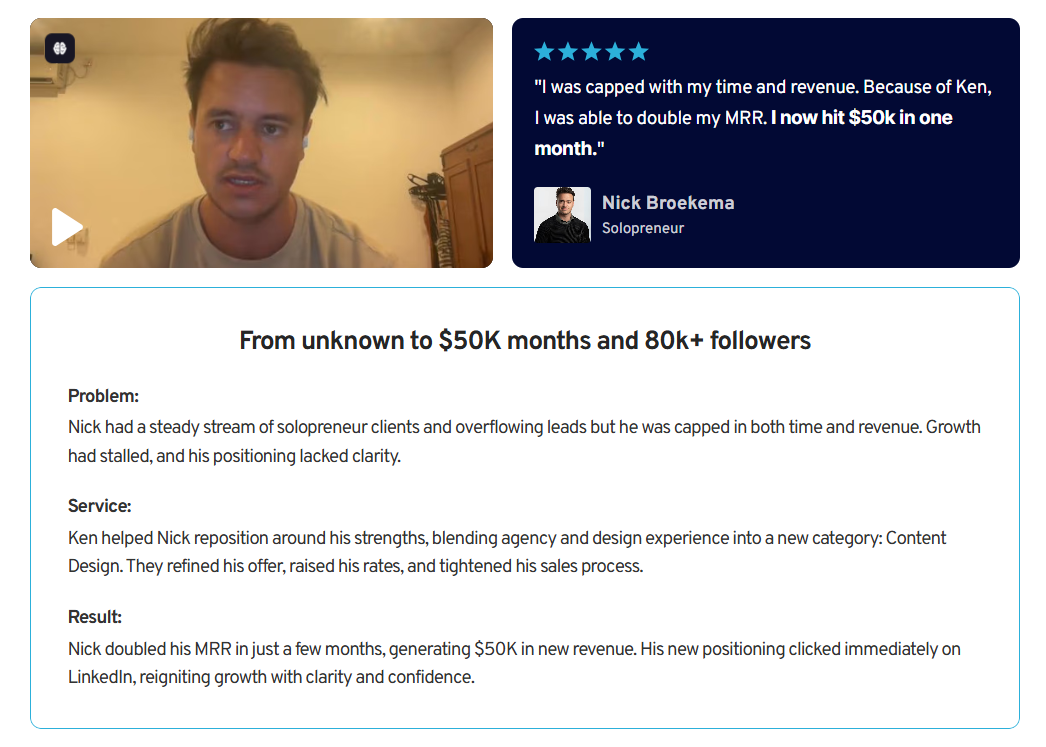
One of my clients scaled to $50K in monthly revenue with async delivery, a codified playbook, and a few strategic contractors. They don’t have an office or full-time staff.
The emphasis shifts from meetings to SOPs and from managing people to managing processes. When your delivery is documented and repeatable, you stop being the bottleneck.
Prioritize systems over headcount
Every time you think "I need to hire someone," ask a different question first: "Can I build a system instead?"
For example, it could be a ClickUp dashboard that clients can see in real time—or Loom updates instead of status meetings. The goal is to create modular delivery frameworks that work whether you have one client or ten.
The old model threw people at problems. The new model throws architecture at them.
I've built more in two weeks with GPTs than I did with a full team in previous years. That's not hyperbole—it's the new math. When AI handles the repetitive cognitive work, your role shifts from doer to director.
A contractor can be a cheat code here. One trusted person, upskilled on your systems, operating from your playbooks. They're not an employee. They're an extension of your intellectual property.
Create a remote-first infrastructure and use AI as a co-worker
Modern agency leaders must understand automation, not just delegation.
This means building workflows where AI handles first drafts, research, data synthesis, and content generation. You handle strategy, client relationships, and the judgment calls. The media landscape keeps fragmenting, but your systems adapt without adding headcount.
Marketing automation isn't optional anymore. Neither is understanding how agentic systems can run portions of your delivery. The agencies that treat AI as a threat will lose to the ones that treat it as infrastructure.
Optionality is the new scale
Here's what traditional agency growth looks like: more clients require more staff, which in turn requires more overhead, which in turn requires more clients. It's a trap disguised as success.
Agency 3.0 flips this. You build so you can scale, not so you must scale.
Some of my clients run maintenance-mode clients on autopilot for $2-3K per month—minimal touch. Systems handle delivery. Meanwhile, they focus energy on one or two high-retainer "skunkworks" clients where the real strategic work happens.
That's optionality. The freedom to say no.
The ability to scale up or down based on what you want, not what your overhead demands.
Warning signs you're stuck in the past—and how to evolve
The transition from Agency 2.0 to 3.0 isn't just possible. For most, it's mandatory.
Red flags that you're still in Agency 2.0
Be honest with yourself. How many of these sound familiar?
- Still billing hourly or using SOWs that took longer to write than the work itself
- Chasing more clients primarily to fund more headcount
- Clients can't see your work or collaborate in real time
- Hiring employees before you've built systems
- Your profit margin shrinks every time you "grow"
- You dread vacations because everything falls apart without you
That last one is the tell.
If your agency can't function for two weeks without you, you don't have an agency. You have a job with extra steps.
How to begin the transition
This isn't an overnight transformation. But it starts with specific moves.
- Step 1: Systemize your offer. Stop selling custom everything. Create Good, Better, Best tiers that clients can understand in thirty seconds. Standardization is the foundation of scale.
- Step 2: Shift delivery to async. Loom updates. ClickUp dashboards. Notion workspaces. Your clients don't need more meetings—they need more visibility.
- Step 3: Systematize before you hire. Document your processes. Build templates. Create playbooks. Only then consider whether you need a human or whether the system can handle it.
- Step 4: Use AI to offload low-leverage work. First drafts. Research. Data analysis. Content outlines. These are table stakes now, not competitive advantages.
- Step 5: Build a delivery team using high-trust contractors, not employees. Find people who can execute your playbooks. Train them on your systems. Pay them well. Keep your overhead flexible.
The goal isn't to never work with people. It's to work with people on your terms, through your systems, without the weight of traditional employment dragging down your margins and your freedom.
The best agencies of 2030 won't look like agencies at all
That $296,463.65 monthly payroll I mentioned at the start? It bought me headcount. It didn't buy me freedom.
The agencies that win the next decade will be micro-factories of value—run by one to three people with massive leverage. They’ll have smaller teams but a much sharper focus, and systems that do what staff used to do.
The Mad Men are gone. The 100-person agency is optional. And the founders who figure this out first will own their markets while everyone else fights over shrinking margins.
You don't need more people. You need better playbooks.
