
🚀 TL;DR
- The fractional CMO model replaces project chaos with recurring, high-margin retainers.
- Fractional CMOs sell strategic leadership and outcomes—not execution or hours.
- The model works best when you specialize in a niche and operate at the executive level.
- Fractional work creates leverage, reduces burnout, and funds scalable future offers.
- Success comes from positioning yourself as a partner, not a freelance marketer with a new title.
The fractional model changed everything for me early on.
I offered a fractional COO retainer at $25k/month. That one client funded everything else I built. No more project-to-project scrambling. No more trading hours for dollars. Just recurring revenue and executive-level impact.
The future of work is fractional. Companies get top-tier marketing leadership without full-time payroll. You get freedom, focus, and high-margin income.
But most marketing consultants position it incorrectly. They sell hours instead of outcomes. They operate like freelancers with fancier titles.
In this guide, I'll break down what a fractional CMO actually does, why the model works for scaling solopreneurs, and how to position yourself as strategic marketing leadership.
What's a fractional CMO?
A fractional Chief Marketing Officer (fCMO) provides executive marketing leadership to companies on a part-time or contract basis.
Think of it this way: a full-time CMO costs $250k-$400k annually when you factor in salary, benefits, and equity. Most growth-stage startups and B2B companies can't justify that. But they still need someone who can build a marketing strategy, align the marketing team, and connect marketing efforts to revenue growth.
That's where you come in.
As a fractional CMO, you're not executing campaigns or managing paid media day to day. You're setting strategic direction and building the marketing foundation.
The key distinction is this: you operate at the leadership level, not the task level. You might work with a company 10-15 hours per week—or even less—but your impact shows up in their strategic planning, their marketing programs, and ultimately their revenue.
What are the responsibilities of a fractional CMO?
Your job is to bring clarity where there's chaos. Most companies hiring fractional marketing leadership have the same problem: lots of marketing activity, very little strategic direction.
The core responsibilities look like this:
- Develop and own the overall marketing strategy tied to business objectives
- Align marketing efforts across content marketing, digital marketing, email marketing, and paid media
- Lead or coordinate the internal marketing team and external agencies
- Establish performance metrics and run data analysis on what's actually working
- Guide brand development, brand identity, and brand positioning in the market
- Build the go-to-market plan for new products or services
- Advise the leadership team on marketing technology, budget allocation, and hiring
- Create systems for lead generation and sales development pipeline
- Conduct market research to inform strategic decisions
Notice what's not on that list: writing blog posts, managing Google Ads, scheduling social media, or building landing pages. Those are execution tasks.
Your value is in the thinking, not the doing. You provide the strategic marketing framework.
You make sure all the digital strategies, content strategy, and growth marketing initiatives actually connect to revenue. Then the marketing manager or agency handles the execution.
What are the benefits of becoming a fractional CMO?
Most people try to scale by hiring. The better move? Increase your leverage first—through scalable services and fractional offers.
The fractional CMO model sits in a sweet spot.
Here are a few benefits:
Earn premium retainers without going full-time
Fractional CMOs typically charge $ 3k–$10k per client per month. Some go higher depending on the scope and the company's stage.
Do the math on that. Three clients at $7k/month is $252k annually. Four clients at $5k is $240k. You're earning executive-level income while working maybe 40-50 hours total across all clients—not per client.
Compare that to project work, where you're constantly hunting for the next gig. Or hourly consulting, where your income disappears the moment you stop working. Retainers create a baseline. They let you breathe. They let you plan.
Avoid burnout from agency work or one-off gigs
I've watched talented marketers burn out chasing project after project. New scope every month. New client expectations. New onboarding. It's exhausting.
The fractional model flips this. You go deep with a few clients instead of shallow with many. You understand their business, their market, and their team. You're not constantly context-switching between twelve different brands and strategies.
This depth also makes you better at the work. When you're embedded with a company for 6-12 months, you see what actually moves the needle. You learn patterns you can apply across your portfolio.
Position yourself as a strategic partner
Vendors get compared on price. Strategic partners get judged on impact.
When you position yourself as a fractional CMO, you're sitting at the leadership table. You're in Slack groups with the CEO and the executive team. You're part of strategic planning conversations, not just receiving briefs and executing tasks.
This positioning changes everything about how clients perceive you. They stop asking for your hourly rate. They start asking how you can help them hit their growth goals.
Build a long-term runway for scalable offers
Fractional work works best when you productize your approach. Sell the outcome, not your hours.
The fractional model isn't the end state—it's a launchpad. Once you've worked with 10-15 companies as a fractional CMO, you have frameworks. You have templates. You have a repeatable process that gets results.
That intellectual property becomes the foundation for other revenue streams: group advisory, workshops, or even team development programs for marketing managers. The fractional work funds everything else you build.
How to become a fractional CMO as a solopreneur
You don't need a Fortune 500 resume to position yourself as a fractional CMO. You need proof that you can drive marketing results and the ability to articulate your value at the executive level.
That said, this isn't a rebrand you slap on overnight. The consultants I work with who succeed in fractional roles have usually spent years in marketing leadership—either in-house or running their own client work. They know what good looks like because they've built it.
1. Pick a niche where you already have leverage
Generic fractional CMOs compete on price. Specialized ones compete on expertise.
If you've spent a decade in SaaS marketing, lean into that. If your background is in ecommerce, B2B services, or healthcare tech, own it. Companies willing to pay $5k-$10k/month want someone who already understands their market, buyers, and competitive landscape.
You're not starting from scratch. You're packaging what you've already done into a focused offer.
2. Package your offer and outcomes
Stop selling "fractional CMO services." Start selling a specific transformation.
What does a company look like after six months of working with you? Maybe they have a documented marketing strategy for the first time. Maybe their lead generation system actually connects to revenue. Maybe their brand positioning finally makes sense to customers.
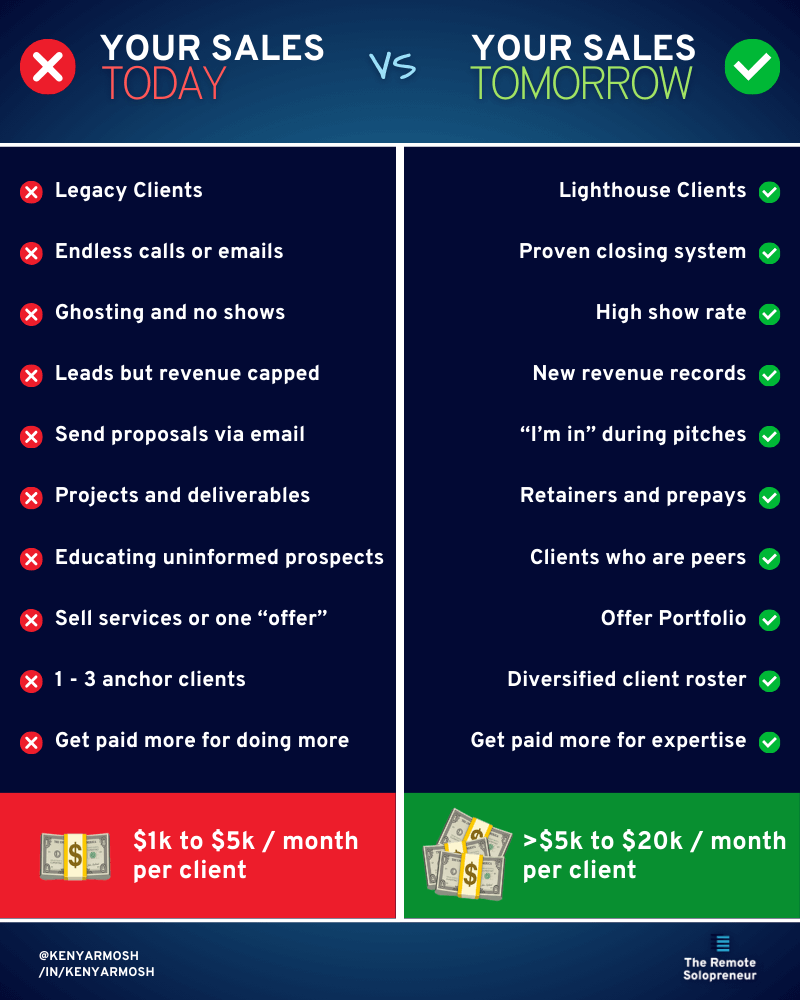
Define that outcome. Build your engagement around delivering it. This is how you escape the “What's your hourly rate?” conversations entirely.
3. Price based on strategic value, not deliverables
A full-time CMO costs $250k+ per year. You're offering the same strategic marketing leadership at a fraction of that. Price accordingly.
Most fractional CMOs I know charge between $4k-$8k monthly for 10-15 hours of strategic work per week. Some charge more for larger companies or broader scope. The anchor isn't your time—it's the cost of the alternative.
When a CEO compares your $6k/month retainer to a $300k annual salary plus benefits plus equity, you look like a bargain. Frame it that way.
4. Create assets that build credibility fast
You need proof before you have a long client roster. Build it yourself.
Write about your frameworks. Publish your perspective on marketing strategy for your target niche. Create a simple case study or two showing how your approach drives results—even if it's from past employment or consulting work.
A one-page PDF outlining your fractional CMO methodology does more for credibility than a fancy website. Founders want to see how you think, not how good your designer is.
5. Use warm networks to get your first retainer
Cold outreach rarely works for high-ticket fractional roles. Trust matters too much.
Start with your LinkedIn network. Past colleagues, former clients, and founders you've met at events. Let them know you're offering fractional CMO services and what kind of company you're looking for.
One client at $5k/month changes everything. It validates your offer, funds your runway, and gives you a case study for the next conversation. I've seen consultants land their first fractional client within weeks just by telling their network what they're building.
Checklist to become a fractional CMO
Ready to make the move? Here's what you need in place:
- Pick a profitable niche where you have existing expertise and results
- Write a positioning statement that names your target client and the outcome you deliver
- Define your outcomes-based offer with clear scope and boundaries
- Set monthly retainer pricing tiers (entry, core, premium)
- Build a one-page landing page or PDF that explains your methodology
- Collect 2-3 proof points: case studies, testimonials, or documented results
- Reach out to 20+ warm contacts with a value-first message
- Close your first client with a 3-month pilot engagement
- Block 2 days per week for delivery and reporting per client
- Start documenting your systems so you can scale later
You don't need to be perfect before you start conversations. But you do need enough clarity to articulate what you do, who you do it for, and why it works.
The fractional model is a business, not a title
Most marketing consultants treat "fractional CMO" like a LinkedIn rebrand. They swap their headline, keep selling hours, and wonder why nothing changes.
The ones who win? They sell outcomes, not time. They position themselves as strategic marketing leadership, not another vendor. They build something that compounds—one project at a time.
That $25k/month client I landed early on didn't just pay the bills. It proved the model. It funded everything else I built.
Fractional work works best when you package your approach based on outcomes. So stop selling hours. Stop selling capacity. Start selling clarity. And go land that first retainer.
