
🚀 TL;DR
- AI is accelerating the collapse of the generalist consulting model by making surface-level expertise abundant.
- Prompts and tools don’t create leverage—systems trained on your data, context, and judgment do.
- Specialist solopreneurs win by codifying deep customer understanding into AI-powered systems.
- Your first-party data becomes defensible intellectual property when embedded into workflows.
- The real opportunity is building one focused system that removes you as the bottleneck and compounds over time.
Fifteen percent of the working world is using AI. Almost nobody is using it in a way that builds a 2030 business.
I've watched this pattern for months. Consultants treating AI like an overpriced version of Google. Throwing $500 at $50,000-a-month problems, but they’re doing it in every direction except the one that actually scales.
We are entering the specialist era of AI specialization. The gap between general users and specialist builders? That's the entire story of the next decade.
I've built 17 specialized AI systems this year. One of them—my Offers GPT—has generated six figures this year alone. Not because I'm smarter, but because I stopped building clever things and started building focused things.
This article is about the changes you experience when you become a specialist solopreneur who designs systems that become your competitive moat.
Why AI breaks the generalist model
Most people use AI for small tasks
Write a thing. Summarize a thing. Marketing ideas for a thing.
That's the pattern. They’re quick fixes and one-off outputs which don’t compound.
I had a client show me a beautifully engineered AI setup recently. It was gorgeous work and truly smart technical execution. It was built to optimize a part of their business that did not matter. They had lovingly built a Ferrari engine to power a golf cart.
When every tool can generate competent answers across dozens of domains, breadth stops being a differentiator. It becomes background noise on social media platforms where everyone sounds the same, posts the same content formats, and competes for the same shrinking attention.
The consultants getting flattened right now share common traits:
- They use AI for tasks, not systems
- They chase every new tool instead of mastering one domain
- They treat prompts like products instead of building real intellectual property
- They optimize for speed when they should optimize for depth
That last one stings. Because speed feels productive. Depth feels slow. But depth is what clients pay premium rates for.
Prompts are not systems
The obsession with prompt engineering has become a distraction. People share their "prompt stacks" like treasure maps. But prompts don't build businesses.
Systems do.
I was listening to a Y Combinator conversation recently, and the top investors in AI, people who've funded hundreds of companies, said something that stopped me in my tracks.
"Prompts aren't the crown jewels of their companies. The data is. The real-world context. The workflow knowledge."
They described sitting next to a tractor sales manager in Nebraska, watching exactly how they work, what they care about, and how that person got promoted. Then, translating those observations into extremely specific evaluation data that makes sense only for that role.
That's the founder skill of the next decade. Deep, obsessive customer understanding that’s codified into systems that software can consume and use.
The skill gap is growing
You don't need AI to fix $500 problems. Your generalized AI approach is holding you back.
Two types of AI users are emerging now. General users who treat it like a search engine—type question, get an answer, move on. And specialist builders who design systems around their domain expertise, their case studies, and their documented patterns of what actually works.
The specialists are pulling away fast. They're not asking AI to solve tasks. They're integrating AI into systems trained on their business, their clients, and their proprietary frameworks. Every conversation, every client win, every documented failure becomes training data for systems that get smarter over time.
This is how you win over the next five years: context, data, specialization.
That's the competitive moat. Everything else is noise.
The new role of AI in your solo business
Your data is your unfair advantage
Specialist solopreneurs don't just use AI. They train it.
They feed it everything:
- Sales calls where objections surfaced and were handled
- Onboarding notes that captured what clients really wanted
- Project retrospectives documenting why certain approaches worked
Every piece of first-party data becomes fuel for systems that generate tailored outputs based on real context—not generic templates pulled from someone else's playbook.
When I built my Offers GPT, I didn't download someone else's framework. I documented my own. Twenty years of building and selling offers across multiple seven-figure businesses went into it:
- Pricing strategies that actually closed deals
- Positioning approaches that differentiate in crowded markets
- Objection patterns I'd heard hundreds of times
- The specific language that resonated with my audience
That's what makes it valuable. Your data becomes your visual identity as a specialist—distinct, documented, defensible. Your content creation process. Your profit and loss statements show what actually works versus what just sounds good.
All of it becomes intellectual property when you codify it into systems.
Systems make your expertise scalable
Your value isn't in repeating what you know. It's in codifying that knowledge so it can run without you.
Without AI, I wouldn't have reached seven figures in this business. But only this year have I actually begun to build true systems by codifying my expertise into tools that can run with and without me.
Think about it differently. For example:
- Instead of answering the same client questions over and over, you build a system that captures your thinking.
- Instead of rewriting proposals from scratch every time a prospect shows interest, you train AI on your winning patterns—the structure, the language, the positioning that converts.
- Instead of manually researching every market before you can give informed advice, you create workflows that automatically pull insights.
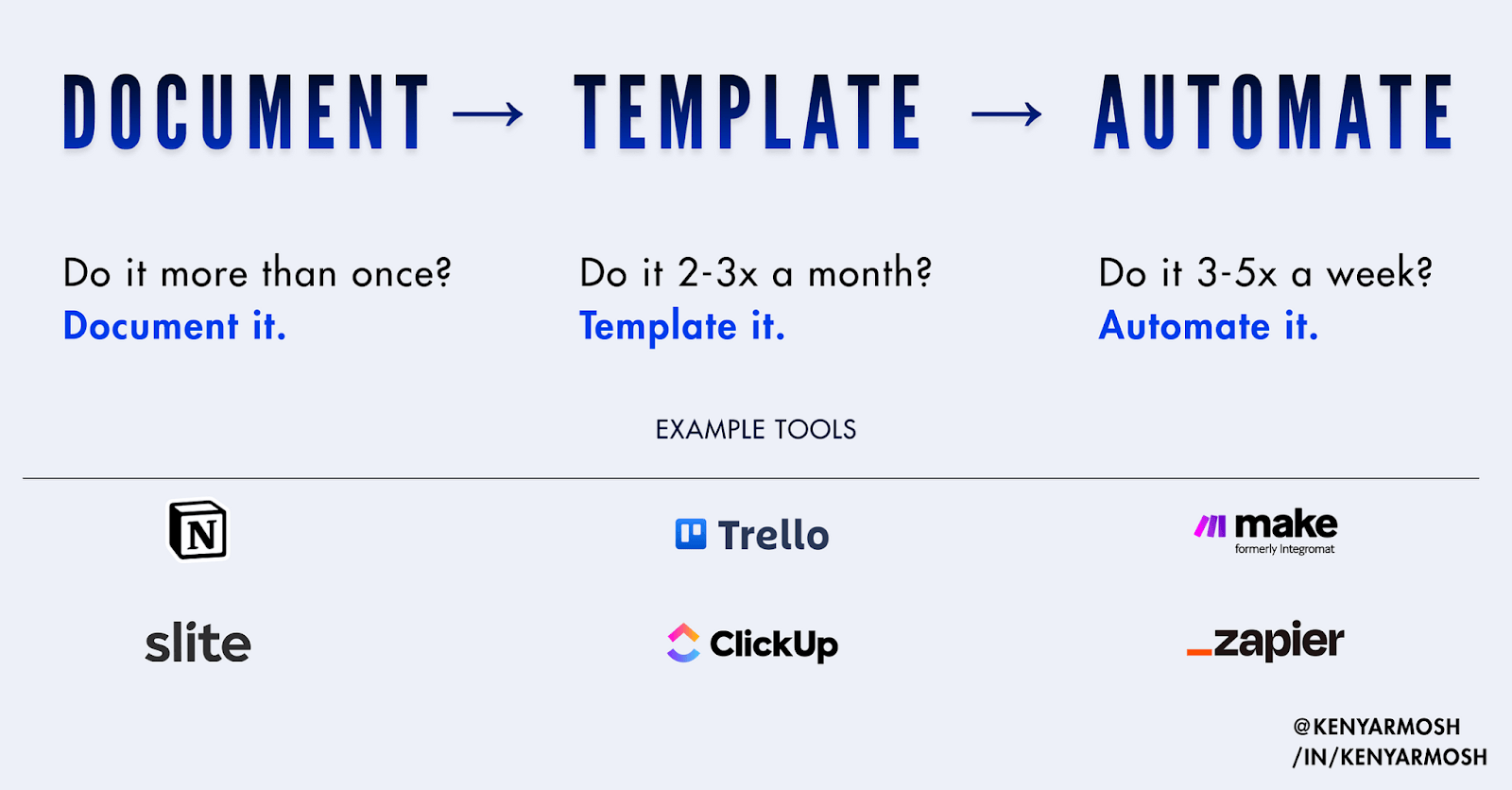
That's the Document → Template → Automate framework I've been teaching for years. AI just accelerates it exponentially.
Focus beats features
Founders often build shiny AI setups that don't solve meaningful problems. They chase novelty. Build clever prompt stacks. Obsess over which AI assistant is better this week versus last week.
They optimize $100 problems with $1000 worth of effort when they want to be a $500,000 or million-dollar-a-year business.
But the one system—the ONE, not the 27—that would erase the problem?
That's the one they never build.
What's the one system in your business that, if it ran without you, would 10x everything? That question is worth sitting with longer than feels comfortable.
Most people skip past it because answering honestly means admitting they've been busy with the wrong things.
What changes when you become a specialist
You stop being the bottleneck
With specialized systems, generating new approaches doesn't depend on your time or mood. You can run variations, test angles, and explore adjacent markets, all with tools that reflect how you actually think and sell.
Your landing page messaging gets better because it's informed by actual conversion data from your previous campaigns.
Your proposals improve because they're built on documented wins, not hopeful guesses.
Your personal brand sharpens when you stop trying to appeal to everyone.
This isn't traditional software development. It's judgment engineering.
You're encoding your expertise into tools that multiply your capacity without multiplying your hours. The specialist who builds these systems can serve more clients at higher rates while working fewer hours than the generalist, who's still doing everything manually, responding to every request in real time, and burning out slowly.
Market feedback becomes continuous
Instead of doing manual research once per quarter (or, let's be honest, whenever you remember), specialists build AI systems that pull insights in real time.
The inputs that matter:
- Comments on your content showing what resonates
- Sales transcripts revealing objection patterns
- Audience signals indicating shifting priorities
- Content formats that drive engagement versus those that fall flat
- Competitive movements you'd otherwise miss
All of it feeds back into how you position and price. The net profit on your projects increases because you're no longer guessing.
You're responding to documented patterns, adjusting your approach based on evidence rather than intuition alone.
Offer testing becomes automated
I use AI to test positioning, pricing, and framing without needing to build or ship each variation manually. Specialized systems run these loops behind the scenes while I focus on client work and strategic thinking.
Iteration becomes a background process instead of a quarterly project that never quite happens.
This is how you can charge beyond value-driven pricing—what I call outcome-based pricing.
When your systems continuously improve your offers based on real data, you're not competing on the same playing field as generalists who update their business cards once a year and wonder why nothing changes.
Tips to go from being an assistant to an architect
1. Stop learning tools and start designing them
Most consultants ask: "What tool should I use?"
The better question: "What tool should I build?"
The most valuable AI systems aren't downloaded from an app store. They're tailored to your domain, designed to solve your specific problems, and trained on your data. When you stop being a tool user and become a tool designer, your relationship with AI changes entirely.
You're not dependent on whatever features someone else decided to build. You're building features for yourself, which are systems that work exactly the way your business needs them to work.
2. Turn your workflow into the product
Something interesting happens when you specialize deeply: your process itself becomes valuable.
When you design a system that captures how you think and work, your workflow transforms into an asset. Instead of being the only one who can do the work—trapped in delivery, trading hours for dollars—you've built something that scales your decision-making.
I've seen specialists leverage this in multiple ways:
- License their frameworks to other consultants
- Turn internal systems into scalable digital offers
- Create consulting packages that include access to proprietary tools
- Build case studies around their methodology that attract premium clients
That's leverage. That's what separates a freelancer stressed about self-employment taxes and quarterly income swings from a specialist building real enterprise value.
The freelancer sells time. The specialist sells systems.
3. Build one system that changes everything
I ask every client I work with the same question: What's the one system in your business that, if it ran without you, would 10x everything?
That's where to invest your time. That's what AI should be built around. Everything else is a distraction dressed up as productivity—and I see it all the time.
Consultants building elaborate Notion dashboards when they don't have a clear value proposition. Founders are automating email sequences when they haven't validated their offer, while solopreneurs are optimizing gross profit tracking when they should be closing more deals.
Most people never answer this question honestly. They're too attached to being busy with many things instead of being excellent at one.
4. Avoid overengineering small problems
A pattern I correct constantly with clients: they spend enormous effort optimizing problems that don't actually matter to their bottom line.
They build elaborate systems for projects that shouldn't exist. They automate workflows before they've figured out which workflows actually generate revenue. They obsess over tools when they should obsess over clients.
Being a specialist means focusing only on systems that create real leverage.
And ignoring the rest—even when ignoring them feels uncomfortable, even when LinkedIn tells you that you need to be doing seventeen things at once to stay relevant.
5. Grow without hiring
My core promise has always been this: you can grow without building a big team.
Specialized AI systems make this more true than ever. But it's not automation for the sake of speed. It's not about doing more faster. It's specialization as a business model—doing less, but doing it so well that you become the obvious choice for a specific type of client.
You're not replacing yourself with AI. You're multiplying yourself.
You need to create a fleet of tools that carry your judgment, your positioning, and your expertise, without requiring more headcount.
Specialization is the only defensible position left
15% of consultants use AI. Most of them are using it wrong—throwing it at small problems, chasing novelty, staying generalists in a world that increasingly rewards depth.
The gap between general users and specialist builders is widening every month.
You don't have to build 17 systems like I did. You need to build one. The one that, if it ran without you, would 10x everything.
That's the specialist advantage. That's how you stay relevant while others get flattened by the same tools they thought would save them.
