
🚀 TL;DR
- Most pricing mistakes come from fear, insecurity, and poor positioning—not lack of skill or market demand.
- Underpricing to “get in the door,” discounting on objections, and competing on price all destroy leverage and margin.
- Hourly billing, static pricing, and reactive price increases cap income and trap consultants in volume-based work.
- Pricing should reinforce positioning, specialization, and outcomes—not self-doubt or peer comparison.
- Intentional pricing psychology and experimentation turn pricing into a strategic lever instead of a liability.
You think you don't have leverage in your sales conversations.
But actually, you simply gave it away when you:
- Priced your services too low
- Acted like you needed the deal more than the prospect did
- Dropped your rate the second someone pushed back
Your pricing mistakes aren't random. They follow predictable patterns rooted in fear, poor positioning, and misunderstanding how to value your work. These patterns keep you trapped in feast-or-famine cycles while your skills deserve premium rates.
After mentoring 550+ consultants and solopreneurs, I've seen the same eleven pricing mistakes destroy otherwise talented freelance businesses. You're probably making three or four of them right now without realizing it.
Here are a few mistakes I see freelancers, consultants, founders, and coaches make all the time:
1. Pricing too low to "get in the door"
You're trying to compete on price instead of positioning.
Underpricing doesn't make you accessible, but it makes you forgettable. When you slash your rates to win work, you're signaling that your expertise isn't valuable. You attract clients who shop on price and treat you like a commodity.
The worst part? Low pricing becomes a trap.
You need more clients to hit your revenue goals, which means less time per project, which means lower quality work, which means you can't justify raising rates.
How to avoid it:
Price based on the outcome you create, not fear. Research market rates for your specific expertise. Then position yourself as the specialist who solves a particular problem exceptionally well.
Confident pricing attracts better-fit clients who value results over hourly rates.
2. Lowering your price when you hear an objection
Objections get harder when you're insecure about your pricing.
You start dropping your price to save the deal instead of learning how to reframe the value. But price objections usually mean your value isn't clear, not that you're too expensive.
When you immediately discount, you train clients to negotiate. They learn that your initial price was inflated. You lose credibility and margin in one move.
How to avoid it:
Hold the line. Use objections as feedback to improve your positioning and sales conversations. Ask questions to understand the real concern.
Often, it's about risk, timing, and understanding, not the actual budget. Practice saying your price without flinching. That confidence matters more than the number itself.
3. Pricing by the hour instead of by the outcome
Hourly billing caps your income at your available time.
It doesn't matter how skilled you become. You still only have 40 billable hours per week. Worse, hourly rates punish efficiency. Get faster at your work, and you earn less. You shouldn't penalize yourself for getting better at your job.
Clients don't actually want to buy your hours. They want solutions to their problems.
A web designer who rebuilds a site in two days versus two weeks delivers the same value. The client doesn't care about the timeline—they care about the result.
How to avoid it:
Shift to offer-based pricing or project-based rates. Price based on the transformation you create. If your work generates $100K in new revenue for a client, charging $15K makes perfect sense regardless of hours invested.
Package your expertise into defined scopes with clear outcomes. This moves you from a cost center to a profit center in your client's mind.
4. Offering discounts out of desperation
When you're desperate for a deal, you start stacking discounts and throwing in free work. You think it shows goodwill. Really, it signals desperation and devalues your expertise.
I've seen this pattern destroy businesses. A consultant offers 20% off, then adds extra deliverables "to sweeten the deal," then throws in a monthly retainer at half price. The client wonders why the offer keeps changing—and whether the work is actually worth anything.
How to avoid it:
Build trust through clarity, not deals. If you want to create urgency, use deadlines or limited spots—not discounts.
"Sign by Friday and we start immediately" works better than "Sign by Friday for 25% off." The first suggests demand. The second suggests desperation.
Focus on making your value crystal clear rather than artificially lowering your price.
5. Keeping the same price forever
Every launch is a chance to reset your price and test whether people believe your value has increased.
But most freelancers set their rates once and never touch them. They work with the same clients at the same rates for years, even as their expertise deepens and their results improve.
Your skills from three years ago aren't the same as your skills today. Your pricing should reflect your current expertise, not your starting point. Old pricing leaves money on the table and signals you haven't grown.
How to avoid it:
Treat every new client engagement as an opportunity to test pricing. Review your rates quarterly. Talk to other professionals in freelance communities or a Facebook group to understand what experienced practitioners charge.
Grandfather existing clients at old rates if you want, but new clients should pay for your current level of expertise. Small rate increases compound significantly over time.
6. Thinking pricing is permanent
Pricing isn't a tattoo—it's a lever.
You can and should experiment with different price points for different audiences, seasons, or offers. A marketing strategist might charge differently for startup clients versus enterprise clients.
Too many freelancers treat their first pricing decision like it's carved in stone. They're terrified to test because they think it'll confuse the market or damage their reputation. That rigidity costs you learning and revenue.
How to avoid it:
Experiment intentionally. Test different pricing levels with different segments. Try offer-based freelance pricing versus monthly retainers.
Offer pricing levels that serve different client needs. Track what converts and what doesn't. The market will teach you what works, but only if you're willing to test.
7. Letting insecurity drive your pricing decisions
Many solopreneurs talk themselves out of the right price before they even say it out loud.
You've calculated what you need to charge. You know your expertise justifies it. But when it's time to send the proposal, you knock $2K off "just to be safe." That's insecurity, not strategy.
Your internal doubt bleeds into client conversations. If you don't believe your price, neither will they. Clients pick up on hesitation instantly. They hear it in your voice, see it in your body language, feel it in your energy.
How to avoid it:
Anchor your price in confidence, not comparison. Here are a few things you can do:
- Practice saying your price out loud until it feels natural.
- Role-play with a peer or mentor.
- Document your results and client outcomes so you have concrete evidence of your value.
Confidence in pricing comes from clarity about what you deliver and who you serve.
8. Not tying pricing to positioning
If your brand says "premium" but your price screams "bargain," there's a mismatch.
Pricing is perception design. It tells a story about your offer before you ever pitch. A $500 package and a $5,000 package create completely different expectations about quality, outcomes, and expertise.
Business owners shopping for expert help use price as a quality signal. If you price too low, they assume you're inexperienced or desperate. If your price is appropriately high, they assume you deliver exceptional results.
How to avoid it:
Make your price match your promise. If you position yourself as a specialist serving established companies, charge specialist rates. If you're targeting startups with limited budgets, adjust your positioning to match.
Don't try to be premium and cheap at the same time—it destroys trust and confuses your market.
9. Only raising prices when you're overwhelmed
Don't wait until burnout to charge more.
Most freelancers finally raise rates when they're drowning in work and can't take on another project. That's reactive pricing. You're using price as a last-resort filter instead of a strategic tool.
Pricing should prequalify clients before you reach capacity. It should create space for the right opportunities, not just stop the flood of wrong ones.
How to avoid it:
Raise prices before you hit capacity. Use pricing strategically to manage demand and attract ideal clients.
If you're consistently booked solid, that's a signal to test higher rates. If you're fielding inquiries from clients who aren't a good fit, repricing (higher) naturally filters them out.
Let pricing help you scale sustainably instead of waiting until you're desperate for relief.
10. Trying to compete on price instead of quality or specialization
Racing to the bottom is a race you'll win by losing.
When you compete primarily on being the cheapest option, you attract clients who care primarily about being cheap. These clients negotiate aggressively, push scope boundaries, and jump to competitors for tiny cost savings.
Solos who build sustainable businesses compete on clarity, outcomes, and focus. They don't use cost-plus or demand-based pricing. They're the best choice, not the cheapest one.
How to avoid it:
Differentiate through specialization and positioning. Here are a few ways to do that:
- Become known for solving a specific problem exceptionally well.
- Develop proprietary methods or frameworks.
- Build case studies that show concrete outcomes.
You can even join freelance communities where members share pricing research and support each other in holding firm rates. It’s something many of my clients do in The Club as well.
When you're the obvious expert for a particular need, price becomes secondary to fit.
11. Ignoring the psychology of pricing
The number you choose influences how clients perceive value, how seriously they take the work, and how they engage with the process. A $997 offer feels different from a $1,000 offer.
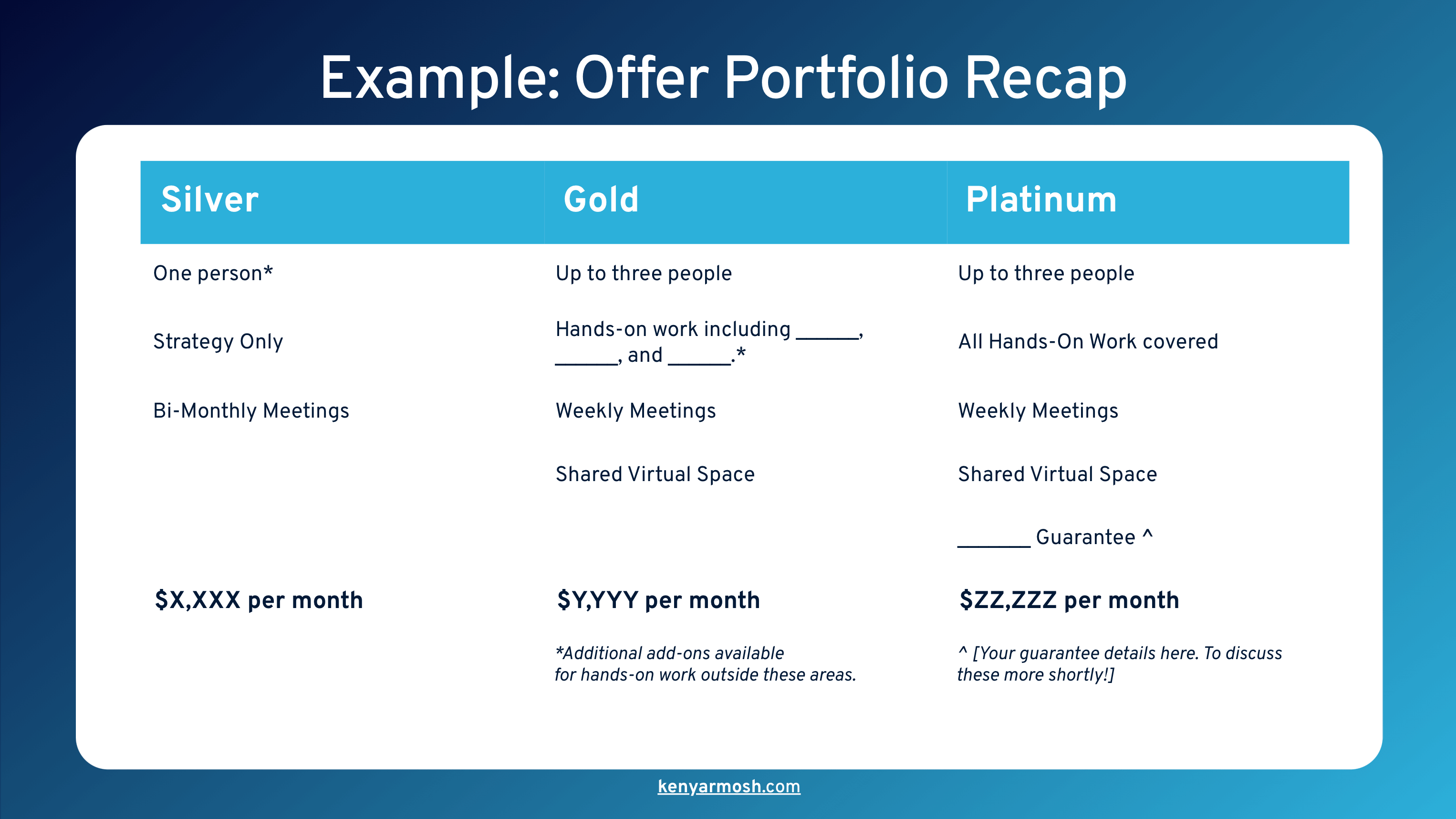
A three-tier structure with clear differences creates decision-making ease.
Some freelancers pick numbers randomly. Others overthink to paralysis. Both miss the strategic opportunity pricing provides to guide client conversations and shape buying behavior.
How to avoid it:
Use pricing to move people. For example, you can create urgency through limited-time pricing (not permanent discounts). Or structure tiered offers so your preferred package is the obvious middle choice.
Pay attention to client conversations. Where do they hesitate? What questions come up?
Let those insights refine your pricing structure over time.
Your pricing tells a story before you speak
Pricing isn't just a number you pull from thin air or copy from competitors.
It's a narrative about your value, your positioning, and your confidence. When you price with intention and clarity, you stop chasing clients and start attracting the right ones.
If you've been making any of the mistakes above, you're not alone. I've watched hundreds of talented consultants and freelancers price themselves out of the market. The difference between struggling and thriving often comes down to getting pricing right.
Your pricing mistakes aren't character flaws. They're strategic blind spots that signal deeper issues with positioning, confidence, or understanding your market.
Fix the mistakes, and you fix everything downstream—your leverage in client conversations, the quality of prospects you attract, and ultimately your income trajectory.
What story does your pricing tell? Make sure it's the one you want clients to believe.
